
Tour · Egypt & Turkey
13-Day Egypt & Turkey: Nile Cruise and Istanbul
Giza, a 3-night Nile cruise and five full nights in Istanbul
From, per person$3,469
Customize this tripYour journey, clearly mapped
Cairo to Istanbul · 13 days
- 13 days12 nights
- 3 domestic flights
- 3 cruise nights
- Group tour
The route, stop by stop
- 01CairoArrive Cairo · Giza · GEMDays 1 – 33 hotel nights
Fly to AswanDomestic flight
02Nile cruiseFly to Aswan · Philae · Kom OmboDays 4 – 63 nights on boardFly to CairoDomestic flight
03CairoWest Bank · fly to CairoDay 71 hotel nightFly to CairoDomestic flight
04IstanbulFly to Istanbul · Hagia Sophia · Blue MosqueDays 8 – 135 hotel nights
Trip at a glance
Egypt's temples, then five nights in Istanbul
This 13-day trip pairs a 3-night northbound Nile cruise with five nights in Istanbul. You see Giza, the Grand Egyptian Museum and historic Cairo, then sail from Aswan past Kom Ombo and Edfu to Luxor's temples and the Valley of the Kings, with a Cairo night as a buffer before your flight to Turkey. In Istanbul, the monuments, the Bosphorus, the Grand Bazaar and a free day are spread over five nights. It suits travelers who want depth in both countries at an easy pace.
Two great waterways in 13 days: Egypt's Nile and Istanbul's Bosphorus. After Giza and historic Cairo, you fly to Aswan for a 3-night northbound cruise past Kom Ombo and Edfu to the temples and tombs of Luxor. A night in Cairo then separates the cruise from your flight to Turkey, and five nights in Istanbul give its monuments, the Bosphorus, the Grand Bazaar and a free day room to breathe.
- Duration
- 13 days / 12 nights
- Tour type
- Guided sightseeing, Nile cruise and transfers
- Nile cruise
- 3 nights · Aswan to Luxor
- Flights
- Cairo–Aswan, Luxor–Cairo, Cairo–Istanbul: your quote states whether they are included
- Best months
- October – April
Why this trip
What makes this trip different

A safe gap between countries
A Cairo night after the cruise protects your flight to Istanbul from delays on the Nile.

Five nights in Istanbul
Monuments, the Bosphorus, the Grand Bazaar and a free day each get their own time.

Both banks of Luxor
Karnak, Luxor Temple, the Valley of the Kings and Hatshepsut's temple are all in the plan.
Day by day
The itinerary
Day01Arrive CairoWelcome to Cairo
Overnight: Cairo
Your 13 days begin at Cairo International Airport, where a representative meets you after immigration and baggage collection and walks you to a private car. The drive into the city takes from 30 minutes to over an hour depending on traffic and your hotel, and on the way you may catch your first glimpse of the Nile, the river that will carry you through the first half of this trip.
Today is deliberately unhurried. Settle in, rest after your flight and review tomorrow's meeting time with your representative. If you arrive early, a gentle walk near the hotel or dinner with a river view is a better beginning than forcing a museum visit into a travel day. This itinerary is built around slow, well-spaced days, with a 3-night cruise and five nights in Istanbul still to come, so there is no need to rush anything on the first evening. It is worth checking your flight details too: on Day 4 you fly south to Aswan, and having your passport and documents organized now makes the coming transfers easier.
Day02Giza · GEMPyramids, the Sphinx and the Grand Egyptian Museum
Overnight: Cairo
Begin on the Giza Plateau, where the Great Pyramids stand within an ancient funerary landscape rather than as isolated monuments. Your Egyptologist guide walks you between viewpoints around the pyramids of Khufu, Khafre and Menkaure and explains how the plateau worked as a royal necropolis, with temples linked by causeways to the edge of the Nile floodplain. That link to the river is a good theme for this trip, because the same Nile carried the stone, the workers and the funeral processions, and in two days you will be sailing on it.
See the Great Sphinx up close before continuing to the Grand Egyptian Museum. The afternoon is devoted to its collections, from the colossal statues of the grand staircase to the treasures of Tutankhamun, whose tomb lies in the Valley of the Kings that you visit at the end of the cruise. Specific galleries, admission categories and any pyramid-interior visit depend on the confirmed ticketing plan. Take water and a hat for the open plateau and wear comfortable shoes; you will be on your feet for most of the day, and the museum galleries make a welcome, cooler contrast in the afternoon.

Day03Historic Cairo · Khan el-KhaliliHistoric Cairo, faith and the city at work
Overnight: Cairo
Spend the morning in the older quarters of Cairo, moving between selected Coptic or Islamic landmarks according to opening times and your interests. Coptic Cairo, with churches such as the round Church of St George, tells the story of Egypt's Christian centuries, while the mosques and gateways of Islamic Cairo record the city of the medieval sultans. Your guide helps distinguish the stories of the places you enter, so that each feels distinct rather than part of a blur of old buildings.
Later, follow the lanes around Al-Muizz Street and Khan el-Khalili, where worship, trade and everyday life continue alongside centuries of architecture. Brass lamps, spices, textiles and perfume bottles fill the shops, and time for tea and browsing is part of the day, not an afterthought. Cover shoulders and knees for religious sites, and carry a light scarf. In the evening, organize your luggage for the cruise: tomorrow starts with a morning flight to Aswan, and a cabin is easier to live in when what you need for three nights is packed together. Your representative confirms the airport pickup time tonight.

Day04Fly to Aswan · PhilaeFly to Aswan and embark on the Nile cruise
Overnight: Nile cruise
This morning you fly south from Cairo to Aswan, a little over an hour in the air, timed so you can board the ship on its designated embarkation day. Aswan feels different at once: the Nile runs between granite boulders and golden dunes, feluccas cross the water, and the Nubian heritage of the south shows in its colors and villages. You transfer to the ship and settle into your cabin.
After lunch aboard, and if the ship's shore program and arrival time allow, you visit Philae Temple, the island sanctuary of the goddess Isis. Its temples were dismantled and rebuilt on the higher island of Agilkia in the 1970s to save them from the rising waters behind the Aswan dams, one of the great rescue projects of modern archaeology, and you reach it by small boat. Tonight is your first cruise night. This route is a 3-night northbound sailing from Aswan to Luxor; embarkation runs on set days only and should never be assumed available on every calendar date, which is why your travel dates are matched to the ship's schedule when we prepare your quote. Meals on board follow the ship's plan confirmed in your quote.

Day05Kom Ombo · EdfuKom Ombo and Edfu: temples from the river
Overnight: Nile cruise
Today the ship sails north through the landscape of Upper Egypt, with palm groves, sugarcane fields and mud-brick villages sliding past the sundeck. It is the kind of day that makes a river cruise worthwhile: you see the country at the pace of the water, with time to read, rest and watch life on the banks between visits.
Stops are made at two temples in the order confirmed by the ship. Kom Ombo stands right on a bend of the river and is unusual for its double design, with twin sanctuaries dedicated to the crocodile god Sobek and to the falcon-headed Haroeris, a form of Horus. At Edfu, the Temple of Horus is one of the best-preserved temples in Egypt, with a towering entrance pylon, a roof still over its inner halls and walls carved with the story of Horus and Seth. Your Egyptologist connects the two sites without treating them as interchangeable, explaining what each reveals about Egyptian religion in the Ptolemaic era. Keep the afternoon flexible for sailing and lock or mooring delays; both the route and meals follow the actual cruise schedule.

Day06Luxor · East BankArrive in Luxor and see the East Bank
Overnight: Nile cruise
The river journey reaches Luxor, the site of ancient Thebes and for long periods the religious capital of Egypt. Today you explore the East Bank, where Karnak and Luxor Temple introduce the ceremonial heart of the ancient city.
Karnak is less a single temple than a vast complex built and rebuilt over some 2,000 years. You walk past its avenue of ram-headed sphinxes and through great gateways into the Hypostyle Hall, a forest of 134 massive columns carved with scenes and hieroglyphs. Luxor Temple, on the riverfront, was linked to Karnak by a long avenue of sphinxes and was the setting for the annual Opet festival, when the images of the gods traveled between the two. Its pylon is fronted by colossal statues of Ramesses II and a single obelisk, whose twin now stands in Paris. Explore at a pace that allows time among the columns and carved gateways. Return aboard for your third and final cruise night. The timing and order of temple visits will be fixed by the selected vessel's mooring schedule, and your guide plans the day around the heat and the light.

Day07West Bank · fly to CairoDisembark in Luxor and return to Cairo
Overnight: Cairo
After breakfast you leave the ship and cross to the West Bank, the side of the river the ancient Thebans reserved for their dead. The planned selection typically includes the Valley of the Kings, where pharaohs of the New Kingdom were buried in tombs cut deep into the hills and painted with texts to guide them through the afterlife, and the Temple of Hatshepsut, rising in terraces against the cliffs of Deir el-Bahari. Your guide explains which tombs are open on the day, since they rotate for conservation, and whether any extra tickets apply, such as for the tomb of Tutankhamun.
Later in the day you take the scheduled flight back to Cairo and check into your hotel. The West Bank visit is timed around the flight, and the itinerary never assumes that both sightseeing and an onward flight are guaranteed without checking the timetable. This Cairo night is an important buffer: it separates the cruise from your international flight to Istanbul, so a delay on the Nile or a schedule change does not cost you a connection.

Day08Fly to IstanbulFly from Cairo to Istanbul
Overnight: Istanbul
Today you move from the Nile to the Bosphorus. After breakfast, your driver takes you to Cairo airport for the flight to Istanbul, about two hours in the air. Your Turkish representative meets you on arrival and transfers you to the hotel that will be your home for the next five nights, a welcome change after several days of flights and cabins.
Let the first evening introduce the city at your own pace, perhaps with a short walk near your accommodation, a first Turkish tea or a dinner of meze and grilled fish. Between airport procedures at both ends and Istanbul's traffic, the day does not promise a full old-city tour. You will feel the difference in climate and atmosphere at once: after the dry heat and desert light of Upper Egypt, Istanbul is a city of water, wind and hills, where ferries cross between two continents. With five nights here, the city's great monuments, its waterways and its neighborhoods each get their own day, and the last full day is yours. Tomorrow's program gives Hagia Sophia and the Blue Mosque the time and context they deserve.
Day09Hagia Sophia · Blue MosqueHagia Sophia, the Blue Mosque and the old city
Overnight: Istanbul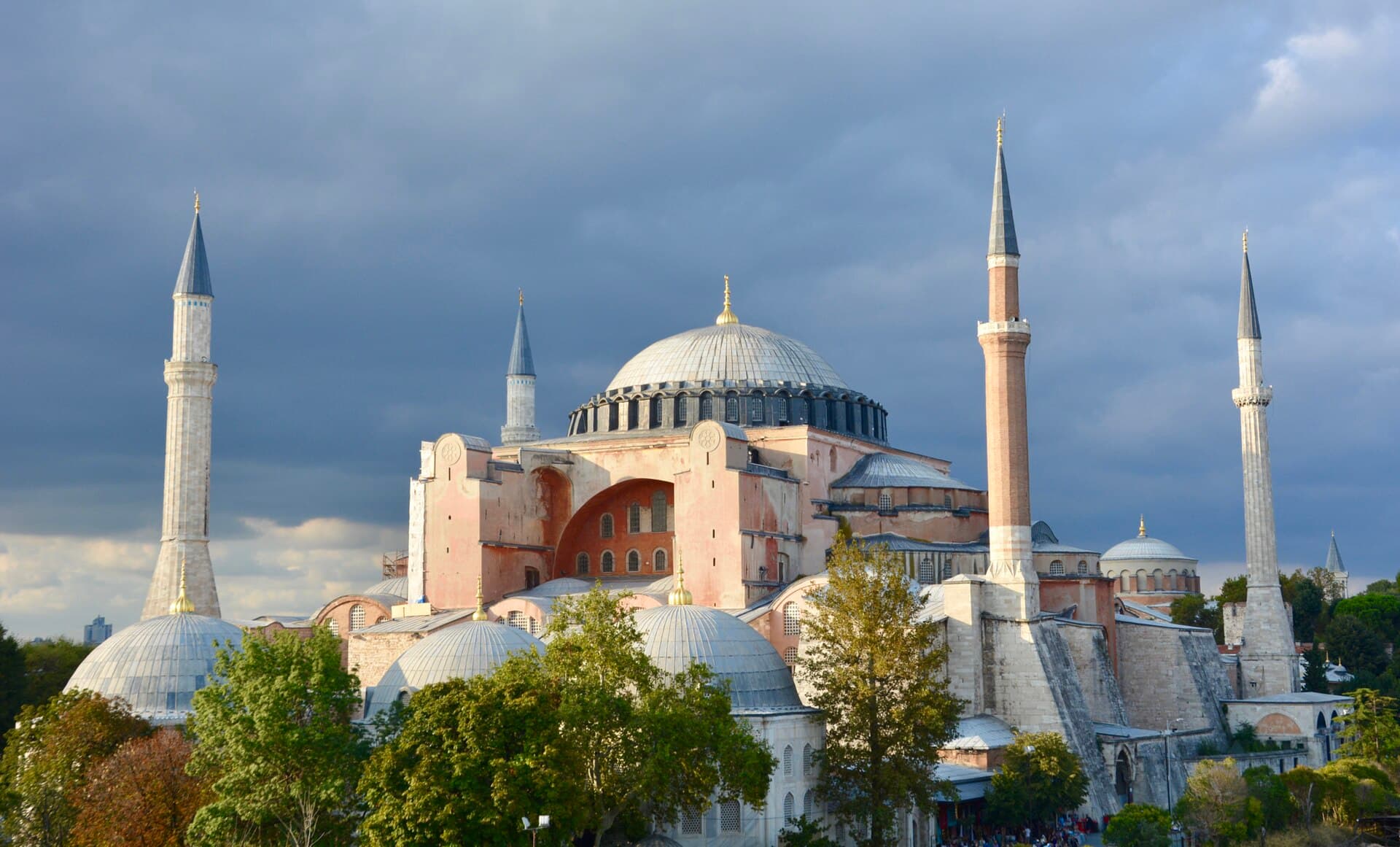
Explore Istanbul's historic peninsula with a local guide, beginning with Hagia Sophia and the Blue Mosque according to their current visitor arrangements. Hagia Sophia, completed in the sixth century, was the great church of Byzantine Constantinople before becoming a mosque under the Ottomans; after decades as a museum it is a working mosque again today. Its vast dome, marble floors and surviving mosaics make it one of the most remarkable buildings anywhere, and your guide explains how its meaning changed with each empire.
The Sultan Ahmed Mosque, the Blue Mosque, faces it across the gardens, its interior covered in thousands of hand-painted tiles. Prayer times, entry queues and conservation restrictions can change the sequence of the morning, so your guide adapts the order on the day. Continue through the surrounding streets and public squares, including the old Hippodrome, where an obelisk carved for Thutmose III now stands, a neat link back to the temples of Karnak you saw only days ago. Because this Istanbul stay is long, the pace today is relaxed, with time to sit in the gardens and simply look. Dress modestly and carry a scarf.
Day10Topkapi · Basilica CisternTopkapi Palace, the Basilica Cistern and city stories
Overnight: Istanbul
Spend a full day with two very different Istanbul landmarks. Topkapi Palace, whose courts and collections tell the story of Ottoman rule, spreads across the headland above the meeting of the Golden Horn and the Bosphorus. Your guide leads you through its gateways and courtyards in the order they were used, from the public outer court to the private apartments of the sultans, with time for the treasury, the pavilions and the terraces overlooking the water. Ticketed sections such as the palace harem require the agreed admission category, so check your quote if it matters to you.
Then descend to the Basilica Cistern beneath the streets of the historic center. Built in the sixth century to store water for the Byzantine city, it is a cool, dim hall of marble columns rising from the water, with two Medusa heads reused as column bases at its far end. After the open-air temples of Egypt, it is a very different kind of ancient space. Keep the afternoon spacious, with time for a café rather than another long list of stops; the long Istanbul stay means there is no need to fit everything into today.
Day11Bosphorus · Grand BazaarThe Bosphorus and the Grand Bazaar
Overnight: Istanbul
Discover Istanbul from the water on a scheduled Bosphorus cruise, subject to vessel operations and weather. Just as the Nile shaped Egypt, the Bosphorus shaped this city: the narrow strait between the Black Sea and the Sea of Marmara divides Europe from Asia and made Istanbul a crossroads of trade and power for more than 2,000 years. From the deck you see Ottoman palaces and waterside mansions, mosques, fortresses and bridges along both shores, and your guide explains how the city grew along the water.
Back on land, spend time among the trading lanes of the Grand Bazaar, a vast covered market with thousands of shops beneath painted vaults, selling carpets, ceramics, lamps, textiles and jewelry. Your guide can explain how its inns and streets are organized and how to bargain politely. The two experiences offer different perspectives on the city, one shaped by geography and the other by commerce. Confirm whether the boat ticket and private transport are included, and allow for market closures on relevant dates; the bazaar is usually closed on Sundays and some religious holidays, so the order of days may change.
Day12Free day in IstanbulA slower day in Istanbul
Overnight: Istanbul
Today is yours. After a Nile cruise, three flights and many hours on temple floors and palace courtyards, a flexible day near the end of the trip is particularly valuable. Choose a part of Istanbul you have not yet explored, or keep the day genuinely open for cafés, markets and an independent neighborhood walk. Your guide can suggest routes suited to your interests before you set off, but additional admissions are optional unless clearly listed in your quote.
Some travelers take a public ferry across to the Asian side simply for the ride and the view back to the old city's skyline; others explore the steep lanes of Galata and Karakoy, with their cafés and galleries; others choose a long breakfast, a hammam they book themselves and a quiet afternoon at the hotel. Istanbul's ferries, trams and taxis make independent exploring easy, and your representative remains reachable if you need help. This is also the day to finish shopping and pack at leisure, so tomorrow's departure is calm.
Day13Depart IstanbulFarewell and airport transfer
After breakfast, check out at the agreed time and transfer to the departure airport. Your driver knows the route, but allow generous time: Istanbul's airports are large, with security screening at the terminal entrance as well as at the gate, and the city's traffic can be unpredictable at busy hours. Please verify flight times, luggage allowance and any visa or exit requirements before travel.
Extra hotel time, late check-out or an additional excursion is not included unless it appears in the confirmed booking. If your flight leaves in the evening, let us know before you travel and we can suggest how to use the time.
Over 13 days you have followed two of history's great waterways: the Nile, from the granite of Aswan past Kom Ombo and Edfu to the temples and tombs of Luxor, and the Bosphorus, with the domes, palaces and bazaars of Istanbul along its shores. Between them stood the pyramids of Giza and the lanes of historic Cairo. We hope the slow pace gave each place the time it deserves, and that you leave with the wish to return.
Prices & hotels
Choose how you want to stay
Per person, two sharing. Prices are a starting point; your planner confirms the final price for your dates.
4-Star
From, per person$3,469two sharing
| Two sharing | $3,469 |
| Single room | $4,909 |
5-Star
From, per person$4,160two sharing
| Two sharing | $4,160 |
| Single room | $6,070 |
Single supplement from $1,440
The small print
What's included, and what isn't
Included
- Meet and assist on arrival in Cairo and Istanbul, and on departure
- Airport, ship and hotel transfers named in the day-by-day program
- Guided visits named in the itinerary, with an Egyptologist in Egypt and a local guide in Istanbul
- Three nights on a Nile cruise ship from Aswan to Luxor
- Hotel nights as shown: three in Cairo before the cruise, one after it, and five in Istanbul
Not included
- International airfare (your quote states whether the flights within Egypt and from Cairo to Istanbul are included)
- Entry visas for Egypt and Turkey
- Meals and drinks not listed in your confirmed quote
- Optional admissions such as pyramid interiors, Tutankhamun's tomb or the Topkapi harem, unless listed
- Gratuities for guides, drivers and cruise staff
- Travel insurance
- Personal expenses and optional activities
- Deposit
- 25% to confirm
- Balance
- Due 7 days before arrival
Before you go
Good to know
Weather
Aswan and Luxor are very hot from May to September, so temple visits start early in the morning. Istanbul is cooler and can be wet in winter; October to April suits the Egyptian half best.
What to wear
Bring light, breathable clothing, a hat and good walking shoes for the temples. Cover shoulders and knees, and carry a scarf, for mosques in Cairo and for Hagia Sophia and the Blue Mosque.
Walking
The pace is moderate, with significant walking through archaeological sites and city centers. Early starts help you avoid the midday heat in Upper Egypt, and Istanbul's old city involves hills and cobbles.
On the cruise
The 3-night sailing runs north from Aswan to Luxor with stops at Kom Ombo and Edfu. Visit order, meals and mooring times follow the ship's own schedule, and embarkation runs on set dates only.
Flights
You fly Cairo to Aswan and Luxor back to Cairo, then on to Istanbul. A full Cairo night separates the cruise from the international flight, so a delay on the Nile does not cost you a connection.
Money & tipping
Cards work in most hotels, but carry cash in Egyptian pounds and Turkish lira for tips and small purchases. Gratuities are excluded, and tipping guides, drivers and cruise staff is customary in Egypt.
FAQs
Questions people actually ask
Which way does the Nile cruise sail?
North, from Aswan to Luxor, over three nights. You board in Aswan on Day 4, stop at Kom Ombo and Edfu on Day 5, reach Luxor on Day 6 and leave the ship on Day 7 after a West Bank visit. Cruise ships run on set embarkation days, so your travel dates are matched to the ship's schedule in your quote.
Why is there a night in Cairo between the cruise and Istanbul?
It protects your flight to Turkey. Domestic flights and ship schedules in Egypt can change, and connecting straight from Luxor to an international departure leaves no margin. With a Cairo night in between, a delay on Day 7 does not cost you the Istanbul flight on Day 8.
Which meals are included on the cruise?
The day-by-day plan does not list meals, so your quote is the reference. Nile cruise ships usually work on a full-board plan, but the exact plan, and whether any drinks are included, depends on the ship and the package you confirm.
Do I need visas for both countries?
Yes, check the rules for each, because visas are not included in the package. Entry rules depend on your passport and can change, so please check the official source before you travel.
When is the best time for this trip?
October to April is best for the Egyptian half: Aswan and Luxor are extremely hot from May to September, when visits start very early. Istanbul is pleasant in spring and fall and cool, often wet, from December to February. October, November, March and April balance both countries well.
Is this itinerary suitable for children?
Yes, especially for families who like a slower pace. The cruise gives everyone rest between visits, and the five nights in Istanbul mean no hotel changes in Turkey. Temple days start early to avoid the heat, so plan for afternoon rest on board. Tell us your children's ages and we can suggest suitable cabins and adjust the guiding.
What should I pack for the Nile and for Istanbul?
For Egypt: light, breathable clothing, a sun hat, sunglasses, sunscreen and comfortable closed shoes for temple floors and tomb corridors, plus a light layer for air-conditioned cabins and cool mornings. For Istanbul: a warm layer and a rain jacket outside summer, and clothing that covers shoulders and knees for mosques, with a scarf for women.
Keep exploring
All tours with TurkeySimilar trips

12 days / 11 nights · Egypt & Turkey12-Day Egypt & Turkey: Cairo, Istanbul and EphesusFrom $3,099 per person

14 days / 13 nights · Egypt & Turkey14-Day Egypt & Turkey: Istanbul, Cappadocia & PamukkaleFrom $3,729 per person

11 days / 10 nights · Egypt & Turkey11-Day Egypt & Turkey: Pyramids, Istanbul & CappadociaFrom $3,019 per person
Plan your visit
Photo credits: Istanbul — User:Ggia / Wikimedia Commons (CC BY-SA 3.0) · Hagia Sophia — Adli Wahid / Wikimedia Commons (CC BY-SA 3.0)