About Hagia Sophia
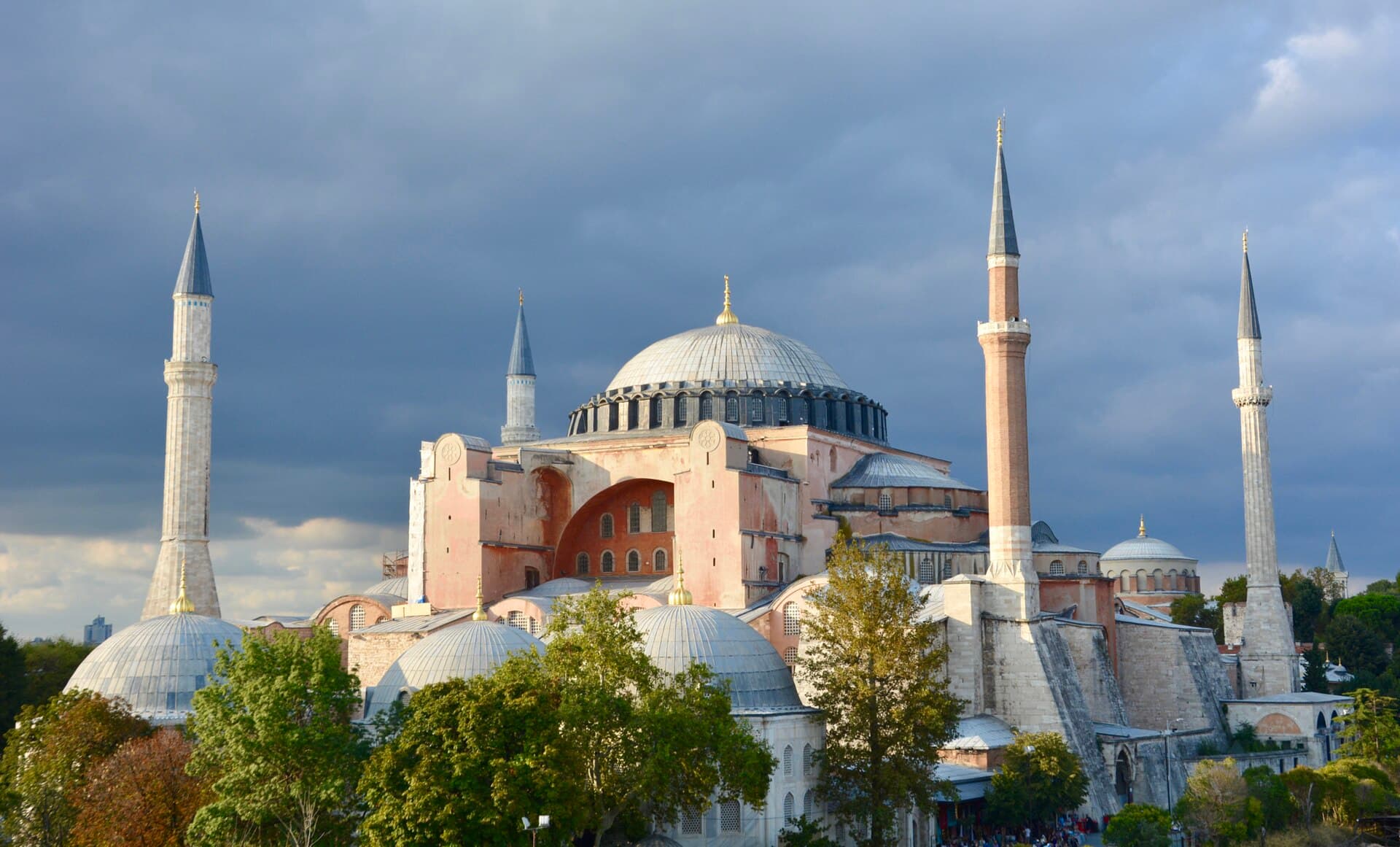
Hagia Sophia is the great domed building at the heart of Istanbul's historic peninsula, and few structures anywhere have carried so many identities. Built as the cathedral of Constantinople, it became an imperial mosque after the Ottoman conquest, a museum under the Turkish Republic, and since 2020 a mosque once again. For nearly 15 centuries it has dominated the skyline above the meeting point of the Bosphorus, the Golden Horn and the Sea of Marmara.
What makes a visit so rewarding is that both of its great lives are still visible under one roof. Gold-ground Byzantine mosaics of Christ, the Virgin and emperors share the space with Ottoman calligraphy, a marble mihrab and minbar, and the sultan's prayer lodge, while four minarets frame the building outside. Its central dome, raised over a vast open space, influenced builders across the Byzantine and Ottoman worlds for a thousand years.
Hagia Sophia is part of the UNESCO-listed Historic Areas of Istanbul. It faces the Blue Mosque across a garden square in Sultanahmet, with Topkapı Palace, the Basilica Cistern and the old Hippodrome all a few minutes away on foot, which makes it the natural anchor for your first day in the city.
History in brief
The name means Holy Wisdom, and the building you see is the third church on the site. The first was dedicated in the fourth century and the second in the early fifth century. Both were lost to fire, the second during the Nika riots of 532. Emperor Justinian I immediately commissioned a far more ambitious replacement, designed by Anthemius of Tralles and Isidore of Miletus, two scholars known for their work in geometry and mechanics rather than as conventional builders. Remarkably, it was completed in 537, less than six years later.
The first dome partly collapsed after earthquakes in 558. It was rebuilt with a higher profile by Isidore the Younger, nephew of the original architect, and the church was rededicated in 562. Later earthquakes brought down sections of the dome again in the tenth and fourteenth centuries, and each time it was repaired. In 1204 the armies of the Fourth Crusade sacked Constantinople, and Hagia Sophia served as a Latin Catholic cathedral until the Byzantines retook the city in 1261.
After Sultan Mehmed II conquered Constantinople in 1453, he converted the church into a mosque. Over the following centuries, minarets, a mihrab, a minbar and other Islamic features were added, and the great Ottoman architect Mimar Sinan strengthened the structure with buttresses in the sixteenth century. A major restoration in the 1840s under Sultan Abdülmecid, led by the Swiss-Italian Fossati brothers, stabilized the building and brought the giant calligraphic roundels that hang in the nave today.
In 1934 the government of the young Turkish Republic decided to turn the building into a museum, and it opened as one the following year. Restorers then uncovered many mosaics that had been plastered over during the Ottoman centuries. In July 2020 Hagia Sophia was reopened as a mosque, and it remains open to visitors of all faiths outside prayer times.
What to see
- The main dome: Ribs radiate from its crown, with a ring of 40 windows at its base, so the dome seems to hover on light, an effect writers have remarked on since Justinian's time. Stand near the center of the nave and look up to see how it is carried by four pendentives and supported east and west by two great half domes.
- The seraphim in the pendentives: Each of the four curved triangles below the dome carries a six-winged seraph. One of the faces, hidden for centuries, was uncovered during restoration work in 2009.
- The apse mosaic of the Virgin and Child: High in the eastern semi-dome, this ninth-century image was among the first figurative mosaics created after the end of the Iconoclast period, when religious images had been banned. During prayer use it may be veiled or softly lit.
- The calligraphic roundels: Eight enormous wooden medallions bear the names of God, the Prophet Muhammad, the first four caliphs and the Prophet's grandsons Hasan and Husayn. They were written by the calligrapher Kazasker Mustafa İzzet Efendi during the nineteenth-century restoration.
- The mihrab, minbar and sultan's lodge: The mihrab is set slightly off the church's axis to face Mecca, which is why the Ottoman furnishings and prayer carpets sit at a gentle angle to the building. The tall marble minbar beside it and the screened imperial lodge both date from the Ottoman centuries.
- The gallery mosaics: The upper galleries hold the famous Deësis, a thirteenth-century mosaic of Christ flanked by the Virgin and John the Baptist. Nearby are imperial panels showing Empress Zoe and John II Komnenos with their consorts offering gifts to Christ and the Virgin. Access to the galleries depends on the current visitor route.
- The entrance mosaics: Above the Imperial Gate, the main door into the nave, an emperor kneels before an enthroned Christ. In the southwestern vestibule, a mosaic shows the Virgin and Child with Constantine offering the city and Justinian offering the church, a neat summary of the building's meaning to Byzantium.
Architecture and details worth noticing
Look down as well as up. In the floor of the nave is the omphalion, a square of inlaid colored marble discs that is traditionally said to mark the place where Byzantine emperors were crowned. The walls are faced with panels of veined marble that were cut and opened like the pages of a book, so the patterns mirror each other, and many of the columns were brought from quarries and older buildings around the Mediterranean. The green and red porphyry columns in the side spaces are especially fine.
Small details reveal the building's long human story. On a marble parapet in the upper gallery, runic graffiti is generally read as the name Halfdan, most likely carved by a member of the Varangian Guard, the Norse soldiers who served the Byzantine emperors. In the same gallery a marker names Enrico Dandolo, the Venetian doge who led the Fourth Crusade and was buried here. Outside, the Ottoman additions include an eighteenth-century ablution fountain and the domed tombs of several sultans, among them Selim II, whose mausoleum was designed by Sinan.
How to get there
Hagia Sophia stands in the Sultanahmet district on the historic peninsula. The T1 tram stops at Sultanahmet, a short walk away, and links the old city with the ferry piers at Eminönü and Kabataş. Many hotels in the old city are within walking distance. Taxis can drop you near the square, though traffic around the area is heavy and some streets are pedestrian only, so the tram is often quicker.
How long to spend and when to go
Allow about an hour inside, and longer if your route includes the galleries or you want to study the mosaics closely. Because the building is an active mosque, visitor access pauses around each of the five daily prayers and is more limited around Friday midday prayer, so plan around the prayer timetable rather than assuming fixed hours.
Mornings, ideally around opening, are usually the calmest. Lines can be long in the middle of the day from spring to fall and during public holidays. Summer in Istanbul is warm and humid, while winter is cool and wet but much quieter. Visitor routes, entry arrangements and fees have changed several times in recent years, so check current hours, tickets and rules before you go or let your guide arrange entry.
Tips from our specialists
- Dress modestly: shoulders and knees covered, nothing tight or see-through. Women need a scarf for their hair, and it is easier to bring your own than to rely on what may be offered at the door.
- You may need to remove your shoes in prayer areas, so wear shoes that slip off and on easily and carry a small bag for them.
- Speak quietly, never walk in front of someone praying, and do not photograph worshippers up close. Leave flash and tripods aside.
- A licensed guide makes a real difference here. Many mosaics are small, high or in shadow, and a good guide knows where to look and how to read the layers of history.
- Build slack into your day around prayer times, especially if you plan to visit Hagia Sophia and the Blue Mosque back to back.
Nearby sights to combine
The Blue Mosque, built in the early seventeenth century for Sultan Ahmed I, stands just across the square and was designed in conscious dialogue with Hagia Sophia, so seeing the two in sequence is rewarding. Below street level nearby, the Basilica Cistern is a Byzantine reservoir from Justinian's era, with rows of columns rising from the water and two carved Medusa heads used as column bases. Topkapı Palace, the Ottoman sultans' residence for centuries, begins just behind Hagia Sophia, and in its outer courtyard stands Hagia Irene, another Byzantine church that was never converted into a mosque.
On the old Hippodrome you will find an obelisk of Thutmose III brought from Egypt in late antiquity, a fine link for travelers arriving from Luxor or Cairo. The Istanbul Archaeology Museums and the Grand Bazaar are both within walking distance or a short tram ride.
Frequently asked questions
Is Hagia Sophia a mosque or a museum?
It has been a mosque since 2020, after more than eight decades as a museum. Visitors of all faiths are welcome outside prayer times, provided they follow the dress code and etiquette of a place of worship.
Can you still see the Byzantine mosaics?
Yes, though how many you see depends on the current visitor route and on prayer use. Some figurative images in the prayer area may be veiled or softly lit, while the gallery mosaics are best seen when the galleries are open to visitors.
Do I need a guide?
You can visit on your own, but a guide helps you make sense of 15 centuries of change and points out details most people miss, such as the omphalion and the runic graffiti. A guide can also handle entry arrangements, which have changed often.
How does Hagia Sophia differ from the Blue Mosque?
Hagia Sophia is a sixth-century Byzantine cathedral later adapted as a mosque, while the Blue Mosque was built as a mosque in the seventeenth century. Ottoman architects learned a great deal from Hagia Sophia's dome, so the two are best understood together.
Istanbul pairs easily with an Egypt itinerary, and with frequent direct flights from Cairo, Hagia Sophia makes a fitting first morning in the city.