
Two nights near Ephesus
The ancient city gets a full day of daylight, never squeezed between two flights.
Tour Operator · Egypt, Jordan, UAE, Turkey and Morocco
Giza and historic Cairo, then Istanbul's monuments and two unhurried nights near Ephesus
Cairo to Istanbul · 12 days
Fly to IstanbulDomestic flight
Fly to IzmirDomestic flight
Fly to IstanbulDomestic flight
This 12-day trip follows three ancient worlds: pharaonic Egypt at Giza, the Grand Egyptian Museum and historic Cairo; Byzantine and Ottoman Istanbul; and the Greco-Roman city of Ephesus, with two nights in Kusadasi so the site gets a full day. Three final nights in Istanbul add a Bosphorus cruise, the Grand Bazaar and a free day. It suits history lovers who want depth rather than speed.
Follow three great ancient worlds in 12 days: pharaonic Egypt at Giza and the Grand Egyptian Museum, Byzantine and Ottoman Istanbul, and the Greco-Roman city of Ephesus on Turkey's Aegean coast. Two nights in Kusadasi mean the archaeological site gets a full, unhurried day rather than a rushed stop between flights. The trip ends with three nights in Istanbul, including a Bosphorus cruise, the Grand Bazaar and a free day, so the final stretch is relaxed.
The ancient city gets a full day of daylight, never squeezed between two flights.
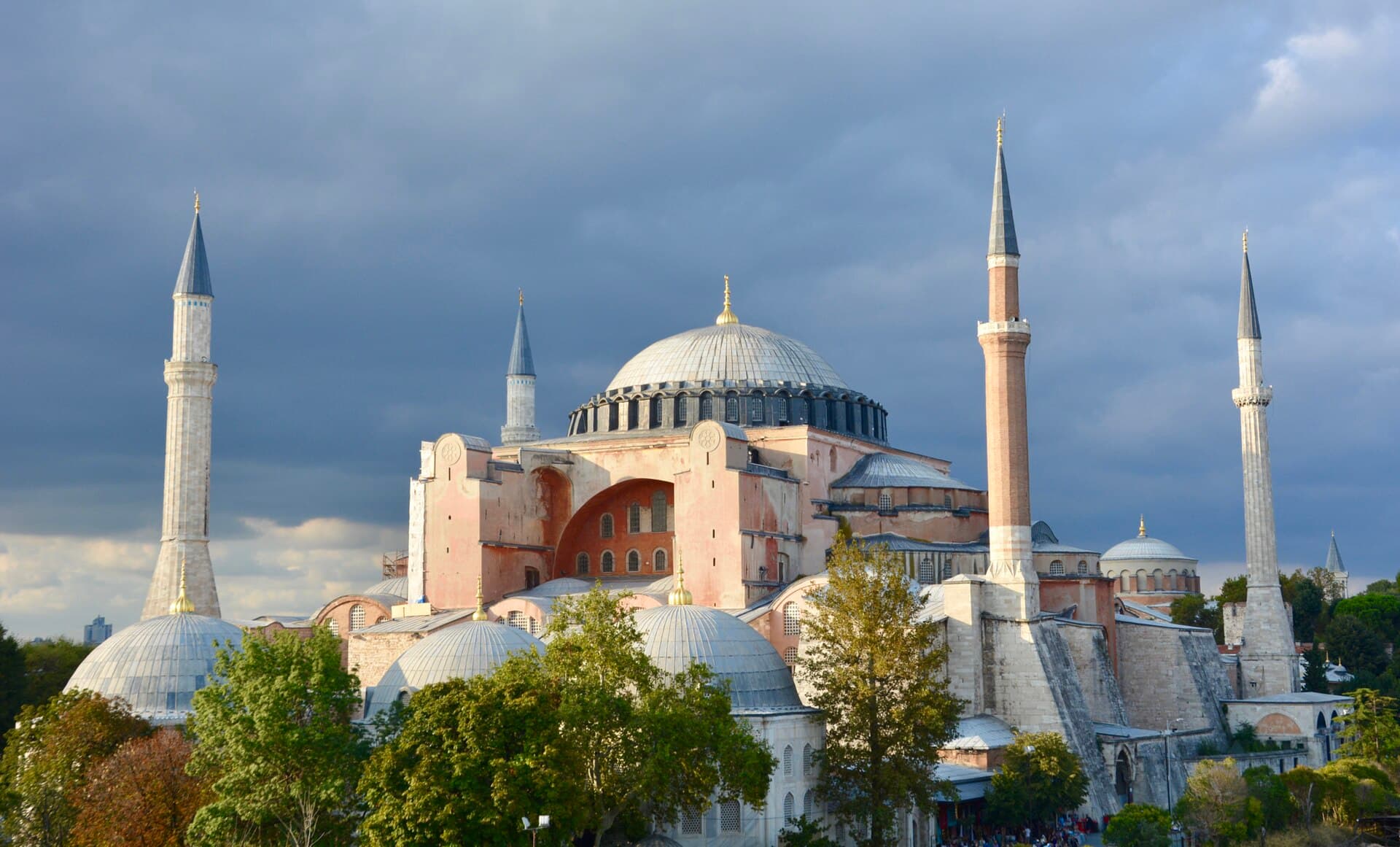
Giza, Byzantine Istanbul and Roman Ephesus connect, down to an Egyptian obelisk in Istanbul.

Monuments first, then the Bosphorus, the Grand Bazaar and a free day when you return from the coast.

Local guides in Cairo, Istanbul and Ephesus explain each site in the light of the others.

The trip that will take you from the pharaohs to Roman streets begins at Cairo International Airport. After immigration and baggage collection your representative meets you, helps with your luggage and takes you by private car to your hotel. The transfer is deliberately unhurried; depending on traffic and the location of your hotel it can take from half an hour to more than an hour, and it gives you a first view of the city's flyovers, minarets and the Nile.
No sightseeing is scheduled today. Twelve days and three regions call for a calm start, and the evening is best spent resting after your flight, adjusting to the time difference and reviewing tomorrow's meeting time. If you land early, a gentle walk near the hotel or dinner on a terrace is a better beginning than squeezing a major museum into a travel day. If you enjoy reading ahead, this is a good evening to dip into the history of the Old Kingdom: tomorrow you stand in front of monuments that were already ancient when the first Greek settlers arrived at Ephesus.

Today you meet the oldest monuments of the trip. On the Giza Plateau your Egyptologist guide explains the pyramids of Khufu, Khafre and Menkaure as part of a planned royal necropolis, with valley temples, causeways and the tombs of officials, rather than as isolated wonders. You walk between viewpoints and talk through the questions archaeologists still debate: how the stone was quarried and moved, how the workforce was organized and fed, and what the pyramids meant to the people who built them some 4,500 years ago.
Next you stand before the Great Sphinx, carved from the living rock beside Khafre's causeway, before continuing to the Grand Egyptian Museum. The afternoon is devoted to its collections, from colossal royal statues to the treasures of Tutankhamun, presented with the context archaeologists have pieced together over two centuries of excavation. Specific galleries, admission categories and any pyramid-interior visit depend on the confirmed ticketing plan. Wear comfortable shoes and bring water and sun protection for the morning. Later in the trip, at Ephesus, it is worth remembering that Greek and Roman visitors came to Egypt as sightseers to admire these same monuments.

Today follows Cairo's history forward from the pharaohs. In the morning your guide leads you through the older quarters of the city, selecting Coptic or Islamic landmarks according to opening times and your interests. Coptic Cairo grew in and around the walls of the Roman fortress of Babylon, and churches such as the round Church of St George recall the centuries when Egypt was a province of Rome and then of Byzantium, the same empire that will meet you again in Istanbul. Islamic Cairo, founded later, adds mosques, gates and madrasas built by the medieval sultans.
In the afternoon you walk Al-Muizz Street and the lanes around Khan el-Khalili, where worship, trade and everyday life carry on alongside centuries of architecture. Your guide helps you tell the stories of each place apart, and time for tea and browsing is part of the plan rather than an afterthought. Dress modestly for religious sites, with shoulders and knees covered. By the end of the day you have traced thousands of years of Egyptian history, a fine prologue to the Byzantine and Ottoman layers of Istanbul.

After breakfast you transfer to Cairo airport for the scheduled flight to Istanbul, crossing the eastern Mediterranean from one former Roman province to the city that became the capital of the eastern Roman Empire. Your Turkish representative meets you on arrival and accompanies you to your hotel. With check-in, immigration and the drive from either of Istanbul's two international airports, this is a travel day, and the itinerary does not pretend otherwise by promising a full old-city tour.
Let the first evening introduce the city at your own pace. A short walk near the hotel, a glass of Turkish tea or dinner in a local restaurant is enough. If you are staying near the historic peninsula, you may see the domes of Hagia Sophia and the Blue Mosque lit up after dark, a preview of tomorrow. Istanbul began as the Greek colony of Byzantium, was refounded by Constantine as Constantinople in 330 and became the Ottoman capital in 1453; over the next days you will see each of those layers. Tomorrow's program gives the landmarks the time and context they deserve, so rest well tonight.
Today you explore Istanbul's historic peninsula with a local guide, starting with Hagia Sophia, the building that best captures the city's layered past. Completed in 537 under Justinian, it was the cathedral of Byzantine Constantinople for over nine centuries, a mosque under the Ottomans from 1453, a museum from the 1930s and a working mosque again today. Your guide explains the engineering of its huge dome and the mosaics and calligraphy that record each era. Visitor arrangements have changed several times in recent years, and access follows the current rules.
Across the square is the Sultan Ahmed Mosque, the Blue Mosque, built in the early 1600s and still an active place of worship; prayer times, entry queues and conservation restrictions can change the sequence of the morning. Between the two, the site of the Hippodrome preserves monuments of the Roman and Byzantine city, among them an obelisk of the pharaoh Thutmose III brought from Egypt in the fourth century, a direct link to the days you have just spent in Cairo. The afternoon continues through the surrounding streets and squares, where Byzantine and Ottoman histories meet in a living city. Dress modestly and carry a scarf.
A full day with two very different Istanbul landmarks. Topkapi Palace, begun soon after the Ottoman conquest, was the residence of the sultans and the center of their empire for nearly four centuries. Your guide leads you through its courts in sequence, from the outer gateways to the inner pavilions, explaining how the palace worked as government, court and household, and pointing out collections such as the treasury, the imperial costumes and the sacred relics. Ticketed sections such as the palace harem require the agreed admission category.
Beneath the streets nearby lies the Basilica Cistern, built in the sixth century to store water for the Byzantine city and its palace. Its hundreds of columns, many of them reused from older buildings, stand in rows in the water, and two carved Medusa heads sit at the base of columns at the back, probably taken from an earlier Roman monument. For anyone heading to Ephesus, this reuse of classical stone is a useful preview of what you will see on the Aegean. Keep the afternoon spacious, with time for a café rather than another long list of stops, because tomorrow is a travel day.
Today you leave Istanbul for Turkey's Aegean coast. A scheduled domestic flight of about an hour takes you to Izmir, and a road transfer of roughly an hour and a quarter brings you to the accommodation serving Ephesus in Kusadasi, a seaside town on a wide bay facing the Greek island of Samos. The landscape changes on the way: olive groves, fig orchards and low hills replace the city skyline, and the air takes on the mild feel of the Mediterranean world.
If time permits after check-in, enjoy a stroll along the Kusadasi waterfront, where the harbor is a pleasant place to watch the sunset, or simply have a quiet evening nearby. The archaeological visit itself is reserved for tomorrow, so you can move through the ancient streets with enough daylight rather than combining a major site with airport travel. That choice is the reason for two nights here instead of a day trip from Istanbul. Ask your guide about the plan for tomorrow; Ephesus is best begun early, before the day warms up and the site gets busy, and a good night's sleep makes the long walk easier.
Today is the reason for the Aegean chapter. With a local guide you explore Ephesus, once one of the great cities of the Roman province of Asia, walking its excavated avenues from one end to the other. You follow marble-paved streets lined with columns, fountains and inscriptions, pass the remains of temples and public baths, and reach the monumental facade of the Library of Celsus, the image most people know. Nearby, the Great Theater, cut into the hillside, once held many thousands of spectators and still gives a sense of the city's scale.
The site makes sense only on foot, and the visit is allowed to unfold at a walking pace rather than being reduced to one famous photograph. Your guide explains how the harbor silted up, how the city declined, and the place of Ephesus in early Christian history. Depending on the confirmed program, the day may add a nearby Selcuk museum or heritage stop. The Terrace Houses, where wealthy Ephesians lived among mosaics and frescoes, are ticketed separately and should be specified in your inclusions if you want to see them. There is little shade, so bring a hat, water and good shoes.
After a final morning on the Aegean, you leave the Ephesus region for Izmir Airport and take the domestic flight back to Istanbul, where your driver brings you to your final hotel. The journey takes a good part of the day once road time, check-in and transfers are counted, so the evening is kept free for transport changes and an unhurried dinner.
This second Istanbul stay is planned differently from the first. You have already seen the great monuments of the historic peninsula, so the next days look at the city from new angles: the water, the markets and the neighborhoods where Istanbul lives day to day. If you arrive with energy, a walk near your hotel or along the shore is a good way to reconnect with the city. Note that this itinerary does not assume a same-day connection from Izmir to a long-haul flight unless it has been ticketed as a protected onward journey; the three remaining nights give you ample margin. Take a moment tonight to think about how you would like to spend Day 11, your free day, so your guide can suggest ideas tomorrow.
Today you discover Istanbul from the water and from its oldest market. A scheduled Bosphorus cruise, subject to vessel operations and weather, takes you along the strait that separates Europe from Asia, past Ottoman palaces, wooden waterside mansions, mosques, fortresses and the great suspension bridges. This waterway made the city rich for more than 2,000 years, controlling trade between the Black Sea and the Mediterranean, and seeing it from a boat explains why Byzantium was founded where it was.
In the afternoon you spend time among the trading lanes of the Grand Bazaar, a covered market of thousands of shops whose origins go back to the 15th century. Carpets, ceramics, textiles, lamps and jewelry fill its streets and inner courtyards, the old inns known as hans. The two experiences offer different perspectives on the city, one shaped by geography and the other by commerce. Confirm in your quote whether the boat ticket and private transport are included, and note that the bazaar is usually closed on Sundays and during some religious holidays, so the order of days may be adjusted to your dates.
Today is yours to shape. After a week of airports and walking-heavy archaeological sites, a flexible day is particularly valuable on a 12-day, two-country journey. You might choose a part of Istanbul you have not yet explored, revisit a monument you would like to see again, or keep the day open for cafés, markets and an independent neighborhood walk. Your guide can suggest routes suited to your interests before you set off, but additional admissions are optional unless clearly listed.
If the ancient world has caught your imagination, Istanbul has much more to offer on the subject, and your guide can point you toward collections and quarters that continue the story you followed at Giza and Ephesus. If you would rather rest, a long lunch, a hammam you book yourself or an afternoon at the hotel are equally good choices. Public ferries make it easy to cross to the Asian shore for a change of scene and a view back to the old city. This is also the day to finish your shopping and pack at leisure, so tomorrow's departure is calm.
Your last morning is about a comfortable departure, not new sightseeing. After breakfast, check out at the agreed time and transfer to the departure airport with your driver. Allow generous time: Istanbul's airports are large, there is a security screening at the terminal entrance, and traffic can lengthen the drive considerably at busy hours.
Before travel, please verify your flight times, luggage allowance and any visa or exit requirements. Extra hotel time, late check-out or an additional excursion is not included unless it appears in the confirmed booking, but if your flight leaves late in the day, ask us in advance and we will suggest options.
You leave having followed a thread through three ancient worlds: the pyramids of the Old Kingdom and the treasures of the Grand Egyptian Museum, the Byzantine and Ottoman monuments of Istanbul, and the Greco-Roman streets of Ephesus. Few routes connect them so directly, and many travelers find that each place makes the others easier to understand, from an Egyptian obelisk in Istanbul to Roman columns reused in a Byzantine cistern. We hope the journey leaves you with stories to tell and reasons to return.
Per person, two sharing. Prices are a starting point; your planner confirms the final price for your dates.
| Two sharing | $3,099 |
| Single room | $4,539 |
| Two sharing | $3,719 |
| Single room | $5,629 |
Cairo and Giza are most comfortable from October to April. The Bosphorus cruise runs subject to vessel operations and weather, so keep a light rain layer handy for Istanbul.
Wear comfortable shoes for Ephesus's stone streets and Istanbul's hills. Cover shoulders and knees for Hagia Sophia and the Blue Mosque, and women should carry a scarf for mosque visits.
The pace is moderate, with full days on foot through archaeological sites and historic city centers. Ephesus is explored on foot along its excavated avenues, and a free Istanbul day helps you recover.
After the flight from Cairo to Istanbul, domestic flights connect Istanbul with Izmir and back. The Ephesus visit sits on its own day, never combined with airport travel.
Entry visas for Egypt and Turkey are not included. Entry rules depend on your passport and can change, so please check the official source before you travel.
Cards are widely accepted in hotels; carry cash for tips, the Grand Bazaar and cafés in each country. Tipping is customary for guides and drivers, and gratuities are not included.
On Day 7 you fly from Istanbul to Izmir, about an hour in the air, then continue by road to Kusadasi, which takes roughly an hour and a quarter. On Day 9 you return the same way. The road transfers named in the itinerary are arranged for you, and your quote states which flights are included.
Not automatically. The Terrace Houses are a covered excavation inside the site with their own ticket. If you would like to see their mosaics and wall paintings, ask us to include them, and they will be listed in your quote.
A day trip from Istanbul would squeeze two flights and the archaeological site into one long day, leaving little time on the ancient streets. Two nights let you arrive calmly, see Ephesus with a full day of light and fly back the following day without rushing.
Check both, because visas are not included in the package. Entry rules depend on your passport and can change, so please check the official source before you travel.
Spring and fall are ideal across the whole route. Ephesus has little shade and is hot in July and August, while Cairo is most comfortable from October to April. Winter is quiet and mild on the Aegean but can be wet and cold in Istanbul.
Older children who enjoy history usually love it: the pyramids, the Basilica Cistern and the theater at Ephesus are easy to bring to life. The trip has several flights and long walking days on hard surfaces with little shade, so it suits families whose children are used to walking. Tell us their ages and we can adjust the pace.
Comfortable shoes with good grip are essential, since the marble streets of Ephesus can be slippery and Giza is sandy. Bring a hat, sunglasses, sunscreen and a refillable water bottle. For mosques in Istanbul and religious sites in Cairo, wear clothing that covers shoulders and knees, and women should carry a scarf. A light rain layer helps in Istanbul outside summer.


Photo credits: Ephesus & Selcuk — Benh LIEU SONG / Wikimedia Commons (CC BY-SA 3.0) · Hagia Sophia — Adli Wahid / Wikimedia Commons (CC BY-SA 3.0) · Istanbul — User:Ggia / Wikimedia Commons (CC BY-SA 3.0)
TALK TO A REAL LOCAL EXPERT
Book a free 30-minute consultation with one of our Egypt specialists. We’ll talk through your ideas, answer your questions and help you plan the perfect trip.
“We are here, plan your Egypt journey with people who know it best.”