
Three sides of Turkey
Istanbul's monuments, Cappadocia's valleys and Pamukkale's terraces show the country's range.
Tour Operator · Egypt, Jordan, UAE, Turkey and Morocco
Giza and Cairo, then Istanbul, Cappadocia's valleys and the terraces of Pamukkale
Cairo to Istanbul · 14 days
Fly to IstanbulDomestic flight
Fly to CappadociaDomestic flight
This 14-day route links Egypt's pyramids with three very different sides of Turkey: Istanbul's monuments and the Bosphorus over four nights, the valleys of Cappadocia over three, and the travertines and ruins of Pamukkale over two, with a final Istanbul night before you fly home. Long journeys within Turkey get their own travel days. It suits active travelers who want great monuments and natural wonders in one trip.
A grand loop for travelers who want Turkey's landscapes as much as its monuments. After Giza and historic Cairo, four nights in Istanbul cover Hagia Sophia, Topkapi Palace, the Basilica Cistern, the Bosphorus and the Grand Bazaar. Then come three nights among Cappadocia's valleys, with an optional balloon window, and two at Pamukkale for the white travertine terraces and ancient Hierapolis. Each long journey in Turkey gets its own travel day, and a last Istanbul night protects your flight home.
Istanbul's monuments, Cappadocia's valleys and Pamukkale's terraces show the country's range.

The long journeys to Pamukkale and back to Istanbul are planned as travel days, not hidden in sightseeing.

A full Göreme day and a spare morning give an optional balloon flight more than one chance.
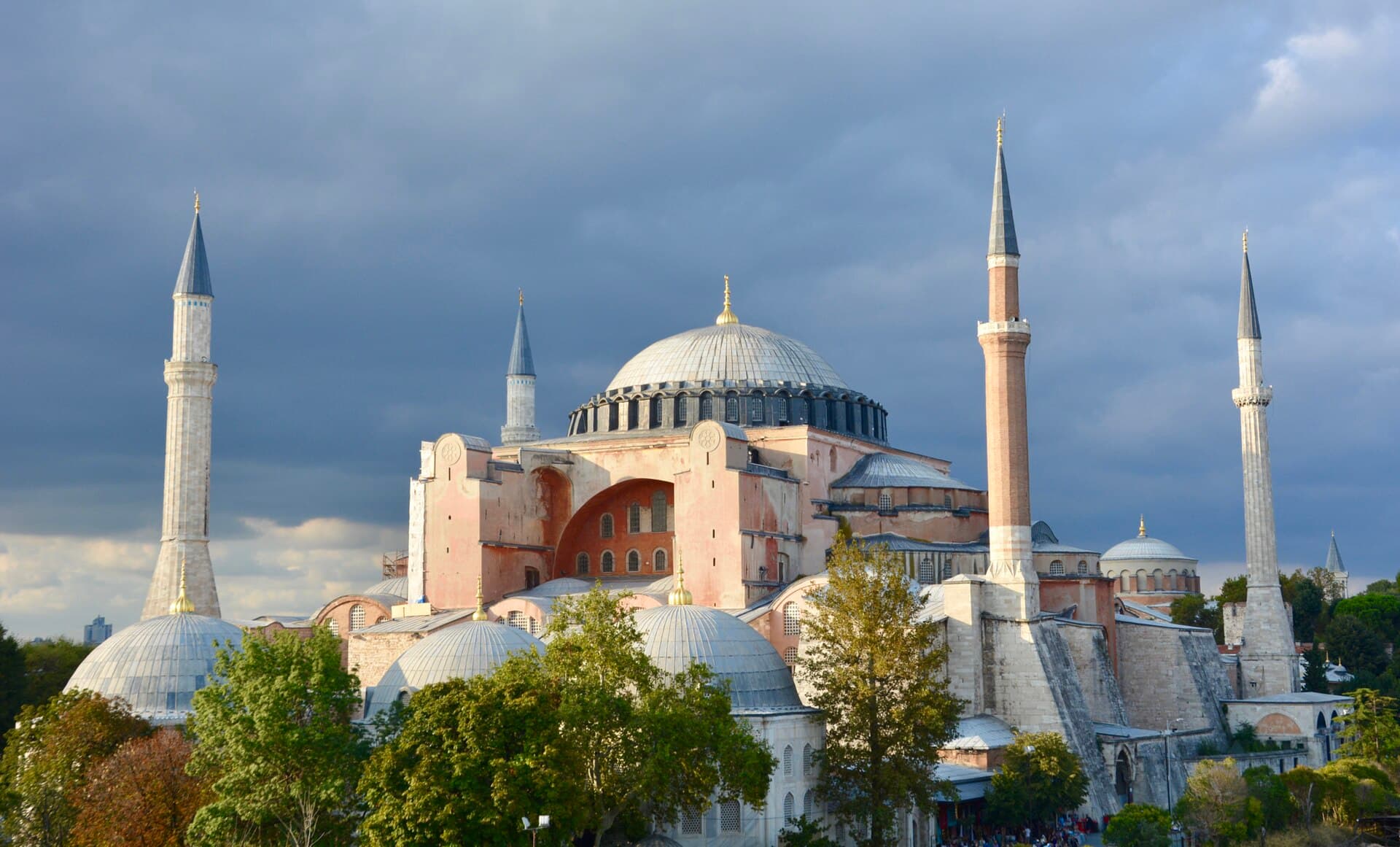
Hagia Sophia, Topkapi, the cistern, the Bosphorus and the bazaar each get proper time.

This 14-day loop through two countries starts gently at Cairo International Airport. A representative meets you after immigration and baggage collection and accompanies you to a private car for the transfer to your hotel, which can take from half an hour to more than an hour depending on traffic. Use the drive to take in the scale of the city, one of the largest in Africa and the Middle East, and its endless mix of old and new.
There is no sightseeing today, and on a trip with this many miles ahead, that matters. Settle in, rest after your flight and review tomorrow's meeting time. If you arrive early, a short walk or an early dinner near the hotel is a better beginning than squeezing a major museum into a travel day. Ahead of you are the pyramids and historic Cairo, then Istanbul, the valleys of Cappadocia and the white terraces of Pamukkale, with several flights and long transfers along the way. Starting rested is the best preparation. Before bed, make sure your passport, visa documents and flight details are easy to reach; you will need them on Day 4.

Your first full day is an active one on the Giza Plateau. With your Egyptologist guide you walk between viewpoints around the pyramids of Khufu, Khafre and Menkaure, seeing them as part of an ancient funerary landscape of temples, causeways and cemeteries rather than as isolated monuments. Expect sand, uneven ground and some slopes between viewpoints; good shoes and a hat make a real difference. Along the way your guide explains how the pyramids were planned and built and what they reveal about the kings who commissioned them.
Then you see the Great Sphinx, carved from the bedrock of the plateau, before continuing to the Grand Egyptian Museum. The afternoon is devoted to its collections, from the monumental grand staircase lined with royal statues to the galleries of Tutankhamun's treasures. Specific galleries, admission categories and any pyramid-interior visit depend on the confirmed ticketing plan; if you would like to go inside a pyramid, the passages are narrow and steep, so tell us in advance and check that it suits you. After a day of walking, the evening is free to rest, which is wise on a trip that keeps you moving for two weeks.


Spend the morning in the older quarters of Cairo, moving between selected Coptic or Islamic landmarks according to opening times and your interests. You might visit the churches of Coptic Cairo, including the round Church of St George, or the mosques and gates of the medieval Islamic city. Your guide explains each place in its own context, so you understand the communities that built them and still use them today.
Later, follow the lanes around Al-Muizz Street and Khan el-Khalili on foot, where worship, trade and everyday life continue alongside centuries of architecture. Vendors sell lanterns, brass, spices and fabrics from tiny shops, and the alleys open into small squares where locals stop for tea. Time for tea and browsing is part of the day, not an afterthought, and it is a good moment to buy small gifts before the Turkish half of the trip. Cover shoulders and knees for religious sites. Tonight is your last in Egypt; pack with the rest of the journey in mind, since inland Turkey can be much cooler than Cairo, and keep warm layers near the top of your bag.

After breakfast you transfer to Cairo airport for the flight to Istanbul, roughly two hours in the air. Your Turkish representative meets you on arrival and transfers you to your hotel, where you stay for four nights, the longest base of the trip. Between airport procedures and traffic, the day does not promise a full old-city tour.
Let the first evening introduce the city at your own pace, perhaps with a short walk near your accommodation and a dinner of Turkish meze. Istanbul's setting is the first thing to notice: hills crowned by domes and minarets, ferries crossing the water between Europe and Asia, and a skyline that changes with the light. Over the next three days you will see the city's monuments, its palace and cistern and its great waterway, before the trip turns inland to Cappadocia and Pamukkale. Because the Turkish half of this route covers long distances, it is worth getting a good night's sleep now and keeping the first evening simple. Your guide confirms tomorrow's start time; an early start is best for Hagia Sophia and the Blue Mosque.
Explore Istanbul's historic peninsula on foot with a local guide, beginning with Hagia Sophia and the Blue Mosque according to their current visitor arrangements. In almost 15 centuries Hagia Sophia has been a cathedral, a mosque, a museum and, today, a mosque again, and its great dome still astonishes visitors. The Sultan Ahmed Mosque, called the Blue Mosque for its tiled interior, faces it across the gardens, with six minarets rising above the square.
Prayer times, entry queues and conservation restrictions can change the sequence, so your guide adapts the order to the day. Continue through the surrounding streets and public squares, including the old Hippodrome with its Egyptian obelisk, and the lanes behind the mosques where carpet shops, cafés and wooden Ottoman houses line the cobbles. Your guide helps you see how Byzantine and Ottoman histories meet in a living city rather than in a museum. The historic peninsula is hilly and the paving uneven, so comfortable shoes are essential. Dress modestly for the mosques, with shoulders and knees covered, and women should carry a scarf. The evening is free.
Today brings two very different Istanbul landmarks. Topkapi Palace, set on the headland at the tip of the old city, was the seat of the Ottoman sultans for centuries. Your guide leads you through its sequence of courtyards and gateways, explaining the ceremonies, politics and daily life of the court, and you see collections such as the treasury and the pavilions with views over the Bosphorus and the Sea of Marmara. Ticketed sections such as the palace harem require the agreed admission category.
Close by, beneath the streets of the historic center, the Basilica Cistern is a sixth-century Byzantine reservoir: rows of marble columns rising from shallow water in a cool, dim hall, with two carved Medusa heads at the far end. It is only a short walk from the palace area, which keeps today's distances easy. Keep the afternoon spacious, with time for a café, a rest or a walk down to the waterfront rather than another long list of stops. With Cappadocia and Pamukkale still ahead, pacing yourself in Istanbul pays off later in the trip.
Discover Istanbul from the water on a scheduled Bosphorus cruise, subject to vessel operations and weather. The strait divides Europe from Asia and links the Black Sea with the Sea of Marmara, and from the boat you see Ottoman palaces, waterside mansions, mosques, fortresses and bridges on both shores. It is the best way to understand the geography that made this city one of the great crossroads of the world.
In the afternoon, spend time among the trading lanes of the Grand Bazaar, where thousands of shops under painted vaults sell carpets, ceramics, lamps, textiles and jewelry. Your guide explains how the bazaar is organized and how to bargain politely, then leaves you time to browse. The two experiences offer different perspectives on the city, one shaped by geography and the other by commerce. Confirm whether the boat ticket and private transport are included, and allow for market closures on relevant dates; the bazaar is usually closed on Sundays and some holidays. This is your last evening in Istanbul for now. Pack for the interior, where the Cappadocian plateau is higher and cooler, and remember you return to the city for the final night.
Today the trip turns from cities to landscapes. A domestic flight of a little over an hour takes you from Istanbul to an airport serving Cappadocia, usually Kayseri or Nevsehir, and a road transfer brings you to your hotel on the plateau. You arrive in a region of volcanic tuff, carved by wind and water into cones, pillars and valleys, and by people into houses, churches and underground spaces over many centuries.
If the arrival is early, enjoy a gentle viewpoint or short walk; the main valley and open-air museum visits take place tomorrow. Take a moment to ask your representative about a hot-air-balloon flight if you would like one, since flights are booked separately. Balloon flights are weather-dependent and are never guaranteed merely because the itinerary includes an overnight in Cappadocia; with three nights here, though, you have more than one possible morning. Evenings on the plateau are often cool, even in summer, and cold in winter, so have warm layers ready. Many hotels here are built into the rock, and a terrace at sunset is one of the simple pleasures of your first evening.
Discover Göreme Open-Air Museum and a carefully chosen valley or village viewpoint, learning how people adapted the soft volcanic stone into homes and places of worship. At the open-air museum, a group of monastic churches and chapels is cut into the rock, some decorated with Byzantine frescoes of remarkable color and detail. Your guide explains the life of the monastic communities who lived here and how Cappadocia's landscape shaped its history.
The rest of the day is for exploring the valleys themselves. This is an active trip, and if you enjoy walking, your guide can choose a valley path among the fairy chimneys, orchards and pigeon houses, where the scale of the landscape is best felt on foot. Walking conditions and access vary by site, so the guide will choose an appropriate route for the group, from a short level walk to a longer hike. Leave room for the shifting afternoon light rather than treating the landscape as a collection of identical photo stops; late in the day the rock turns gold and rose, and a viewpoint at sunset is a fine end to the day. Bring water, sun protection and shoes with good grip for dusty paths.
If you choose this option and it is confirmed in your booking, rise before dawn for a hot-air-balloon flight, which operates only when weather and aviation authorities permit. On a good morning, dozens of balloons lift off together and drift over the valleys as the sun comes up, one of the most famous sights in Turkey. If a flight is canceled, a place on the next morning's flight cannot be guaranteed; refund and rebooking terms are set out in your booking conditions. Even if you do not fly, it is worth getting up early to watch the launch from a viewpoint.
The remainder of the day is left open for a relaxed exploration of the valleys and villages, or simply for rest. After a very early start, many travelers sleep for a while before heading out again. You might walk a quieter valley, wander through a village on your own or spend the afternoon on a terrace with the view. Additional admissions are optional. Tonight is your last in Cappadocia, and tomorrow is a long travel day to Pamukkale, so pack this evening and get an early night. Keep a warm layer ready for the morning, which can be cold before sunrise.
Today is a travel day, and the itinerary treats it honestly as one. You travel from Cappadocia to Pamukkale by the domestic flight and road combination confirmed in your quote, or by an agreed overland route. The two regions are far apart: by road the journey across the Anatolian plateau takes most of a day, passing farmland, steppe and mountain ranges, while by air the routing typically involves a connection and a road transfer at each end. Your quote names the selected method.
With the longer transfer as today's main activity, nothing else is scheduled. If you travel overland, your driver stops for breaks along the way, and the changing scenery of central and western Anatolia becomes part of the experience. Settle into your hotel near the site on arrival. The travertines and Hierapolis get their own visit tomorrow, so today stays free of a full sightseeing program. If you arrive before dark, you may catch the white terraces on the hillside glowing in the evening light, a first glimpse of what is to come. Have a light dinner and rest; tomorrow's visit involves walking on the terraces and among the ruins.
Explore Pamukkale's striking travertine landscape and the adjoining remains of Hierapolis, following current conservation rules for paths and water access. The terraces are formed by mineral-rich hot springs that leave white calcium deposits as the water flows down the hillside, creating pools and cascades that look like snow or cotton, which is what the name Pamukkale means in Turkish. To protect the surface, visitors walk barefoot on the permitted paths, so bring a bag for your shoes.
Above the terraces lie the ruins of Hierapolis, a Greco-Roman spa city founded in the second century BC. Your guide explains both the geology and the layers of the ancient city: its theater, its gates and colonnaded street, and its vast necropolis, where people who came to bathe in the healing waters were buried over many centuries. Some sections may close temporarily for conservation, so the visit is based on the areas legally open on your date. There is little shade and the white surface reflects the sun strongly; sunglasses, sunscreen and water are essential. The rest of the afternoon is free to rest at your hotel.
Today you return to Istanbul by the airport and road transfers selected for your dates, most often a domestic flight from the Denizli area with a transfer at each end; depending on the season and schedules, another method may suit better, and your quote names the one chosen. This is primarily a travel day, with a free evening after check-in.
Coming back to Istanbul for the final night is a deliberate choice. A connection straight from a regional flight onto a long-haul departure leaves no margin for delay, so this night protects your journey home. If you arrive with time and energy to spare, use the evening to revisit a favorite spot, take a walk along the water or enjoy a farewell dinner. After two weeks of pyramids, palaces, valleys and terraces, many travelers find that a simple meal and an early night is exactly right. Check your international flight time, luggage allowance and online check-in tonight, and confirm tomorrow's pickup time with your representative so the final morning runs smoothly. It is also a good moment to make sure anything you bought in the bazaars is packed securely.
After breakfast, check out at the agreed time and transfer to the departure airport. Please verify flight times, luggage allowance and any visa or exit requirements before travel, and allow plenty of time for Istanbul's traffic and for the security screening at the airport entrance. Extra hotel time, late check-out or an additional excursion is not included unless it appears in the confirmed booking; the day's schedule is shaped around a comfortable departure rather than new sightseeing.
These 14 days have taken you a long way. In Egypt you saw the pyramids and the Sphinx at Giza, the treasures of the Grand Egyptian Museum and the lanes of historic Cairo. In Turkey you explored the monuments, palace and waterways of Istanbul, the rock-cut churches and valleys of Cappadocia, and the white terraces and ancient city at Pamukkale. Few itineraries combine so many different kinds of place, from desert monuments to volcanic landscapes and mineral springs, and the distances you covered are part of the achievement. We hope the trip leaves you with strong memories and the wish to come back to both countries.
Per person, two sharing. Prices are a starting point; your planner confirms the final price for your dates.
| Two sharing | $3,729 |
| Single room | $5,299 |
| Two sharing | $4,479 |
| Single room | $6,769 |
Cairo is hot from May to September and mild from October to April. Cappadocia and Istanbul are much cooler, and winter mornings in Cappadocia can be cold, so pack for both climates.
Bring layers, a hat and sturdy shoes for rock-cut valleys and ancient sites. Cover shoulders and knees, and carry a scarf, for mosques in Cairo and for Hagia Sophia and the Blue Mosque.
The pace is active. You need a fair amount of energy for walking through ancient sites, uneven valley paths and the Pamukkale terraces, plus several regional airport transfers.
You fly Cairo to Istanbul, then on a domestic flight toward Cappadocia. Pamukkale and the return to Istanbul use the confirmed mix of flights and road transfers, each treated as its own travel day.
A Cappadocia balloon flight is optional and booked separately. It flies only when weather and aviation authorities allow, so a canceled morning cannot be guaranteed for the next day.
Entry visas for both countries and gratuities are not included. Cards work in most hotels; carry Egyptian pounds and Turkish lira in cash for tips, cafés and small purchases.
The two are far apart, so Day 11 is a dedicated travel day. Depending on the season and schedules, you go either by a domestic flight combination with road transfers, typically connecting through Istanbul, or by a long overland drive across the plateau with breaks. Your quote names the method chosen for your dates.
On the travertines, yes: to protect the deposits, visitors walk barefoot on the permitted paths, and some areas may be closed for conservation. The surface can be slippery in some places and rough in others, so walk slowly. Bring a bag for your shoes; in Hierapolis above the terraces, shoes are fine.
No. It is an optional extra, booked and confirmed separately. Flights depend on the weather and on approval from the aviation authorities each morning. Three nights in Cappadocia give you more than one chance, but if a flight is canceled, a place the next day cannot be guaranteed.
Visas are not included. Entry rules depend on your passport and can change, so please check the official source before you travel.
It is one of the more active Egypt and Turkey routes. Expect long days on foot at Giza, on Istanbul's hills, in Cappadocia's valleys and on the Pamukkale terraces, plus several flights and two long transfer days. You do not need to be an athlete, but you should be comfortable walking several hours a day on uneven ground.
October to April is the best time to visit overall, because Cairo is most comfortable then. Cappadocia is cold, sometimes snowy, in winter, and Pamukkale is hot and bright in July and August. Spring brings green valleys; fall brings harvest colors and settled weather.
Layers are the answer. Pack light clothing and sun protection for Cairo and Pamukkale, a warm jacket for Cappadocia's early mornings and evenings, and a rain layer for Istanbul outside summer. Bring sturdy walking shoes, a bag for your shoes on the terraces, swimwear if you want to use hotel pools, and clothing that covers shoulders and knees for mosques.


Photo credits: Pamukkale & Denizli — Biologg / Wikimedia Commons (CC BY-SA 4.0) · Istanbul — User:Ggia / Wikimedia Commons (CC BY-SA 3.0) · Cappadocia — Brocken Inaglory / Wikimedia Commons (CC BY-SA 3.0) · Hagia Sophia — Adli Wahid / Wikimedia Commons (CC BY-SA 3.0)
TALK TO A REAL LOCAL EXPERT
Book a free 30-minute consultation with one of our Egypt specialists. We’ll talk through your ideas, answer your questions and help you plan the perfect trip.
“We are here, plan your Egypt journey with people who know it best.”