
Two cities, one flight
A single flight links Cairo and Istanbul, so you change hotels only once and spend your days in the cities.
Tour Operator · Egypt, Jordan, UAE, Turkey and Morocco
Three nights for Cairo's pyramids, five for Istanbul's palaces, bazaars and Bosphorus
Cairo to Istanbul · 9 days
Fly to IstanbulDomestic flight
This is a nine-day, two-country city trip: three nights in Cairo for the Giza pyramids, the Grand Egyptian Museum and historic Cairo, then five nights in Istanbul for Hagia Sophia, Topkapi Palace, the Basilica Cistern, the Bosphorus and the Grand Bazaar. One flight links the two cities and there are no internal flights in either country. It suits first-time visitors and couples who want the essentials of both cities with a free day at the end.
Two great cities in nine days: three nights in Cairo for the Giza pyramids, the Grand Egyptian Museum and the lanes of historic Cairo, then five nights in Istanbul for Hagia Sophia, the Blue Mosque, Topkapi Palace, the Basilica Cistern, the Bosphorus and the Grand Bazaar. One flight links the two cities and there are no internal flights in either country, so you unpack only twice and spend your days in the cities rather than in airports. The last full day in Istanbul is left free.
A single flight links Cairo and Istanbul, so you change hotels only once and spend your days in the cities.

One unhurried day covers the pyramids, the Sphinx and the Grand Egyptian Museum with a guide.
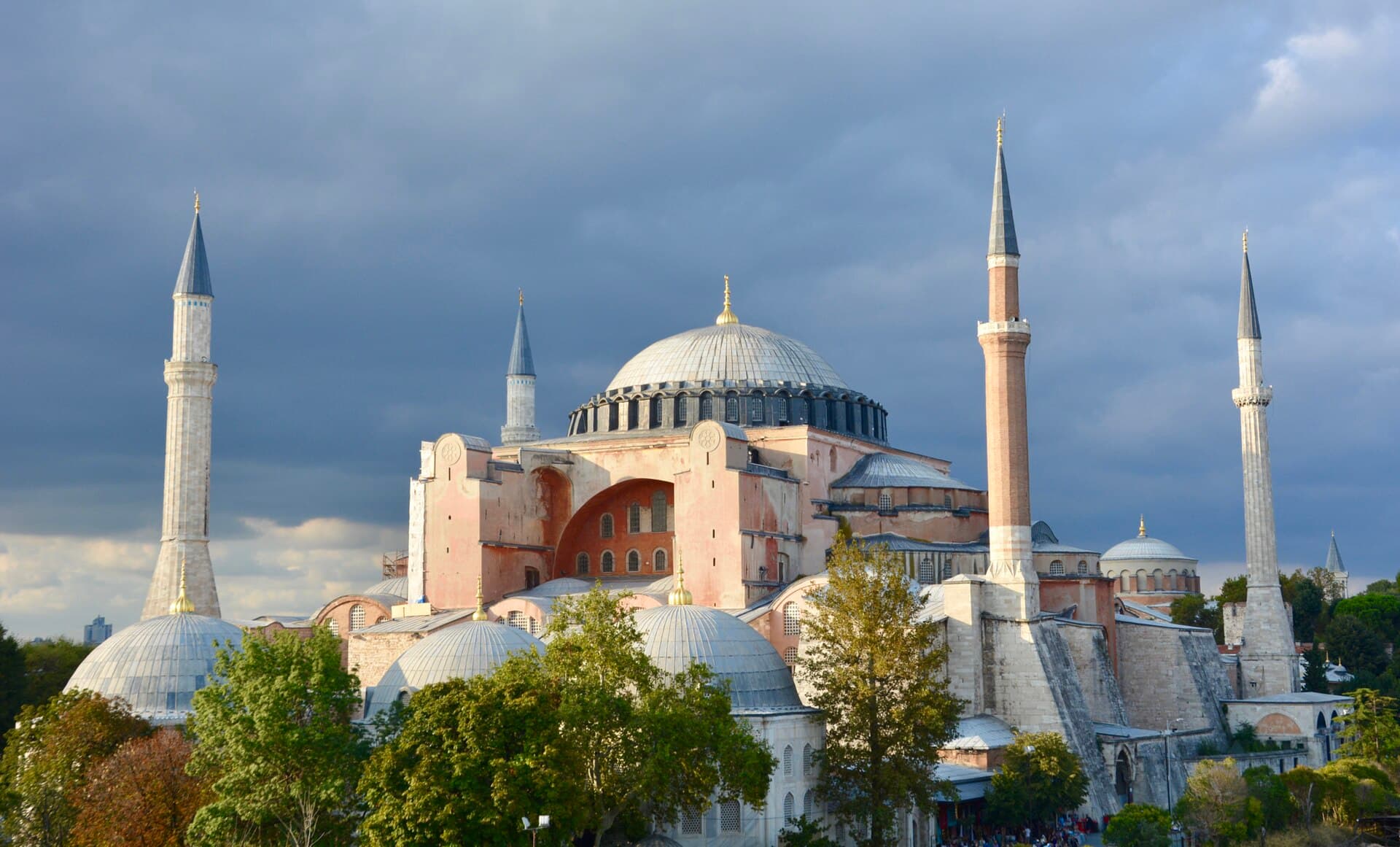
The historic peninsula, Topkapi, the cistern and the Bosphorus each get their own time instead of one rushed tour.

Day 8 is left open for neighborhoods, ferries, shopping or rest before you fly home.

Your journey starts when you step out of passport control at Cairo International Airport. A representative meets you after immigration and baggage collection, helps with the walk to the car and stays with you until you are on your way into the city. The drive to your hotel can take anywhere from 30 minutes to well over an hour, depending on where you are staying and on Cairo's famously unpredictable traffic, so treat the transfer itself as your first look at a city of more than 20 million people.
Nothing else is scheduled today, and that is deliberate. A long-haul flight followed by a full museum day is a recipe for a blurred memory, so this evening is yours to rest, unpack and adjust to the time difference. If you land early, a gentle walk near the hotel or dinner overlooking the Nile is a better introduction than a rushed sight. Before you go to sleep, check tomorrow's meeting time with your representative; Giza is best seen early, before the plateau warms up and the coaches arrive. Keep your phone charged and your passport somewhere safe, since you fly on to Istanbul in three days.

This is the day most people picture when they book Egypt, and it is planned to give the Giza Plateau the time it deserves. With your Egyptologist guide you walk between viewpoints around the Great Pyramid of Khufu and the neighboring pyramids of Khafre and Menkaure, learning how they sat within a wider funerary landscape of temples, causeways and the tombs of officials rather than standing alone in the sand. Questions are welcome; the guide's job is to turn the stones into a story.
Next comes the Great Sphinx, carved from the bedrock beside Khafre's causeway, before a short drive to the Grand Egyptian Museum on the edge of the plateau. The afternoon belongs to its collections: the monumental statues of the grand staircase, the galleries arranged by theme and period, and the treasures of Tutankhamun displayed together. Which galleries you enter, the admission category and any pyramid-interior visit depend on the confirmed ticketing plan, so tell us before you travel if going inside a pyramid matters to you. Wear comfortable shoes, bring a hat and water for the morning, and expect to spend most of the day on your feet.


Today moves from the ancient world to the Cairo that people live in. The morning is spent in the older quarters of the city, visiting a selection of Coptic or Islamic landmarks chosen around opening times and your interests. Depending on the plan you agree, that might mean the Mosque of Muhammad Ali on the Citadel, with its domes and its courtyard fountain, or the churches of Coptic Cairo, where Christian communities have worshipped for many centuries. Your guide explains each place on its own terms, so a mosque, a church and a medieval street are not blurred into one generic idea of old Cairo.
In the afternoon you walk Al-Muizz Street, one of the richest concentrations of medieval Islamic architecture anywhere, and continue into Khan el-Khalili, the bazaar where copper, spices, lanterns and textiles have changed hands for generations. Time for mint tea in a café and unhurried browsing is part of the day, not a leftover. Shoulders and knees should be covered for religious sites, and women may want a light scarf. This is your last full day in Egypt, so it is also a good evening to repack for tomorrow's flight to Istanbul.

After breakfast you transfer to Cairo airport for the flight to Istanbul, roughly two hours in the air plus check-in and immigration on both sides. Your Turkish representative meets you on arrival and takes you to your hotel. Istanbul has two international airports, one on each side of the city, and the transfer time depends on which one your flight uses and on the traffic, so the day is planned as a travel day rather than a sightseeing day.
Once you have checked in, let the city introduce itself at your own pace. A short walk near the hotel, a first glass of Turkish tea or a simple dinner of grilled fish or meze is enough for this evening. You will notice the shift straight away: after Cairo's desert light, Istanbul is a city of water, hills and ferries, where Europe and Asia face each other across the Bosphorus. Five nights here mean nothing needs to be squeezed in tonight. Tomorrow's guided program gives Hagia Sophia and the Blue Mosque the time and context they deserve, so an early night is a perfectly good plan.
Your first full day in Istanbul is spent on the historic peninsula with a local guide, beginning with the two buildings that define the skyline of Sultanahmet. Hagia Sophia was built in the sixth century as the great church of Byzantine Constantinople, became a mosque after the Ottoman conquest of 1453, served as a museum for much of the 20th century and is a working mosque again today. Visitor arrangements have changed several times in recent years, so your guide follows the current rules on entrances, routes and closures during prayers.
Across the square stands the Sultan Ahmed Mosque, known to most visitors as the Blue Mosque for the painted tiles of its interior. As an active place of worship it closes to visitors around prayer times, which can reorder the morning. Between the two you cross the old Hippodrome, where obelisks and columns mark the arena of Byzantine chariot races, including an Egyptian obelisk that links neatly to the days you have just spent in Cairo. The afternoon continues through the surrounding streets and squares at an easy pace. Dress modestly, and carry a scarf for the mosque visits.
Today pairs two landmarks that could hardly be more different. Topkapi Palace was the seat of the Ottoman sultans for centuries, a sequence of courtyards, pavilions and kitchens on the headland where the Golden Horn meets the Bosphorus. Your guide leads you through the courts in the order the palace was used, from the public outer areas toward the private inner rooms, with time for collections such as the imperial treasury and for the views over the water. Ticketed sections such as the harem require the agreed admission category, so check your quote if seeing the harem is a priority.
Later you descend beneath the streets to the Basilica Cistern, a sixth-century Byzantine reservoir whose forest of columns rises from the water in soft, low light. Look for the two carved Medusa heads reused as column bases at the far end. The cistern is a short walk from Hagia Sophia, which keeps today's distances manageable. The afternoon is kept spacious on purpose: a café, a hammam you book yourself, or simply a rest at the hotel are all better choices than another long list of stops.
Istanbul makes most sense from the water, and today begins on a scheduled Bosphorus cruise, subject to vessel operations and weather. The strait runs between Europe and Asia, lined with Ottoman waterside mansions, mosques, fortresses and bridges, and the boat gives you the scale of the city in a way no street can. Your guide points out the landmarks on both shores as you sail and explains how the city grew along the water.
Back on land, the afternoon is spent among the trading lanes of the Grand Bazaar, one of the oldest and largest covered markets in the world, with thousands of shops selling carpets, ceramics, lamps, jewelry and leather under painted vaults. Your guide explains how the bazaar is organized, how its old inns and streets fit together and how to bargain politely, then leaves you time to browse. Take your time; the best finds are often in the quieter side passages rather than on the main streets. The bazaar is usually closed on Sundays and during some religious holidays, so the order of days may swap to suit your dates. Confirm in your quote whether the boat ticket and private transport today are included.
Today is genuinely yours. After five days of guided touring across two countries, a free day lets you return to a favorite spot, explore a neighborhood on your own or simply rest. Your guide can suggest routes before you set off, matched to your interests, but nothing is booked and any additional admissions are optional unless clearly listed in your quote.
Some travelers cross to the Asian side by public ferry for the sea views and the busy markets of Kadikoy; others walk up through the steep lanes of Galata and Karakoy for cafés, galleries and a view back over the old city; others choose a long breakfast and an afternoon at the hotel. Istanbul's ferries, trams and taxis make independent exploring straightforward, and your representative remains reachable if you need help. This is also the moment to finish shopping, write postcards or pack at leisure rather than on the last morning. A slow day near the end of a nine-day, two-country trip is not wasted time; it is often the day people remember for its small, unplanned discoveries, and it gives the busy days before it room to settle.
Your last morning in Istanbul is planned around a calm departure rather than new sightseeing. After breakfast, check out at the agreed time and meet your driver for the transfer to the departure airport. Allow plenty of margin: Istanbul's airports are large, security checks happen at the terminal entrance as well as at the gate, and traffic can lengthen the drive considerably at busy hours.
Before travel, please verify your flight times, luggage allowance and any visa or exit requirements that apply to your passport. If your flight leaves late in the day, ask us about a late check-out or an extra excursion; neither is included unless it appears in your confirmed booking, but both can often be arranged when requested in advance.
As you leave, you take with you two very different cities: the desert-edge monuments of Giza and the lanes of historic Cairo, and the domes, palaces and waterways of Istanbul. Many travelers find that the contrast is what makes the trip, from the Nile to the Bosphorus and from the pharaohs to the sultans, and that nine days was enough to want to come back to both.
Per person, two sharing. Prices are a starting point; your planner confirms the final price for your dates.
| Two sharing | $2,779 |
| Single room | $4,219 |
| Two sharing | $3,339 |
| Single room | $5,249 |
October to April suits sightseeing in Cairo, with warm days and cool evenings. Istanbul is noticeably cooler and can be wet in winter, so pack a warm layer and a rain jacket for the Turkish leg.
Cover shoulders and knees for mosques and churches in both cities; women should carry a scarf for Hagia Sophia and the Blue Mosque. Comfortable shoes matter on Istanbul's cobbles and hills.
A moderate pace, with plenty of walking at historic sites in Cairo and on Istanbul's old peninsula. The schedule slows down once you reach Istanbul, and Day 8 is kept open.
You fly from Cairo to Istanbul on Day 4; your quote states whether that flight is included. Airport and land transfers described in the itinerary are arranged, and the Bosphorus cruise depends on weather.
Entry visas are not included. Entry rules depend on your passport and can change, so please check the official source before you travel.
Cards are widely accepted in hotels and larger shops; carry cash for tips, tea and Grand Bazaar purchases. Gratuities are not included, and extra admissions on the free day are optional.
Yes, each country has its own entry rules, and visas are not included in the package. Entry rules depend on your passport and can change, so please check the official source before you travel.
On Day 4 you take a scheduled flight from Cairo to Istanbul, roughly two hours in the air. Your representative in Cairo handles the airport transfer, and your Turkish representative meets you on arrival in Istanbul. Your quote states whether this flight is included or whether you book it yourself along with your international tickets.
Cairo's essentials, Giza, the Grand Egyptian Museum and historic Cairo, fit well into two full days. Istanbul rewards more time: its monuments are spread across the historic peninsula and the Bosphorus, and a free day at the end lets you explore neighborhoods at your own pace. If you would like more of Egypt, a Nile cruise or a longer Cairo stay can be added in your quote.
October to April is the most comfortable window for Cairo, with warm days and cool evenings. Istanbul is cooler and can be wet and chilly from December to February, while spring and fall are pleasant in both cities. Summer works too, but Cairo is very hot and Istanbul is at its busiest.
Expect a moderate pace: two to four hours on foot on most touring days, over sand and uneven ground at Giza, cobbles in historic Cairo and steep streets in Istanbul's old city. There are no internal flights inside either country and only one change of hotel, which keeps this trip less tiring than longer multi-stop routes.
Yes for most families. There is only one flight between the countries, and the free day in Istanbul works well for rest. Children often enjoy the pyramids, the Bosphorus boat and the Basilica Cistern most; long museum visits may need breaks, so tell us your children's ages and we will adjust the pacing in your quote.
Light, breathable clothing and sun protection for Cairo, plus a warm layer and a rain jacket for Istanbul outside summer. Comfortable walking shoes matter in both cities. For mosques and churches, pack clothing that covers shoulders and knees; women should carry a scarf for Hagia Sophia and the Blue Mosque. Bring some cash in both Egyptian pounds and Turkish lira for tips and small purchases.


Photo credits: Hagia Sophia — Adli Wahid / Wikimedia Commons (CC BY-SA 3.0) · Istanbul — User:Ggia / Wikimedia Commons (CC BY-SA 3.0)
TALK TO A REAL LOCAL EXPERT
Book a free 30-minute consultation with one of our Egypt specialists. We’ll talk through your ideas, answer your questions and help you plan the perfect trip.
“We are here, plan your Egypt journey with people who know it best.”