
One direction, no backtracking
You fly Cairo to Amman once and finish in Jordan, so no day is lost to a return flight.
Tour Operator · Egypt, Jordan, UAE, Turkey and Morocco
Cairo's pyramids and old quarters, then Petra, Wadi Rum and Amman
Cairo to Amman · 8 days
This is an eight-day Egypt and Jordan trip that runs one way from Cairo to Amman. You get three nights in Cairo for the pyramids, the Grand Egyptian Museum and the medieval city, then a flight to Jordan for a full day in Petra, a night at a Wadi Rum desert camp, and Madaba and Mount Nebo on the way to Amman. It suits travelers with one week who want the essential sights of both countries without doubling back.
Eight days is a short window for two countries, so this route gives every day one clear job. Three nights in Cairo cover the Giza pyramids, the Sphinx, the Grand Egyptian Museum and the medieval lanes around Al-Muizz Street and Khan el-Khalili. Then a single flight carries you to Amman and the road takes you south to Petra.
In Jordan the order follows the map rather than doubling back: a full day walking Petra through the Siq to the Treasury and beyond, a night at a desert camp among the sandstone mountains of Wadi Rum, and a drive north through Madaba and Mount Nebo to finish in Amman.
There is no return flight to Egypt and no rushed connection squeezed into a sightseeing day. The trip ends where it naturally ends, in the Jordanian capital, which keeps the week compact without making it frantic.
You fly Cairo to Amman once and finish in Jordan, so no day is lost to a return flight.

The pyramids, the Sphinx and the Grand Egyptian Museum share one well-paced day.
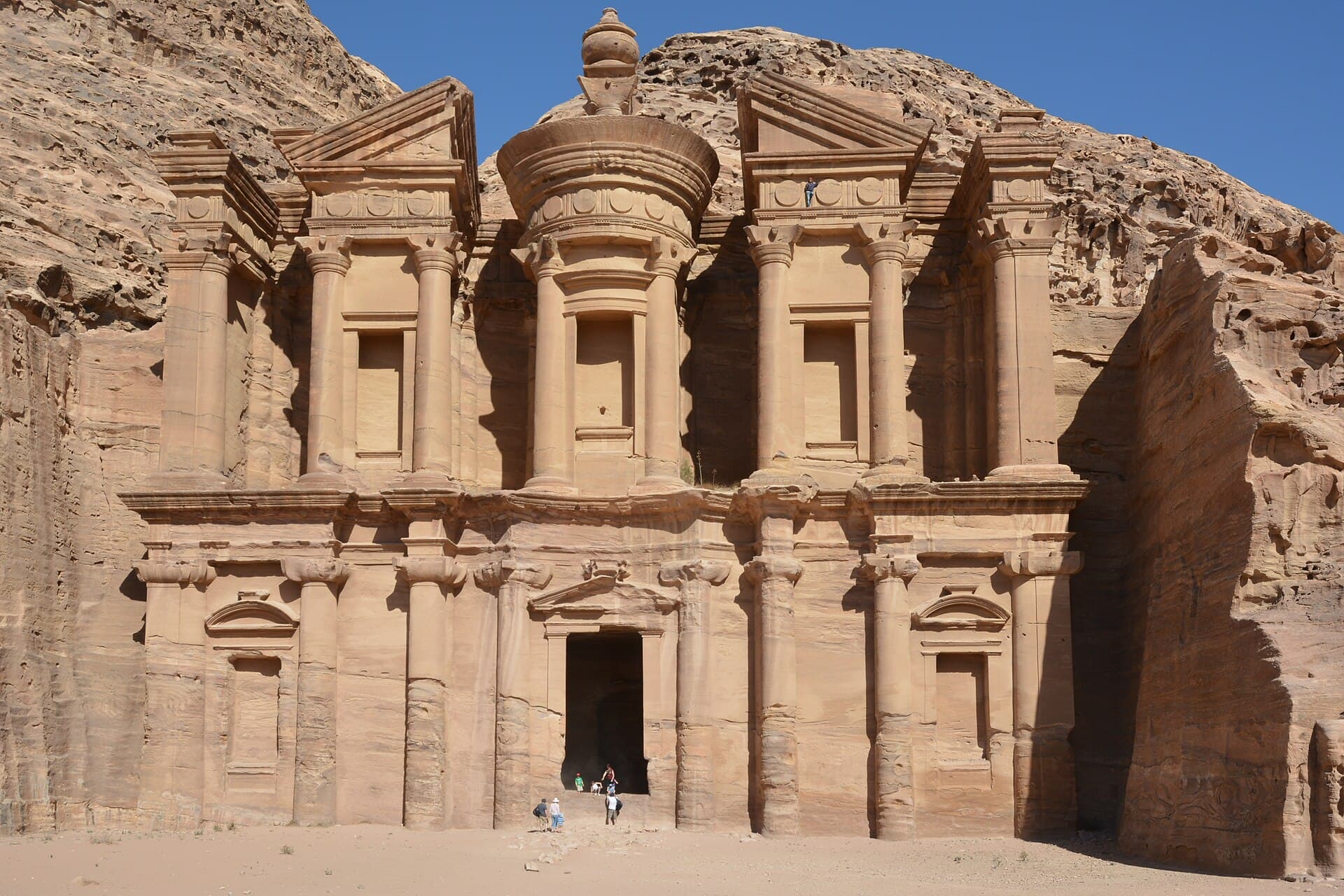
You walk the Siq to the Treasury with time to continue into the wider city.
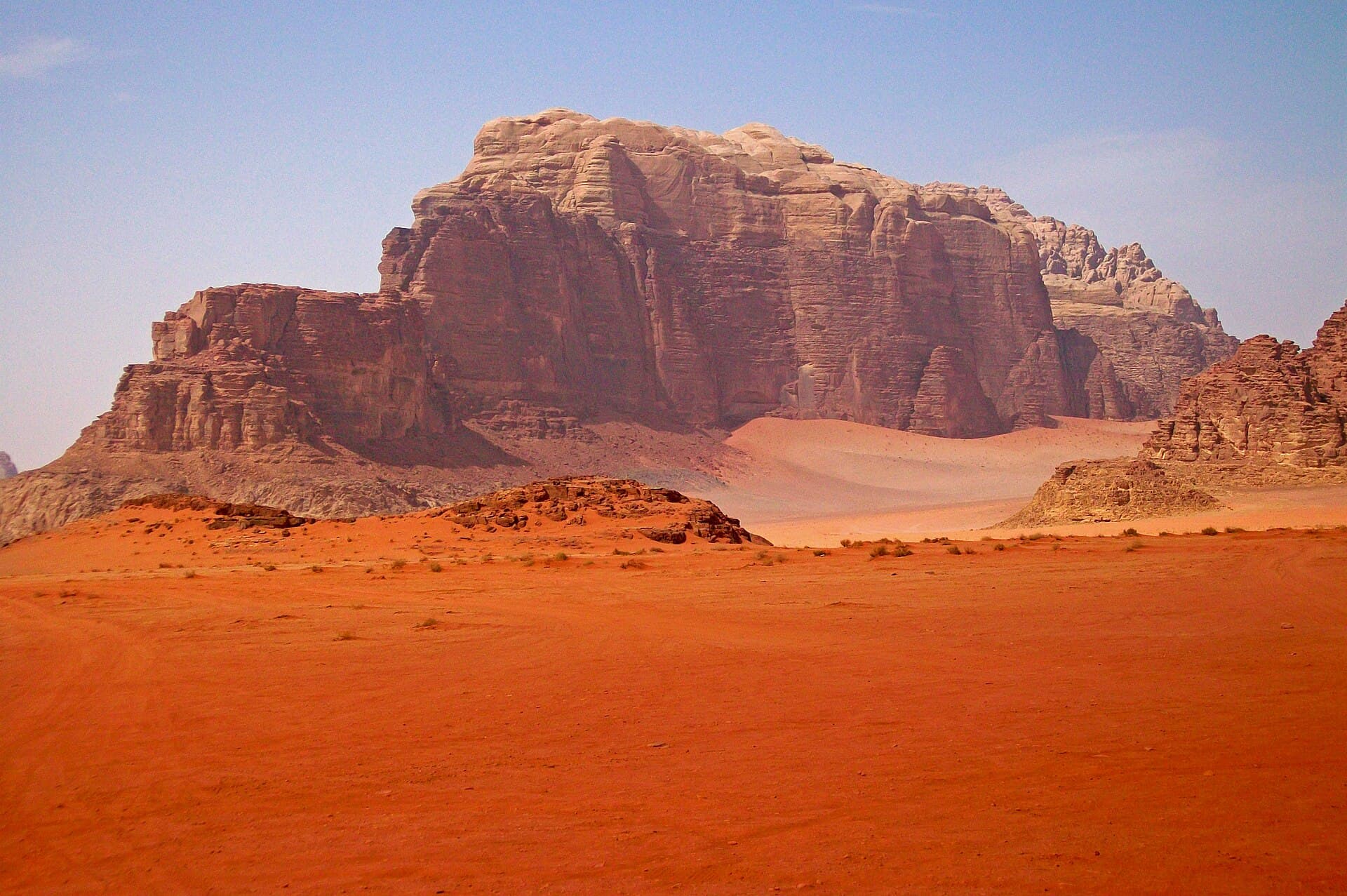
Wadi Rum is not a drive-through stop; you sleep at a camp among the sandstone mountains.

Your week begins at Cairo International Airport, where a representative meets you after immigration and baggage collection and walks you to your private transfer. The drive into the city is your first look at Cairo's scale: elevated highways, minarets between apartment blocks and, if traffic and the route allow, a glimpse of the Nile.
Arrival day is kept deliberately empty. With only three nights in Egypt before you fly on to Jordan, the most useful thing you can do tonight is rest, so that tomorrow's long day at Giza starts with full energy. Check in, unpack and take time to adjust to the clock if you have crossed several time zones.
If you land early and feel fresh, a short walk near your hotel or a relaxed dinner is a gentle way to meet the city. Your representative confirms tomorrow's pickup time and answers practical questions about money, SIM cards and what to wear on the plateau. Keep your passport handy for check-in, and note that the Egypt part of this trip is brief, so any Cairo extras you are curious about are best discussed now.
Today is the day most people picture when they think of Egypt. You start on the Giza Plateau, where the pyramids of Khufu, Khafre and Menkaure have stood on the desert edge for roughly 4,500 years. Rather than treating them as isolated monuments, your guide explains them as part of a funerary landscape of temples, causeways and the tombs of officials, and you move between viewpoints with time to ask questions and take photographs.
Next comes the Great Sphinx, carved from a ridge of limestone left by the ancient quarrymen and usually linked to the reign of Khafre. Seen from its side, the scale and the weathering of the stone make more sense than in any photograph.
The afternoon belongs to the Grand Egyptian Museum, a short drive from the plateau. Its galleries trace thousands of years of Egyptian history, and your guide helps you focus on the pieces that matter most in limited time rather than trying to see everything. Pyramid interiors and special galleries depend on separate tickets and the plan confirmed for your date, so mention any must-see items in advance. You return to your Cairo hotel by evening.


After the pharaohs, Cairo's later history. Your morning is spent in the older quarters of the city, visiting a selection of Coptic or Islamic landmarks chosen around opening times and your own interests. Some travelers want the churches of Coptic Cairo, others the mosques and madrasas of the medieval city; your guide shapes the order so the stories connect rather than blur together.
Later you follow the lanes around Al-Muizz Street, one of the oldest streets in Cairo, lined with domes, minarets and carved facades from many centuries. It leads into Khan el-Khalili, a market whose roots go back to the late Middle Ages. Here worship, trade and everyday life still share the same narrow spaces: coppersmiths at work, spice stalls, lantern shops and cafés where locals sit over tea.
Time for tea and browsing is part of the plan, not an afterthought. It is your last full day in Egypt, so this is the moment for souvenirs and for a final Cairo dinner. Pack tonight with tomorrow's flight in mind and keep liquids and valuables in the right bags. Modest clothing that covers shoulders and knees suits the religious sites you enter today.
This is a genuine travel day, and the itinerary treats it that way. After check-out you transfer to Cairo Airport for your flight to Amman, a short international flight that still involves airport check-in, security and immigration on both sides. Whether this regional flight is part of your booking is shown in your quote.
In Amman your Jordanian representative meets you and you continue south by private vehicle toward Petra. The road journey usually takes around three hours, depending on the route and stops, and the landscape changes from city outskirts to wide plateau and desert. A break on the way is a good chance to stretch and try Jordanian coffee.
You check into your hotel near Petra in the evening, and the rest of the day is yours. It is tempting to rush down to the site the moment you arrive, but Petra's first view is worth saving for a fresh morning with a full day ahead. Use tonight to confirm tomorrow's start time with your guide, charge your camera and lay out comfortable walking shoes, a hat and a refillable water bottle.
This is the day the whole trip has been building toward. You enter Petra on foot along the Siq, a narrow, winding gorge about a kilometer long, where the rock walls rise high on both sides and change color as the light moves. Look for the carved water channels along the walls: the Nabataeans, who built this city around 2,000 years ago, were masters at moving and storing water in the desert.
Then the gorge opens and the Treasury, Al-Khazneh, appears in front of you, its facade cut straight into the rose-colored cliff. Most visitors pause here for a long time, and you should too.
Beyond the Treasury, Petra keeps going: a street of facades, a theater carved from the rock, royal tombs set into the mountainside and the remains of a colonnaded city center. The archaeological park is far larger than its most photographed facade, so your guide discusses distances, the weather and your energy before deciding how far to go and whether a longer trail belongs in today's plan. Petra involves a long day of walking, much of it on sand and uneven stone. You return to your hotel in the late afternoon.
You leave Petra for Wadi Rum, a drive of under two hours to one of the most dramatic desert landscapes in the Middle East. Wadi Rum is a protected area, listed by UNESCO for both its natural and cultural value, and visitors explore it with authorized local operators, usually in four-wheel-drive vehicles driven by Bedouin guides.
Your excursion route is chosen to suit the weather and the protected-area rules. Expect sandstone and granite mountains rising straight out of red sand, narrow canyons, natural rock bridges and rock carvings left by travelers over thousands of years. The scale is hard to judge until you see a vehicle dwarfed against a cliff. This is the landscape associated with T. E. Lawrence, and it has stood in for other planets in several films.
By late afternoon you reach your desert camp, where the shifting light at sunset rewards anyone who simply sits and watches. Evenings at camp are quiet, and on a clear night the stars are remarkable away from city lights. Temperatures can drop quickly after dark, especially in winter, so keep a warm layer in your day bag. The camp, the vehicle and the length of the excursion are named in your quote.

Your last full day turns from desert to the long history of the Holy Land. You drive north from Wadi Rum, a substantial journey of several hours, toward Madaba, a market town known for its Byzantine mosaics. In the Church of Saint George you see the Madaba mosaic map, laid in the sixth century and one of the oldest surviving maps of the region, with Jerusalem shown in recognizable detail.
From Madaba it is a short drive to Mount Nebo, the hilltop traditionally identified as the place where Moses looked out over the Promised Land. The memorial church on the summit holds restored mosaics, and from the viewpoint the land falls away toward the Jordan Valley and the Dead Sea. On a clear day you may see far across the valley.
These places add a very different perspective from Petra's rock-cut architecture: early Christian art, pilgrimage and a sense of how many cultures have crossed this ground. Opening times, accessibility and the specific museum or church entries are confirmed for your departure. You continue to Amman and check into your hotel, keeping the evening easy after the long road. If you have energy, a walk for dinner is an easy way to see the capital.

Your trip ends in Amman rather than with a return to Egypt, which keeps this final morning simple. After breakfast at your hotel there is time to pack without hurry before you check out at the agreed time.
Your driver collects you for the transfer to the departure airport. If your flight leaves later in the day, ask in advance about a short extra stop such as the Amman Citadel or a coffee in the downtown area; anything beyond the transfer is arranged separately and only appears if it is in your confirmed booking. Late check-out is not included as standard, so mention your flight time when you book.
Before you travel, check your flight times, luggage allowance and any exit or transit rules for your passport, and keep a little Jordanian currency for small purchases at the airport if you like. Many travelers find this last morning a good time to look back on the week: three very different worlds in eight days, from the pyramids and the lanes of medieval Cairo to the rose-red rock of Petra, a night under the desert sky in Wadi Rum and the mosaics of Madaba.
Per person, two sharing. Prices are a starting point; your planner confirms the final price for your dates.
| Two sharing | $2,149 |
| Single room | $3,069 |
| Two sharing | $2,469 |
| Single room | $3,529 |
Cairo and Petra are most comfortable in the cooler months. In Wadi Rum the desert can feel much cooler after sunset, so plan for a wide swing between midday and evening at camp.
Bring sturdy walking shoes for Petra's stone paths and the Siq, a sun hat and sunglasses, and a warm layer for the desert evening. Modest clothing suits the religious sites in historic Cairo.
The pace is active, with early departures for flights and significant walking over uneven stone in Petra and Cairo. Your guide adjusts how far you go into Petra to your energy and the weather.
Day 4 is a genuine travel day: the flight from Cairo to Amman, then a road transfer south to Petra. Check your quote to see whether this regional flight is part of the booking.
You need entry permission for both Egypt and Jordan, and visas are not included. Entry rules depend on your passport and can change, so please check the official source before you travel.
Cards work in hotels; you will need cash in both Egyptian pounds and Jordanian dinars for tips, tea and small purchases. Gratuities and optional activities are not included, and tipping is customary.
It is enough for the headline sights if you accept a focused plan. Egypt gets three nights for Giza, the Grand Egyptian Museum and historic Cairo, and Jordan gets Petra, Wadi Rum, Madaba and Mount Nebo. It does not include Luxor, Aswan or the Dead Sea; for those, look at our longer Egypt and Jordan packages.
You fly from Cairo to Amman, where a Jordanian representative meets you, then drive south to Petra by private vehicle, usually around three hours. Whether the regional flight is ticketed by us or booked by you is shown in your quote, and the day is kept free of sightseeing so delays do not cost you anything important.
Yes, you need entry permission for Egypt and for Jordan, and visas are not included. Entry rules depend on your passport and can change, so please check the official source before you travel.
Expect a long day on foot. The Siq alone is about a kilometer each way, and the main monuments beyond the Treasury add more, much of it on sand and uneven stone. Your guide adjusts the route to your energy and the weather. Comfortable shoes with good grip, a hat and water make a big difference.
Camps range from simple Bedouin-style tents with shared facilities to more comfortable tents or domes with private bathrooms. The camp named in your quote decides which you get. Phone signal can be patchy, nights can be cold in winter, and most guests find the quiet and the night sky the highlight.
Spring and fall are the most comfortable for both Cairo and Petra, with October to April generally good for sightseeing. Summer brings strong heat at Giza and in Petra, while winter nights in Wadi Rum can be close to freezing. Whatever the month, start early and carry water.
Ending in Amman saves a second regional flight and a lost day. You fly into Cairo and out of Amman, so book an open-jaw international ticket. If you need to return to Egypt, tell us when you ask for a quote and we can plan the extra flight and night around it.


Photo credits: Petra — Azurfrog / Wikimedia Commons (CC BY-SA 3.0) · Wadi Rum — Daniel Case / Wikimedia Commons (CC BY-SA 3.0) · Madaba & Mount Nebo — Faris El-Gwely / Wikimedia Commons (CC BY-SA 4.0) · Jordan — Mohammad hajeer / Wikimedia Commons (CC BY-SA 4.0)
TALK TO A REAL LOCAL EXPERT
Book a free 30-minute consultation with one of our Egypt specialists. We’ll talk through your ideas, answer your questions and help you plan the perfect trip.
“We are here, plan your Egypt journey with people who know it best.”