About Petra
Petra is an ancient city carved into the red and rose sandstone cliffs of southern Jordan. Built by the Nabataeans, an Arab people who grew wealthy from the caravan trade in incense and spices, it is famous for its monumental tomb facades, its narrow entrance gorge and the sheer scale of a city cut directly from the mountains.
Petra is one of Jordan's best-known sites and a UNESCO World Heritage Site. It is not a single monument but a large archaeological landscape of tombs, temples, theaters, water channels and hilltop shrines spread across valleys and ridges. Most of what you see are facades: the Nabataeans carved their tombs and halls into the rock, while their houses, markets and many public buildings were built of stone and have largely collapsed or remain unexcavated.
You can see the main highlights in a long day, but Petra rewards time. With two or three days you can climb to the Monastery without rushing, walk the quieter trails to high viewpoints and hilltop shrines, and see the rock change color with the light. Many travelers who allow only a few hours leave wishing they had stayed longer.
History in brief
The Nabataeans were originally nomadic, and by the last centuries BC they had settled and made Petra their capital. They controlled trade routes linking southern Arabia with Egypt, Syria and the Mediterranean world, carrying frankincense, myrrh and spices, and taxing and protecting the caravans that passed through their territory.
Their greatest achievement may have been water management. In a dry, rocky landscape, Nabataean engineers carved channels, pipes, dams and cisterns that collected rainwater and spring water and directed it into the city. They also controlled flash floods, a real danger in narrow valleys, by building dams and diverting water away from the main approach.
The kingdom reached its height around the turn of the first century AD, when many of the grand monuments were carved. In AD 106 the Romans annexed the Nabataean kingdom under the emperor Trajan, and Petra became part of the province of Arabia. The city continued as a regional center, and a Roman colonnaded street, temples and baths were developed. Shifting trade routes and a major earthquake in AD 363 contributed to its decline. In the Byzantine period churches were built, and some tombs were adapted for Christian use.
Local Bedouin always knew the site, but it became known in Europe after the Swiss traveler Johann Ludwig Burckhardt visited in 1812, disguised as a traveler from the region. Excavation and research continue, and large parts of the ancient city are still unexplored. Petra was listed by UNESCO in 1985.
What to see
- Bab al-Siq: The open valley between the visitor center and the gorge holds the first monuments, including large carved blocks of rock known as the Djinn Blocks and the Obelisk Tomb, with four tall obelisks carved above its entrance.
- The Siq: The winding gorge, a little over a kilometer long, forms the main approach. Its walls rise high above you and in places close to a few meters apart. Look for the water channels cut into the walls and the remains of a carved relief showing a man leading camels.
- The Treasury (Al-Khazneh): The elaborately carved facade that appears through the last bend of the Siq is Petra's signature view. Despite its name, it was most likely a royal tomb or monument, and the name comes from a local legend that treasure was hidden in the urn at the top.
- The Street of Facades and the Theater: Beyond the Treasury, the valley widens into rows of tombs cut into the cliffs. The theater was carved from the rock by the Nabataeans and later enlarged, and it cuts through some older tombs.
- The Royal Tombs: A group of large facades on the mountainside, including the Urn Tomb, the Silk Tomb, the Corinthian Tomb and the Palace Tomb. The Silk Tomb is famous for its swirling bands of colored sandstone, and the Urn Tomb was later used as a church.
- The Colonnaded Street and Qasr al-Bint: The heart of the ancient city center, lined with columns, leads to Qasr al-Bint, one of the few freestanding buildings still largely standing and an important Nabataean temple. Nearby are the remains of the Great Temple complex.
- The Petra Church: A Byzantine church with well-preserved mosaic floors showing animals, the seasons and personifications. A cache of carbonized papyrus scrolls was found here in the 1990s.
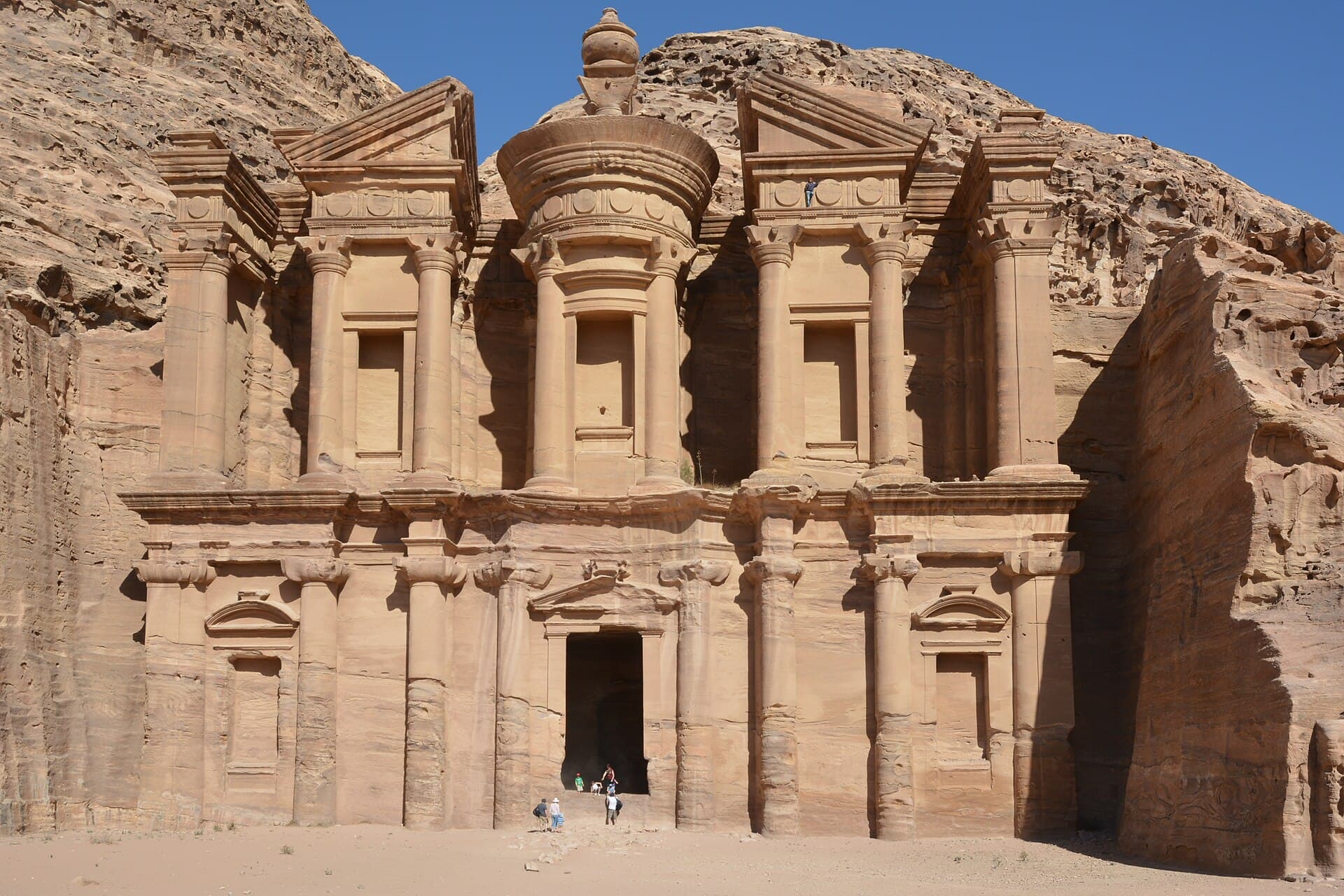
- The Monastery (Ad Deir): A huge facade reached by a long climb of several hundred rock-cut steps from the city center. It is larger than the Treasury and plainer in decoration, and the plateau in front of it offers wide views.
- The High Place of Sacrifice: A hilltop ritual site reached by a steep path near the theater, with altars cut into the summit and views over the whole valley. The descent on the other side passes quieter monuments.
Architecture and details worth noticing
Nabataean carving blends influences from across their trading world. The Treasury combines Greek-style columns and pediments with a round central structure and figures from the classical repertoire, while many simpler tombs carry the distinctive crow-step decoration, a stepped motif often linked to older Near Eastern traditions.
The facades were carved from the top down, which you can sometimes see in unfinished monuments. Notice too how the colors of the sandstone, from pink and red to yellow, white and violet, run in bands through the rock. Iron and other minerals create these patterns, and they are at their most vivid in the Royal Tombs.
Watch for the small details along the trails: niches for carved symbols of the gods, water basins, steps leading to tombs high above the path, and the remains of terracotta pipes that once carried water through the Siq.
How to get there
Petra sits beside the town of Wadi Musa in southern Jordan, roughly three hours by road from Amman and around two hours from Aqaba. You can drive the faster Desert Highway or the slower, scenic King's Highway, which passes Madaba, Kerak and Shobak castles along the way.
From Egypt, many of our guests fly from Cairo to Amman, or travel to Aqaba via the Taba area and the Red Sea. Staying overnight in Wadi Musa lets you enter early, before the day-trip crowds, and gives you the option of a second day for the Monastery or a hiking trail.
How long to spend and when to go
One full day covers the Siq, the Treasury, the main valley and either the Monastery or the High Place of Sacrifice. Two days let you do both climbs at a comfortable pace, and a third allows longer hikes. Entry arrangements, ticket types and evening programs change, so check current details before you travel. If you are flying into Jordan, ask us whether the Jordan Pass makes sense for your itinerary.
Spring and fall are the most comfortable seasons. Summer days are hot and the climbs are exposed to the sun, while winter can bring cold mornings, rain and, occasionally, temporary closures for flash flood risk. In any season, the first hours after opening are the quietest.
Tips from our specialists
- Start as early as you can. The Siq and the Treasury are at their quietest and coolest in the first hours of the day.
- Expect to walk a lot, often many kilometers on sand and stone. Sturdy shoes with good grip matter more than anything else you pack.
- Carry water, sun protection and a hat, especially from late spring to early fall. Drinks and snacks are sold inside, but carrying your own is easier.
- Animal rides are offered inside the site. If you use one, choose handlers whose animals look healthy and well cared for, and agree terms clearly in advance.
- Do the Monastery climb in the morning or late afternoon, when the steps are in shade for longer.
- Hire a guide for at least the first part of the visit. Many details in the Siq and along the main trail are easy to miss on your own.
Nearby sights to combine
- Little Petra (Siq al-Barid): A smaller Nabataean site a short drive north, with carved halls and a painted ceiling, much quieter than the main site.
- Wadi Rum: About two hours south, the red desert makes a perfect contrast to Petra, ideally with a night in a camp.
- Shobak and Kerak castles: Crusader-era castles on the King's Highway, easy to visit on the drive between Amman and Petra.
- The Dead Sea: A few hours north, a restful stop after the walking at Petra.
Frequently asked questions
How much walking is involved?
A lot. Walking from the visitor center through the Siq to the Treasury and on to the city center and back is already many kilometers, and the climbs to the Monastery or the High Place of Sacrifice add steep steps. Plan for a full and active day.
Is one day enough for Petra?
One day is enough to see the main highlights if you start early and keep a steady pace. Two days are better if you want to climb to the Monastery and the High Place without rushing.
What is inside the Treasury?
The Treasury's interior is a plain rock-cut chamber, and visitors are not allowed inside. The magic is in the facade and the moment you first see it from the Siq.
Can I visit Petra from Egypt?
Yes. You can fly from Cairo to Amman, or combine Petra with the Red Sea via Aqaba. We plan both routes as part of combined Egypt and Jordan trips.
Is Petra suitable for travelers with limited mobility?
The main trail to the Treasury is fairly level but long and sandy in places, and the climbs beyond are demanding. Tell us in advance, and we can plan a shorter route and suitable transport options where available.
Petra fits naturally into a combined Egypt and Jordan trip, with a short flight from Cairo to Amman or a crossing via Aqaba.