
A Dead Sea day that is really free
Two resort nights mean one whole day with nothing scheduled.
Tour Operator · Egypt, Jordan, UAE, Turkey and Morocco
Cairo and Luxor, then Petra and two resort nights at the Dead Sea
Cairo to Amman · 11 days
This is an 11-day Egypt and Jordan trip that combines the great monuments of Cairo, Giza and Luxor with Petra, then slows down for two nights at a Dead Sea resort. You get a full free day to float and rest before Madaba and Mount Nebo on the way to a last night in Amman. It suits couples and first-time visitors who want major sites without ending the trip exhausted.
Most Egypt and Jordan itineraries finish at a sprint. This one ends with two nights at the Dead Sea, a full day with nothing on the schedule except floating, resting and watching the light change over the water. It is the reward for everything that comes before it.
And a lot comes before it. In Egypt you see the Giza pyramids and the Grand Egyptian Museum, the medieval lanes of historic Cairo, then fly to Luxor for Karnak, Luxor Temple, the Valley of the Kings and Hatshepsut's temple. In Jordan you walk the Siq into Petra and spend a full day among its tombs and temples before heading north to the lowest point on land.
The last chapter is cultural again but gentle: the mosaic map of Madaba and the view from Mount Nebo on the way to a final night in Amman. The flight from Luxor to Amman may route through Cairo, so the crossing gets a whole day of its own. It is a trip of two tempos, discovery first and restoration last.
Two resort nights mean one whole day with nothing scheduled.

Two hotel nights give the East and West Banks a day each.

The mosaic map and the summit view come after the rest day.
The flight to Amman and the drive to Petra never cut into a visit.

Welcome to Egypt. A representative meets you after immigration and baggage collection and takes you by private vehicle to your hotel in Cairo. Whatever time you land, the city will be awake: Cairo is one of the great round-the-clock capitals of the world, and the drive in gives you a first taste of its energy.
This trip moves through two distinct phases, an active first week of monuments and a slower final stretch by the Dead Sea, so the opening day is about starting well rather than starting fast. Check in, rest after your flight and review tomorrow's meeting time with your representative.
If you arrive early and feel like it, a gentle walk near the hotel, a drink with a view or a relaxed dinner is a better first evening than squeezing a major museum into a travel day. Couples often enjoy a quiet first night before the busy days ahead. Your representative can answer practical questions about money, tipping, phone service and what to wear at the sites, and suggest a nearby restaurant for local dishes. Then sleep: tomorrow you meet the pyramids, and you will want to be wide awake for that.

Begin on the Giza Plateau, where the Great Pyramids stand within an ancient funerary landscape rather than as isolated monuments. The pyramid of Khufu, the largest, was built around 4,500 years ago, with those of Khafre and Menkaure completing the famous trio. You walk between viewpoints with time for questions and photographs, and your guide explains the temples, causeways and lesser tombs that surround the royal monuments.
The Great Sphinx guards the eastern edge of the plateau. Seen close up, its weathered limestone body tells its own story of age, sand and restoration, and your guide shares the debates about who carved it and when.
After lunch you continue to the Grand Egyptian Museum, a short drive from the plateau, which presents thousands of years of Egyptian civilization under one roof, including the treasures of Tutankhamun. Your guide chooses a route through the highlights so the visit stays rich without becoming exhausting; this is a trip that rewards pacing yourself early. Specific galleries, admission categories and any pyramid-interior visit depend on the ticketing plan confirmed for your date. In the evening you return to your hotel.


Cairo is far more than its ancient past, and today shows the city of churches, mosques and markets that grew over the last 2,000 years. In the morning you visit a selection of Coptic or Islamic landmarks in the older quarters, chosen according to opening times and your interests. Your guide helps you understand how each community shaped the city.
In the afternoon you follow the lanes around Al-Muizz Street, where centuries of domes, minarets and carved stone line a street that has been at the center of Cairo life since the city's medieval founding. It leads into Khan el-Khalili, where worship, trade and everyday life continue alongside centuries of architecture. Craftsmen hammer copper, shopkeepers call you in for a look at lanterns and textiles, and cafés serve tea and coffee to locals and visitors alike.
Time for tea and browsing is part of the day, not an afterthought. Bargaining is expected in the bazaar, and your guide can give you tips on doing it with good humor. Dress modestly for the religious sites, with shoulders and knees covered. This is your last full day in Cairo, so enjoy a final dinner in the city before the morning flight to Luxor.

A morning domestic flight carries you south to Luxor, built on the site of ancient Thebes, where the Nile cuts through a green valley between desert hills. After hotel check-in or a luggage drop, you visit the great temples of the East Bank as time and opening arrangements allow.
Karnak is the largest temple complex of ancient Egypt, a sprawl of pylons, courts, obelisks and sanctuaries dedicated mainly to the god Amun and enlarged over many centuries. Walking into its Great Hypostyle Hall, with column after column rising overhead, is one of the most memorable moments of any trip to Egypt.
The Avenue of Sphinxes once connected Karnak to Luxor Temple, and its restored stretches help you picture the great religious festivals that moved between them. Luxor Temple itself, in the heart of the modern town, is especially atmospheric toward the end of the day, when the stone glows in the low light.
This is a hotel night in Luxor, not a cruise embarkation day, so you have the comfort of a fixed room and the freedom to enjoy the evening as you like. The next day's pace can be adjusted to your arrival time.


Today you cross to Luxor's West Bank, the land of the dead in ancient Thebes. In the Valley of the Kings, pharaohs of the New Kingdom were buried in tombs cut deep into the hills, their walls painted with scenes and texts to guide the king through the night and into rebirth. The colors in some corridors remain remarkably bright.
The selection of open royal tombs changes for conservation, and some require separate tickets, such as the tomb of Tutankhamun. Your guide tells you what is open and helps you choose.
From the valley you continue to the memorial temple of Hatshepsut, one of the few women to rule Egypt as pharaoh. Its terraces rise toward a dramatic wall of cliffs, a striking example of architecture designed in harmony with landscape.
You then return to Luxor for an unhurried afternoon. Avoiding too many extra stops makes the painted chambers and temple terraces easier to appreciate and remember. Spend the time by the hotel pool, on a riverside terrace or in a quiet café. This is your last night in Egypt, so pack with tomorrow's flight to Amman in mind and keep documents within easy reach.

Today belongs to the journey between countries. The confirmed flight to Amman may connect through Cairo depending on timings, which is why the whole day is set aside for it. Our team plans the transfers with time to spare, and your quote shows whether the flights are ticketed as part of your booking.
In Amman your Jordanian representative meets you after arrival formalities, and a private vehicle takes you south to Petra. The road journey usually takes around three hours, crossing the high desert plateau. A short stop on the way is a good chance for a coffee and a stretch.
Check in and leave the evening free. However tempting it is to rush to the site gate, the first view of Petra's famous architecture is worth saving for a full morning rather than attempting the site after a long day of airports and roads. Have a relaxed dinner, confirm the start time with your guide, and prepare comfortable shoes, sun protection and water for tomorrow. This is also a good moment to think ahead: the more energy you spend in Petra tomorrow, the more welcome the Dead Sea will feel two days later.
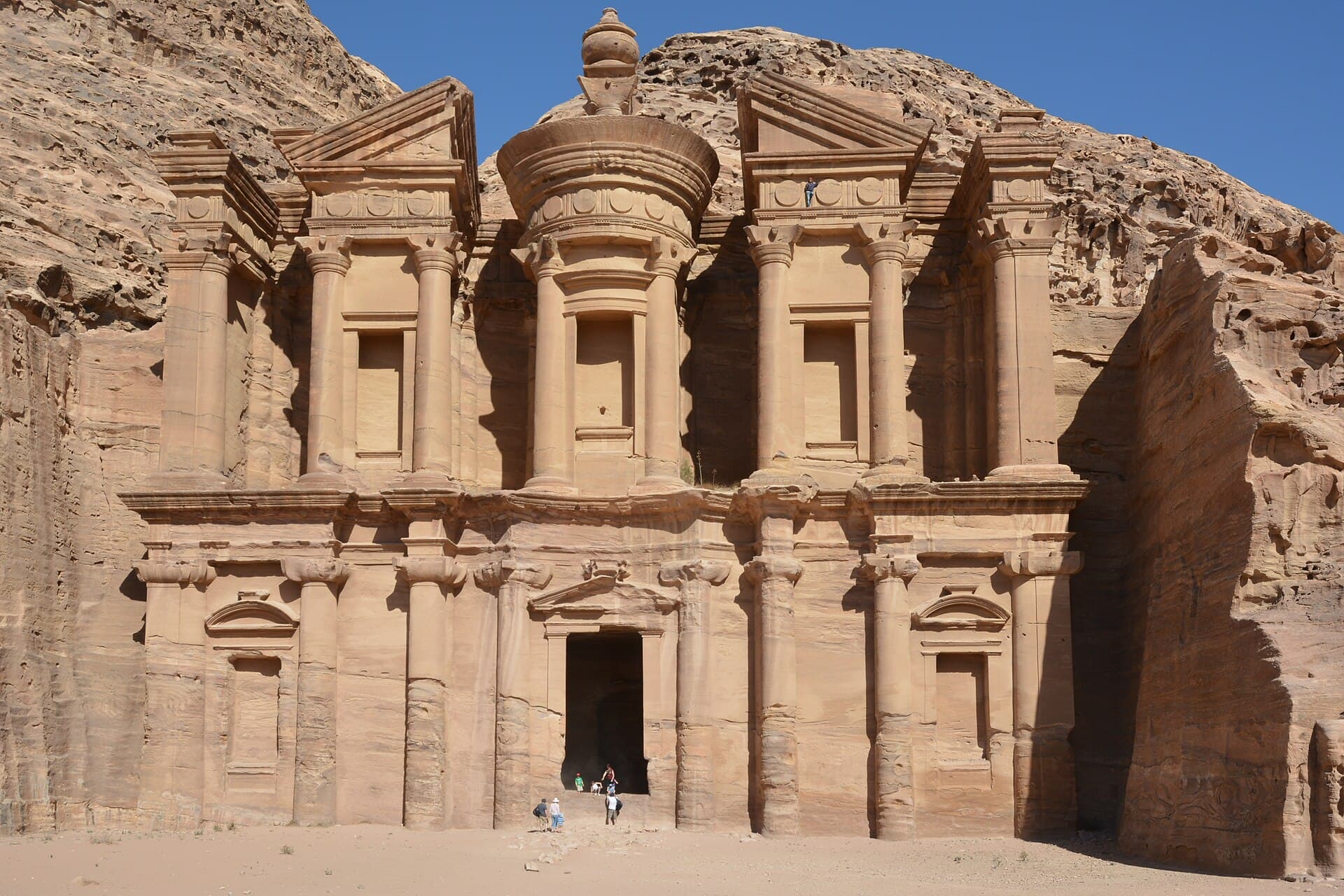
You enter Petra on foot through the Siq, a winding gorge about a kilometer long whose walls rise high and narrow above the path. The colors of the sandstone shift from pink to orange to deep red as you walk, and carved channels along the walls show how the Nabataeans brought water to their city around 2,000 years ago.
Then, at the end of the gorge, the Treasury appears, its facade carved directly into the cliff face. It is one of the great arrival moments in world travel, and you will want time simply to stand and look.
Beyond the Treasury, Petra unfolds into a wide valley of tombs, a theater cut from the rock, the Royal Tombs high on the mountainside and the remains of a colonnaded street and temples. Continue into the wider archaeological city as energy permits; the site is much larger than its most photographed facade. Your guide discusses walking distances, weather, access and whether any additional trail, such as the climb to the Monastery, belongs in today's plan. Expect several miles on sand and uneven stone. You return to your hotel in the afternoon, with the Dead Sea ahead.
Leave Petra after breakfast and head north toward the Dead Sea. The drive is part of the day, and depending on the routing chosen for your departure, it includes one substantial heritage stop at Mount Nebo or Madaba to connect Jordan's religious and artistic history with its landscape. Whichever comes first, Day 10 returns to this area on the way to Amman, so nothing is rushed.
As you descend toward the Jordan Rift Valley, the landscape changes dramatically. The road drops from the highlands to more than 400 meters below sea level, and the air becomes warmer and heavier. Watch for the first glimpse of the water, often hazy blue against the hills on the far shore.
Only one main stop is included before the resort check-in, so you arrive with time to settle in. Enjoy the evening at leisure: watch the sunset over the water from your resort, try a first float if the resort's beach and pools are open, or simply rest after the walking at Petra. Your resort, its beach access and its facilities depend on the property confirmed in your quote, and your representative can explain how to reach the shore safely.
Today has no schedule. Enjoy a complete day at your Dead Sea resort, with time to rest, take in the views and use the facilities included in your confirmed room plan. After a week of early starts, tombs and long walks, this slower day balances the walking at Petra and the road journeys elsewhere in Jordan.
The highlight for most guests is the float. The Dead Sea is so salty that you lie on the surface without effort, a strange and very relaxing feeling. A few simple rules help: enter slowly, keep the water away from your eyes and mouth, do not shave just before, float on your back rather than swimming, limit your time in the water and rinse off at the beach showers afterward. Many visitors also try the mineral-rich mud.
Optional spa treatments and additional excursions are quoted separately. Couples often book a treatment for the afternoon, while others read by the pool or walk the shore at sunset as the hills across the water turn gold and pink. Drink plenty of water; the low altitude and heat are dehydrating. Tonight is your second and last night by the Dead Sea.
After a restful day, you return to history for a gentle final chapter. Travel toward Amman via Madaba, a town famous for its Byzantine-era mosaics. In the Church of Saint George, you see the renowned Madaba mosaic map, laid in the sixth century and the oldest surviving map of the Holy Land, with Jerusalem clearly shown at its center.
Then continue to Mount Nebo, the hill revered as the place where Moses viewed the Promised Land. The memorial church on the summit preserves fine mosaics, and the terrace looks west across the Jordan Valley toward the Dead Sea you have just left. On clear days the view stretches a very long way.
These places add a different historical perspective from Petra's rock-cut architecture, and visiting them after a rest day means you can enjoy them fully. Opening times, accessibility and the selected museum or church entries need confirmation for each departure. Settle into the capital afterward, keeping evening plans light. A last dinner in Amman, perhaps with mezze and grilled dishes, is a fine way to close the trip.
Your journey ends in Amman. After breakfast, take your time packing and check out at the agreed time, then transfer to the airport for your flight home.
Please verify flight times, luggage allowance and any visa or exit requirements before travel, and allow for security checks at the airport. Extra hotel time, late check-out or an additional excursion is not included unless it appears in your confirmed booking, so mention your flight time when you book if you would like us to suggest options.
The day's schedule is shaped around a comfortable departure rather than new sightseeing, which suits the rhythm of this trip. You arrived in Cairo ready for adventure and leave Jordan rested, having stood before the pyramids, walked the temples and tombs of Luxor, followed the Siq into Petra and floated in the Dead Sea.
If you bought Dead Sea products or mud, check liquid rules for your luggage before you pack. And if one part of the trip left you wanting more, perhaps a Nile cruise to Aswan or a desert night in Wadi Rum, our other Egypt and Jordan journeys are a good place to start planning a return.
Per person, two sharing. Prices are a starting point; your planner confirms the final price for your dates.
| Two sharing | $2,919 |
| Single room | $4,179 |
| Two sharing | $3,499 |
| Single room | $4,999 |
October to April is the most comfortable season for Cairo and Luxor and a good time for walking at Petra. Most sites are outdoors, so carry water, a hat and sunscreen.
Walking shoes with good grip for Petra and uneven ground, light layers, and clothing that covers shoulders and knees for historic Cairo's landmarks. Pack swimwear for the Dead Sea.
Expect plenty of walking at outdoor sites and some early starts. Petra is entered on foot through the Siq, and the site is far larger than the Treasury, so pace yourself.
You fly from Cairo to Luxor, then on to Amman (the flight may route via Cairo), with a road transfer south to Petra. In Jordan you continue by road to the Dead Sea, Madaba and Amman.
Entry visas are not included. Entry rules depend on your passport and can change, so please check the official source before you travel.
Cards are accepted in hotels; keep cash for tips and small purchases. Tipping is customary, and gratuities are not included. Spa treatments and optional excursions at the Dead Sea are extra.
With one night you arrive late afternoon and leave the next morning, which barely leaves time for a float. Two nights give you a complete free day to rest, use the resort and recover from the walking in Petra. It is the main difference between this route and our faster packages.
Amman to Petra usually takes around three hours, Petra to the Dead Sea a few hours including one heritage stop, and the Dead Sea to Amman via Madaba and Mount Nebo is a shorter, easy day. Exact timings depend on routing, traffic and stops. All drives are by private vehicle.
Yes. Visas are not included, and you need entry permission for both countries. Entry rules depend on your passport and can change, so please check the official source before you travel.
Floating is safe for most people if you follow the resort's rules. Do not put your head under, keep the water out of your eyes, avoid it with fresh cuts or shaving, and limit each float to a short time. If you have a heart condition or high blood pressure, ask your doctor first.
Day 6 is a dedicated travel day: you fly from Luxor to Amman, possibly connecting in Cairo, and then drive south to Petra. No sightseeing is planned that day, so connections have room to spare. Your quote states whether these flights are ticketed by us and the routing.
Yes. The mix of busy discovery days and a free resort day suits couples who want to see the great sites but also have time together. Many add a spa treatment at the Dead Sea or a special dinner in Luxor. Tell us if you are celebrating, and we can suggest extras.
Bring light clothing that covers shoulders and knees, sturdy walking shoes for Petra and the tombs, a hat, sunglasses and high-SPF sunscreen. For the Dead Sea, pack swimwear, water shoes for the rocky shore and an old swimsuit if you try the mud. A light sweater helps for cool evenings.


Photo credits: Dead Sea — لا روسا / Wikimedia Commons (CC BY-SA 4.0) · Madaba & Mount Nebo — Faris El-Gwely / Wikimedia Commons (CC BY-SA 4.0) · Petra — Azurfrog / Wikimedia Commons (CC BY-SA 3.0)
TALK TO A REAL LOCAL EXPERT
Book a free 30-minute consultation with one of our Egypt specialists. We’ll talk through your ideas, answer your questions and help you plan the perfect trip.
“We are here, plan your Egypt journey with people who know it best.”