Giza · Egypt
Memphis
Continue your trip
Tour Operator · Egypt, Jordan, UAE, Turkey and Morocco
Giza · Egypt
Continue your trip
TALK TO A REAL LOCAL EXPERT
Book a free 30-minute consultation with one of our Egypt specialists. We’ll talk through your ideas, answer your questions and help you plan the perfect trip.
“We are here, plan your Egypt journey with people who know it best.”
Memphis was the capital of Egypt during the Old Kingdom and remained one of the country's most important cities for thousands of years. Today its remains lie beneath fields, palm groves and village houses around Mit Rahina, about 20 kilometers south of Cairo, and the part most visitors see is a compact open-air museum set in a garden.
It matters because many of the ancient sites around Cairo grew out of it. The pyramids of Giza, Saqqara and Dahshur are the cemeteries of this city, built on the desert edge above it. Seeing where Memphis stood helps you connect those monuments to the living capital, with its palaces, temples, workshops and harbors, that built them. Its colossal statue of Ramesses II is among the finest royal sculptures in Egypt.
Memphis also gave Egypt its name. Hut-ka-Ptah, the name of the city's great temple of Ptah and later of the city itself, passed into Greek as Aigyptos, and from there into many modern languages as Egypt.
Egyptian tradition credits the founding of Memphis to Menes, the king said to have united Upper and Lower Egypt around 3100 BC. Its location, close to where the Nile Valley opens into the Delta, made it a natural seat of power between the two halves of the country. The early city was known as Ineb-hedj, the White Walls, perhaps after its whitewashed fortifications. The name Memphis comes, through Greek, from Men-nefer, originally the name of the pyramid of the Sixth Dynasty king Pepi I at Saqqara, which was later applied to the city itself.
The city's great temple belonged to Ptah, the creator god and patron of craftsmen, worshipped alongside the lioness goddess Sekhmet and their son Nefertem. Memphite priests developed a theology in which Ptah created the world through thought and speech, a text preserved on the Shabaka Stone, now in the British Museum. Memphis was also the home of the sacred Apis bull, regarded as a living manifestation of Ptah; when an Apis died, it was embalmed here and buried in the Serapeum at Saqqara.
Even when kings ruled from Thebes, as in much of the New Kingdom, Memphis stayed a major administrative, military and religious center, and rulers such as Ramesses II built lavishly here. Later conquerors understood its importance. Alexander the Great visited Memphis and made offerings to the Apis bull, and Ptolemaic kings were crowned here in traditional Egyptian style. The decree recorded on the Rosetta Stone was issued by a council of priests at Memphis in 196 BC.
The city's decline came after the founding of Alexandria and, centuries later, of the Islamic capitals at Fustat and Cairo just to the north. Much of its stone was carried away for reuse, and Nile silt gradually covered what remained. Memphis and its cemeteries, from Giza to Dahshur, were inscribed together on the UNESCO World Heritage List in 1979.
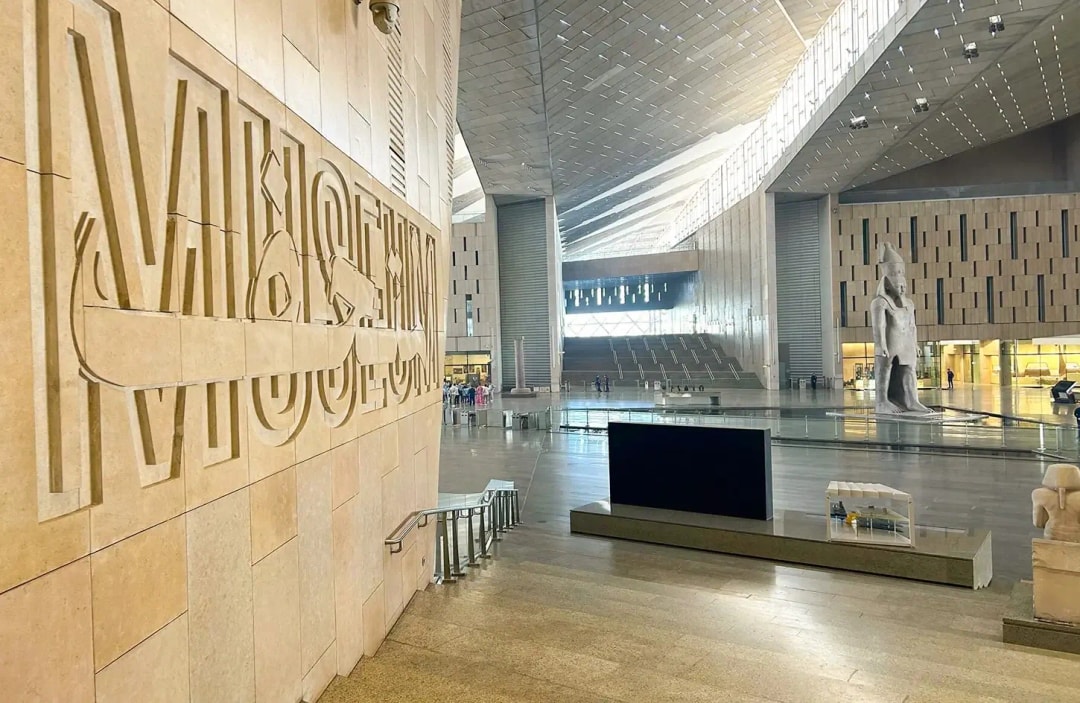
The colossus you see at Mit Rahina has a famous twin. In the early nineteenth century, excavators working near the temple of Ptah found this limestone statue and, nearby, a second colossal statue of Ramesses II in red granite. In 1955 the granite statue was raised in front of Cairo's main railway station, in the square that took the king's name, and in 2006 it was moved to Giza, where it now stands in the entrance hall of the Grand Egyptian Museum. If you visit both, you see two portraits of the same king carved in different stones, one lying in the old capital and one standing in the new museum.
Memphis rarely looks like a lost city because it was never left to the dry desert like the cemeteries above it. It lay in the floodplain, where mud brick dissolved, silt accumulated and villages grew over the ruins. Archaeologists have traced temples, palaces and districts across a wide area, including a palace of the Nineteenth Dynasty king Merenptah and remains of the great temple of Ptah, but much of the ancient city lies below the water table or under modern buildings. That is why the open-air museum focuses on sculpture rather than standing walls.
The sheer number of Ramesses II statues found here is itself a story. The king placed colossal images of himself at the gateways of the temple of Ptah, presenting himself to the god and to the people of the capital. Standing beside the fallen colossus, you can picture how these figures once towered over the processions that passed through the temple gates.
Mit Rahina lies about 20 kilometers south of central Cairo, on the west bank of the Nile, and only a few kilometers from Saqqara. The drive from Giza or central Cairo takes about 45 minutes to an hour depending on traffic, along roads lined with canals and palm groves that give you a glimpse of the farming countryside. A car and driver or an organized tour is the simplest way to get there, as public transport is not practical for visitors.
The open-air museum is small, and most visitors spend 45 minutes to an hour here. It is usually visited on the way to or from Saqqara rather than as a trip on its own. Mornings are best in the warmer months, from May to September, because the garden offers only partial shade; winter is pleasant at any time of day. Because many tours stop here at similar times, the site can be busy for short bursts and then quiet again, so a little patience often gives you the colossus hall almost to yourself. Check current opening hours and ticket prices before you go.
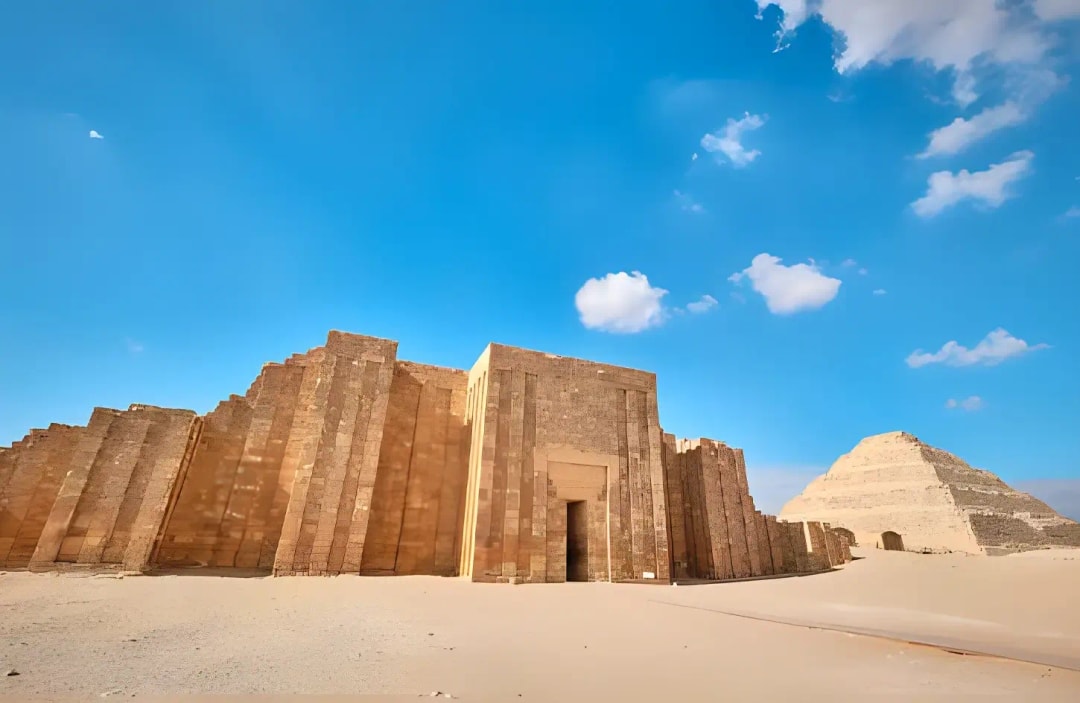
Saqqara, the city's main cemetery, is a short drive west on the desert edge, with the Step Pyramid of Djoser, the Serapeum where the Apis bulls embalmed at Memphis were buried, and the decorated tombs of Old Kingdom officials. Dahshur, a little farther south, adds the Bent and Red Pyramids of Sneferu. Together with Memphis, they make a full and varied day in the desert south of Cairo, and the Giza plateau and the Grand Egyptian Museum, where the granite colossus from Memphis now stands, complete the picture on another day.
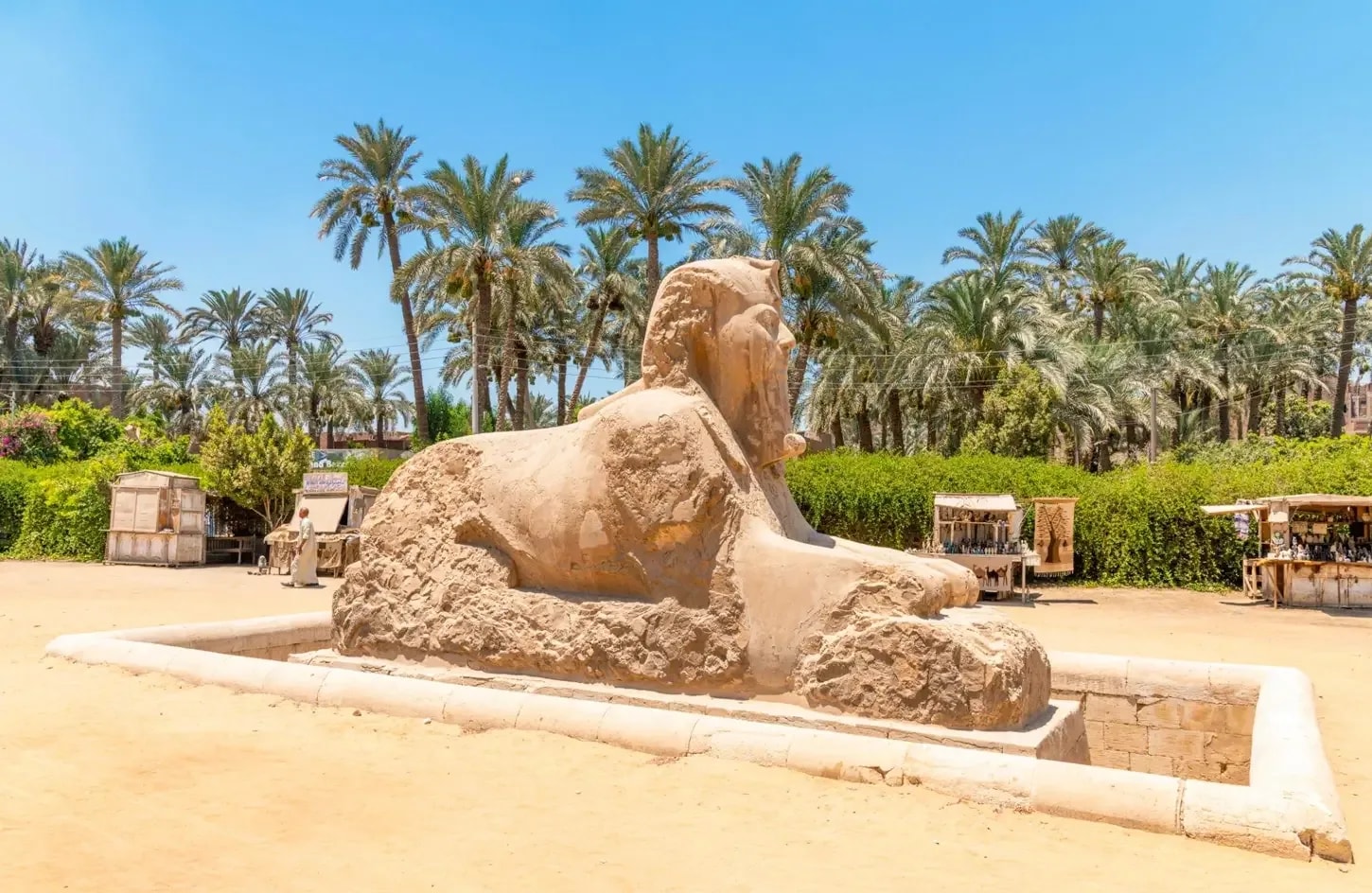
Most of the ancient city lies buried under fields, villages and Nile silt. What you visit is an open-air museum at Mit Rahina with a colossal statue of Ramesses II, a calcite sphinx and many sculptures and architectural pieces, along with excavated remains in the surrounding area.
It is worth a short stop, especially combined with Saqqara. The colossus of Ramesses II is one of the most impressive royal statues in Egypt, and the visit helps you understand the city behind the pyramids.
Memphis was the royal capital during the Old Kingdom, when the great pyramids were built. Giza, Saqqara and Dahshur are its cemeteries, so the kings and officials who lived and ruled here were buried in those monuments.
About 45 minutes to an hour is enough for the open-air museum. Most travelers combine it with Saqqara, and often Dahshur, on the same day.
The name comes through Greek from Men-nefer, originally the name of the nearby pyramid of King Pepi I, which came to stand for the whole city. Earlier, the city was known as Ineb-hedj, the White Walls.
Memphis is a short but meaningful stop that gives the pyramids of Cairo their city, and it fits easily into a day spent exploring the desert south of the capital.