Giza · Egypt
Saqqara & Step Pyramid of Djoser
Continue your trip
Tour Operator · Egypt, Jordan, UAE, Turkey and Morocco
Giza · Egypt
Continue your trip
TALK TO A REAL LOCAL EXPERT
Book a free 30-minute consultation with one of our Egypt specialists. We’ll talk through your ideas, answer your questions and help you plan the perfect trip.
“We are here, plan your Egypt journey with people who know it best.”
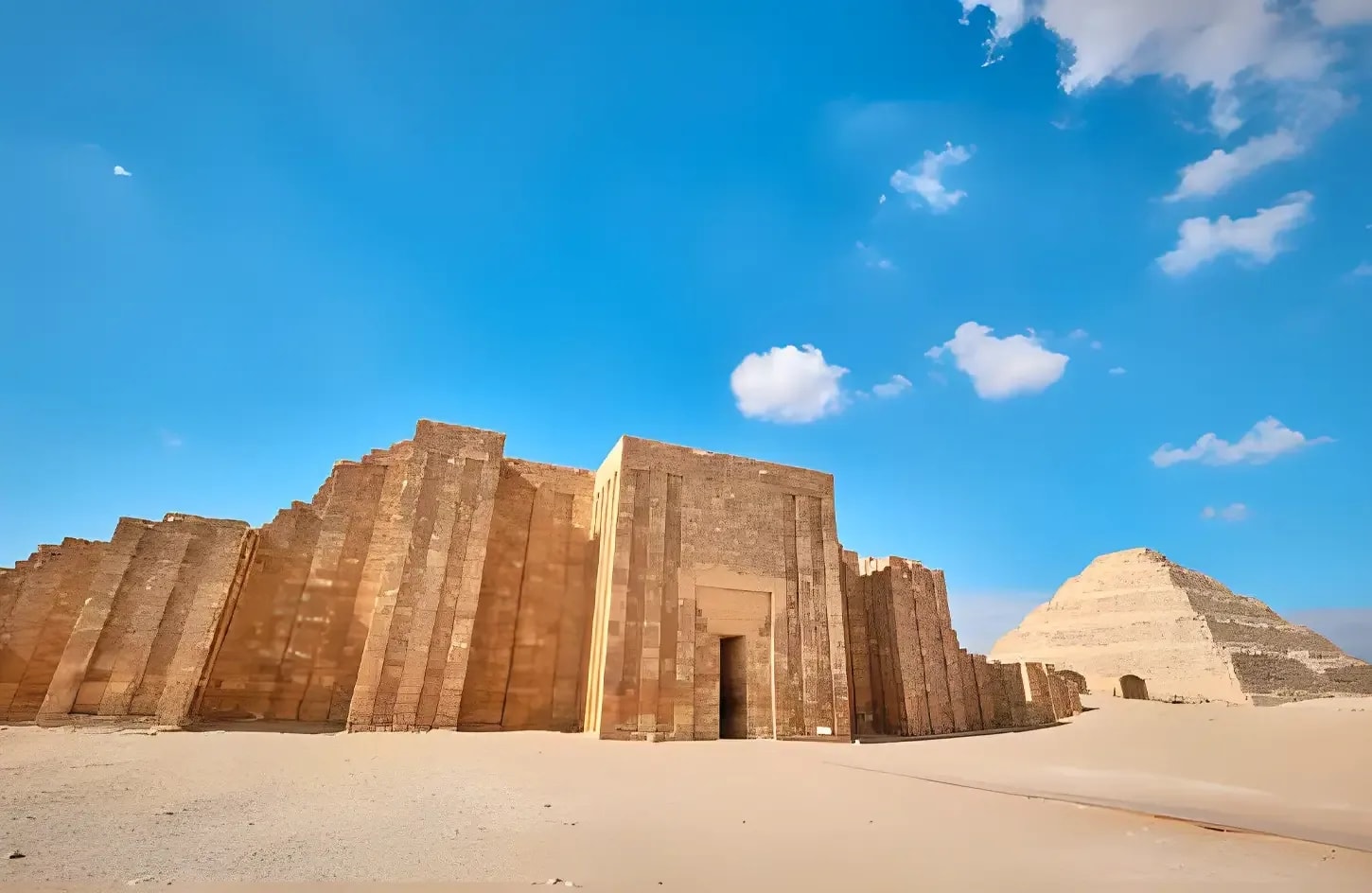
Saqqara is the vast burial ground of ancient Memphis, stretching for several kilometers along the desert edge south of Giza. At its heart stands the Step Pyramid of Djoser, built for a king of the Third Dynasty about 4,700 years ago and generally recognized as the earliest large-scale building made entirely of cut stone.
This is where the pyramid idea begins. Before Djoser, royal and elite tombs were low, flat-topped mastabas; here the design was stacked into six diminishing steps rising about 60 meters above the desert. Later Egyptians credited the work to Djoser's official Imhotep, whose name and titles appear on a statue base found at the site. He was remembered for centuries as a great sage and eventually revered as a god of healing.
Around the pyramid lie tombs from the earliest dynasties to the Roman era, along with animal cemeteries, temples and the ruins of a Coptic monastery, which makes Saqqara one of the richest archaeological sites in Egypt. Excavations continue every season, and new discoveries are still announced here regularly. Yet the site is usually far calmer than Giza, and you can often have a decorated tomb almost to yourself.
The earliest large tombs at Saqqara belong to the First Dynasty, when high officials built mud-brick mastabas along the edge of the plateau overlooking Memphis. In the Third Dynasty, Djoser's builders transformed this tradition. The Step Pyramid began as a square stone mastaba and was enlarged several times, first outward and then upward, until it became a pyramid of six steps. Around it they built a great enclosure with courts, chapels and shrines, all in stone, imitating structures that had previously been made of reeds, wood and mud brick.
Later kings mostly built their pyramids elsewhere, at Giza, Dahshur and Abusir, but several Fifth and Sixth Dynasty rulers returned to Saqqara. The Pyramid of Unas, the last king of the Fifth Dynasty, is small and ruined on the outside, but its burial chamber is carved with the Pyramid Texts, the oldest known collection of Egyptian religious spells for the afterlife, first recorded by modern scholars in 1881. Kings of the Sixth Dynasty, including Teti, followed his example, and their officials built richly decorated mastabas nearby.
Saqqara remained in use for about 3,000 years. New Kingdom officials built temple-like tombs here, including the one Horemheb prepared while he was still a general, before he became king and was buried in the Valley of the Kings. In the Late Period and the Ptolemaic era, the site filled with animal cemeteries holding millions of mummified ibises, cats, dogs and other creatures offered to the gods. The sacred Apis bulls of Memphis were buried in the Serapeum, a set of underground galleries rediscovered by the French archaeologist Auguste Mariette in the early 1850s.
Djoser's complex is a building of firsts. The enclosure wall is built with recessed niches, known as palace-facade paneling, and has many false gates but only one real entrance, near the southeast corner. Inside, the masons copied in stone the forms of earlier, perishable buildings: columns shaped like bundles of reeds, ceilings carved to look like rounded log beams, and doors cut permanently half open. You are looking at architects translating a familiar world of plant and timber construction into stone, apparently so that it would last for eternity.
Beneath the pyramid lies a maze of shafts and corridors, some once lined with blue-green faience tiles in patterns that recall reed matting. Examples of these tiles are now displayed in museums, and they show how colorful the hidden parts of the complex once were.
In the officials' mastabas, notice how the reliefs are organized in horizontal registers, read like strips of scenes. Short hieroglyphic captions record the workers' conversations and songs, small jokes and complaints that bring the Old Kingdom to life. Your guide can point out favorite scenes such as the hippopotamus hunt in the tomb of Ti, or the dancers and craftsmen in the tomb of Mereruka.
Saqqara lies roughly 30 kilometers south of central Cairo, about an hour's drive depending on traffic, and around 30 to 45 minutes from Giza. Public transport is not practical for visitors, so a private car with driver or an organized tour is the usual choice. The site is spread out, and you will drive between its main areas, from the Step Pyramid to the Serapeum and the Teti cemetery, so keep your car with you.
Plan around three hours to see the Step Pyramid complex, one or two mastabas and the Serapeum, or half a day if you want to see several tombs and the Imhotep Museum. Combined with Memphis and Dahshur, it fills a full day. Saqqara has very little shade, and the open desert heats up quickly, so morning visits are best from April to October, while winter days are ideal at almost any hour. Check current opening hours and ticket prices before you go, including any separate tickets for individual monuments, as the tombs that are open change from time to time.
Memphis, the city whose people were buried here, lies a few kilometers to the east in the valley at Mit Rahina. Dahshur, a short drive south, has the Bent Pyramid and the Red Pyramid of Sneferu, which show the next steps toward the true pyramid. North of Saqqara, the pyramids of Abusir are less often visited and worth adding if you have a special interest. Together with Giza, these sites let you follow the whole evolution of the pyramid in one or two days.
It is generally recognized as the earliest large-scale building made entirely of cut stone, and it is the first Egyptian pyramid. It marks the moment when royal tombs moved from flat mastabas to the monumental pyramid form that later reached its peak at Giza.
Imhotep was a high official of King Djoser, and later Egyptian tradition credits him with designing the Step Pyramid. Over the following centuries he was remembered as a sage and eventually revered as a god of healing.
The pyramid's underground chambers were restored and reopened in 2020, and visits inside are possible at times, sometimes with a separate ticket. Access can change, so check the current situation before you go.
The Serapeum is a set of underground galleries where the sacred Apis bulls of Memphis were buried, each in an enormous stone sarcophagus. It was used over many centuries and rediscovered by Auguste Mariette in the 1850s.
Yes. Giza shows the pyramid at its peak, but Saqqara shows where it began, and its decorated tombs offer something the great pyramids do not: detailed scenes of daily life carved more than 4,000 years ago.
Saqqara turns the pyramids from a single image into a story, and it rewards the extra day you give it on any trip to Cairo.