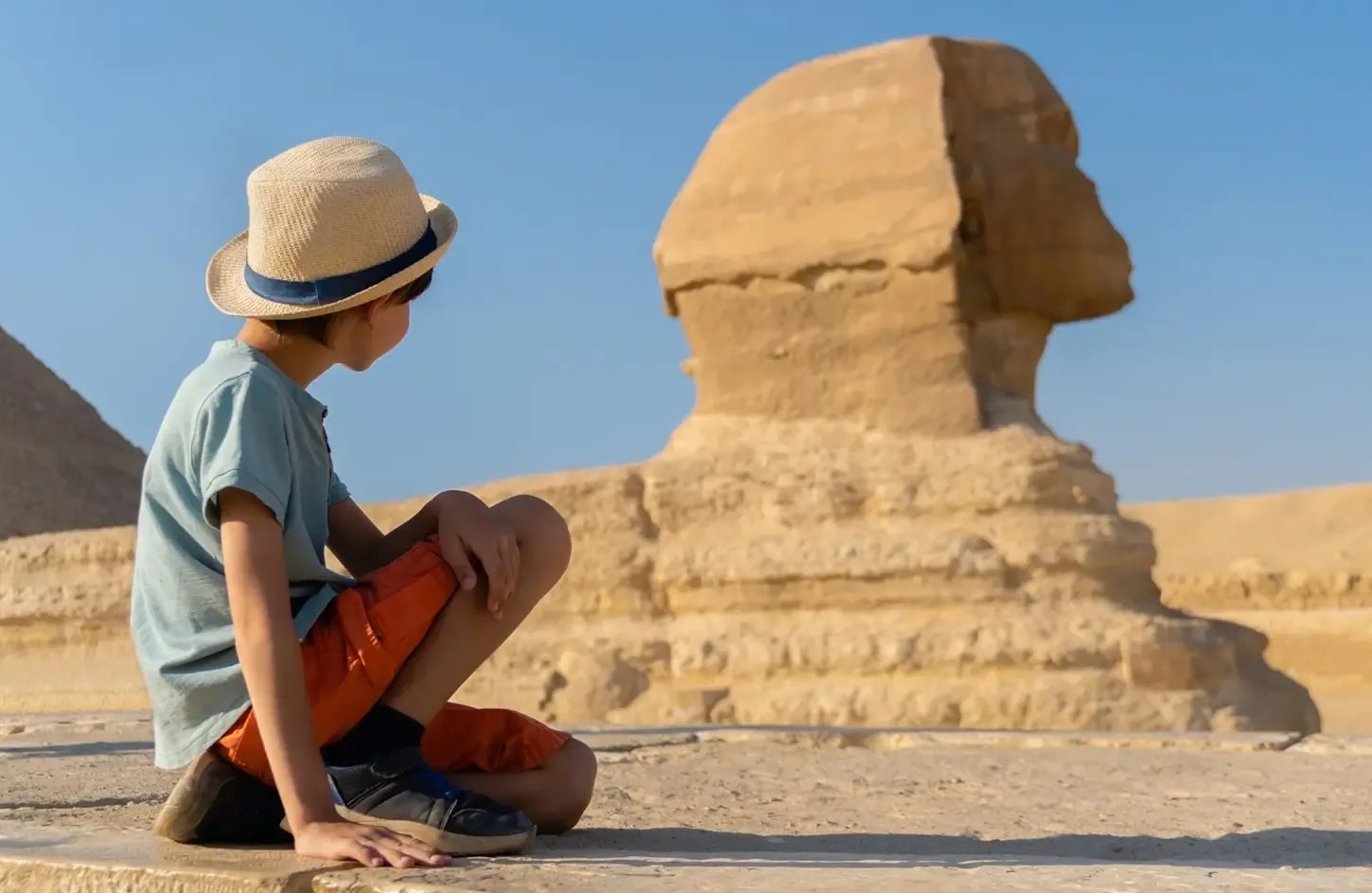
Giza · Egypt
Great Sphinx of Giza
Continue your trip
Tour Operator · Egypt, Jordan, UAE, Turkey and Morocco
Giza · Egypt
Continue your trip
TALK TO A REAL LOCAL EXPERT
Book a free 30-minute consultation with one of our Egypt specialists. We’ll talk through your ideas, answer your questions and help you plan the perfect trip.
“We are here, plan your Egypt journey with people who know it best.”
The Great Sphinx of Giza is a colossal figure with the body of a reclining lion and the head of a king, carved directly out of the bedrock at the foot of the Giza plateau. It faces east, toward the rising sun and the Nile Valley, and sits beside the causeway that once linked the valley edge to the Pyramid of Khafre. Measuring roughly 73 meters from paws to tail and about 20 meters high, it is one of the largest sculptures ever carved from a single mass of rock.
Most Egyptologists attribute it to Khafre, a king of the Fourth Dynasty, which makes it about 4,500 years old and places it among the oldest monumental sculptures in the world. The lion's body joined to a royal head expresses an idea at the core of Egyptian kingship: the king as a being of superhuman strength, guarding the sacred landscape around his tomb.
For many travelers, the sight of that weathered face with the pyramids rising behind it is the image that first drew them to Egypt. In person, what surprises people is how deeply the Sphinx sits in its hollow, below the level of the surrounding desert, and how alive the face still looks after 4,500 years of wind and sand.
The Sphinx was shaped from a knoll of rock that the builders left standing while they quarried limestone around it. The head was carved from a harder upper layer, which is why it has survived better than the body, cut from softer and more fragile beds. Blocks of masonry were later added to fill out and protect the paws and flanks. The king wears the royal nemes headdress, and the face is usually read as a portrait of Khafre, although no inscription from his reign names the statue, so this remains a well-supported attribution rather than a proven fact.
After the Old Kingdom, sand repeatedly buried the body up to the shoulders. In the New Kingdom, more than a thousand years after it was carved, the Sphinx gained new importance as an image of the sun god, worshipped as Horemakhet, Horus in the Horizon. Amenhotep II built a temple to it on the plateau, and his son Thutmose IV cleared away the sand and set up the Dream Stela between its paws. Its text tells how the young prince fell asleep in the statue's shadow, and how the Sphinx appeared to him in a dream, promising him the throne if he freed it from the sand.
Modern excavations in the nineteenth and twentieth centuries cleared the whole figure, and conservation campaigns since then have repaired the weathered limestone of the body, replacing crumbling patches of earlier repairs and treating the stone against damage from salts and groundwater.
The missing nose is a favorite topic. It is often blamed on Napoleon's soldiers, but drawings made in the eighteenth century, decades before the French expedition of 1798, already show it gone. The fifteenth-century historian al-Maqrizi wrote that the face was damaged deliberately in the fourteenth century, and marks of tools driven into the stone support the idea that the nose was removed on purpose. Pieces of a carved stone beard, probably a later addition, were found in the sand at the foot of the statue; one fragment is now in the British Museum.
The Sphinx has gathered stories for as long as people have looked at it. In the New Kingdom it became a place of pilgrimage, and visitors left small stelae dedicated to it, many of which were later found in the sand around the enclosure. Greek travelers wrote about it, and Arab writers called it Abu al-Hol, the Father of Terror, the name Egyptians still use today.
Modern theories also flourish, from hidden chambers beneath the paws to claims that the statue is far older than the Fourth Dynasty. Archaeologists have found no evidence for these ideas. The quarrying around the body, the Khafre temples built on the same alignment and the geology of the site all fit an Old Kingdom date.
The word sphinx itself comes from Greek. The Greek sphinx was a winged, riddle-asking female monster, quite different from the Egyptian figure, which was usually male, wingless and protective. Egyptian sphinxes with royal or ram heads later lined temple avenues, most famously at Karnak and Luxor, but none comes close to the scale of the one at Giza.
The Sphinx is part of the Giza plateau site, so your plateau ticket covers it. You can reach it from the pyramids above or from the lower entrance near the Valley Temple, which faces the Giza district of Nazlet el-Samman. From central Cairo the drive takes from half an hour to more than an hour depending on traffic, and the simplest options are a private car with driver, a taxi, a ride-hailing app or an organized tour.
Allow 45 minutes to an hour for the Sphinx, the Valley Temple and the viewing terraces, as part of a plateau visit of three hours or more. Because the Sphinx faces east, morning light falls on its face and is the best for photographs; by late afternoon the face is in shadow and the light comes from behind. The terraces get crowded from late morning, when coach groups arrive. The cooler months, from November to February, are the most comfortable; in summer, come early, as the hollow in which the Sphinx sits holds the heat.
The evening sound and light show uses the Sphinx as its narrator, with the pyramids lit behind it. If it interests you, check the current schedule and languages in advance, along with current opening hours and ticket prices for the plateau.
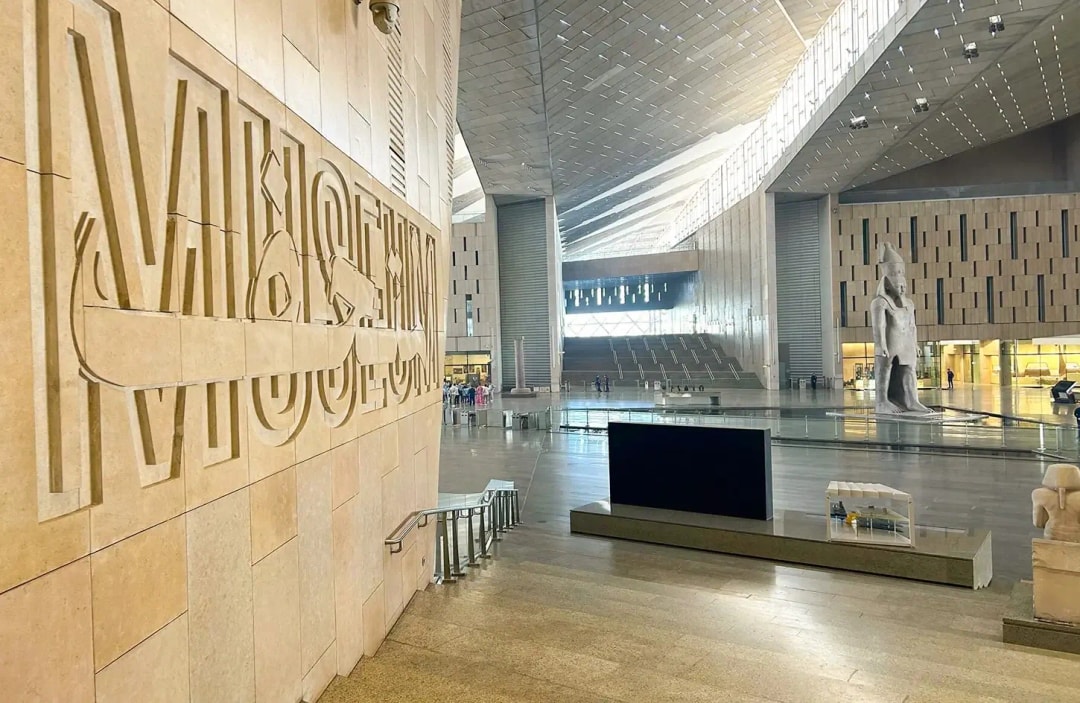
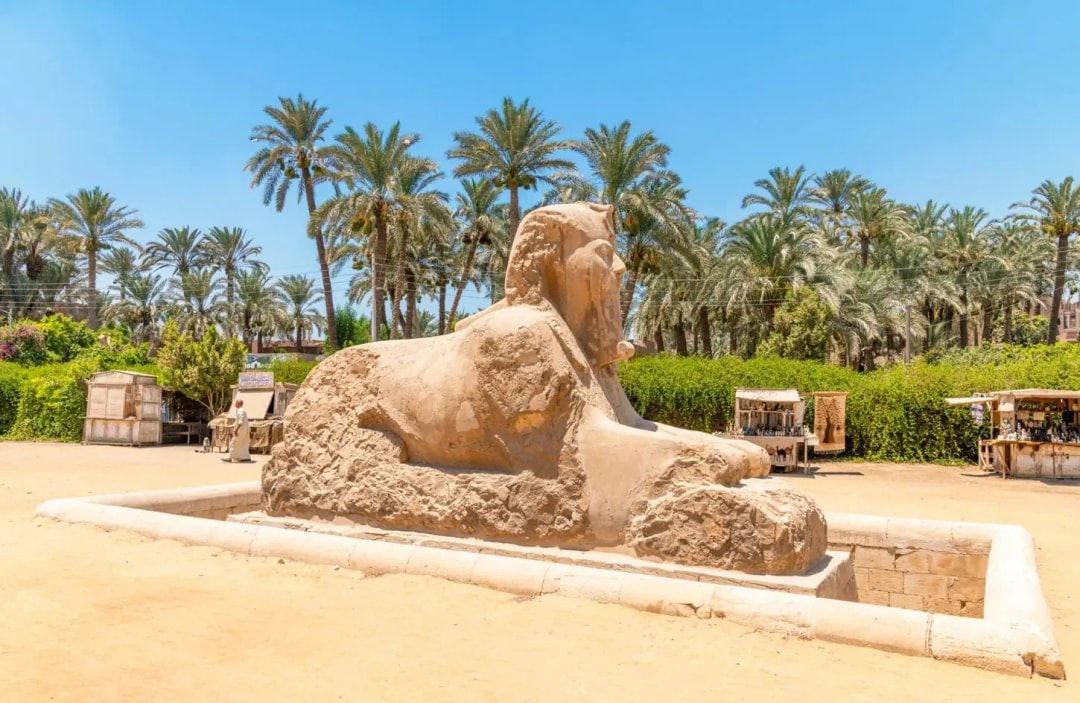
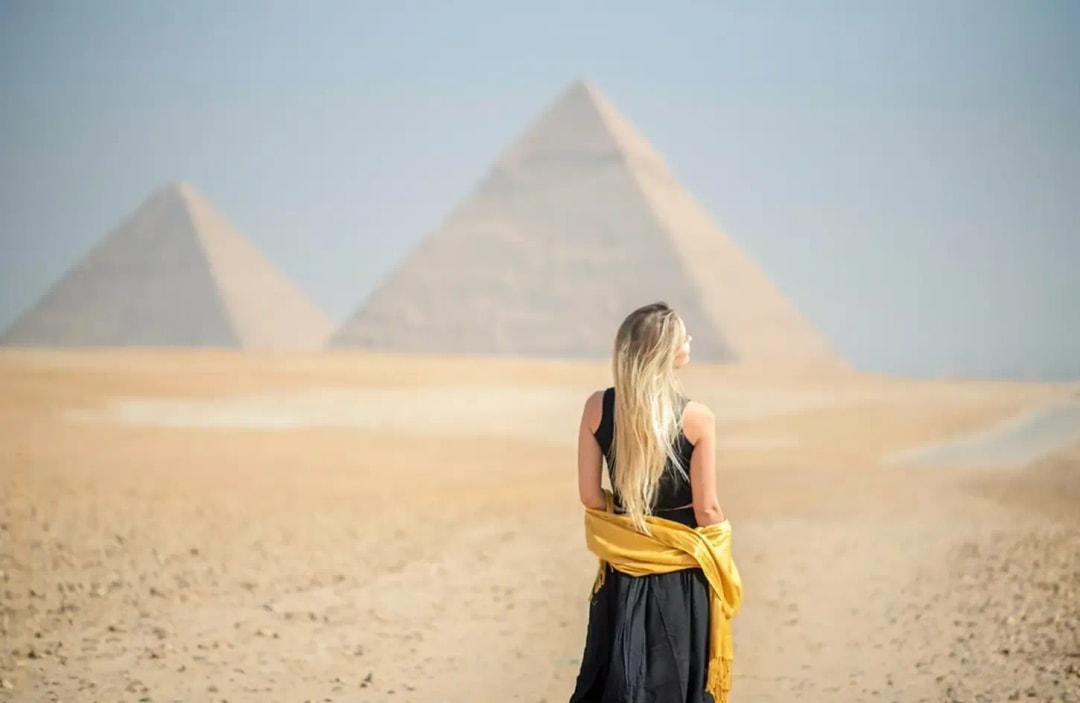
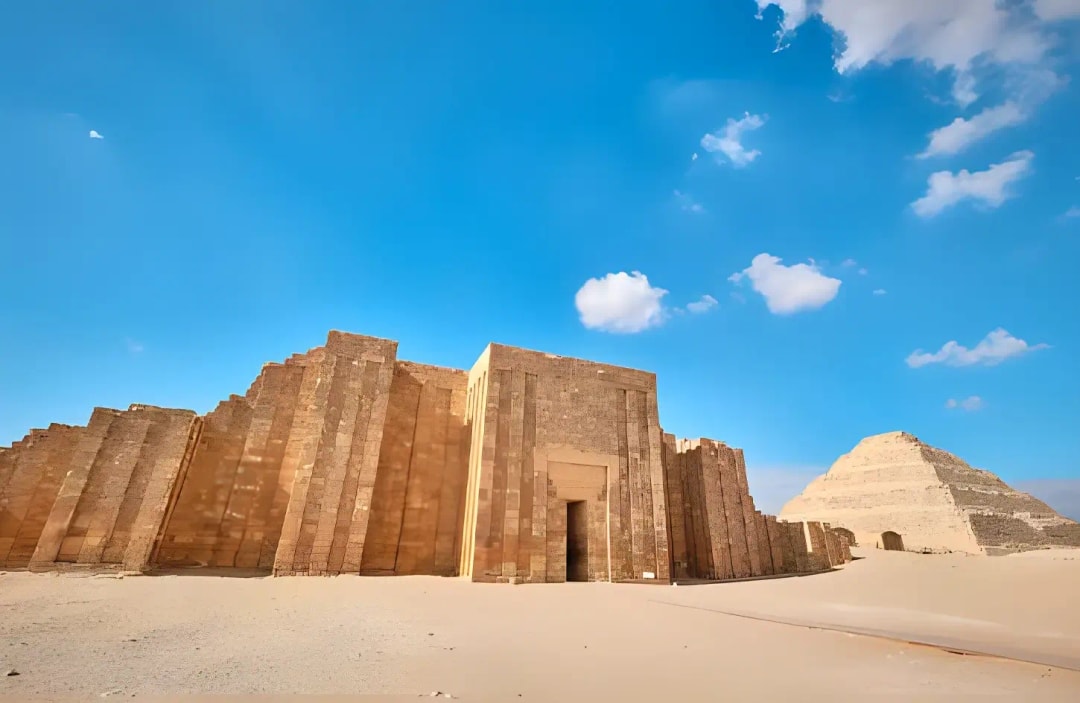
The pyramids of Khufu, Khafre and Menkaure rise directly above the Sphinx and are covered by the same ticket. The Grand Egyptian Museum is just a few minutes away by car and makes a good indoor continuation of the day, with the Tutankhamun collection and the Khufu boat. If you have a second day, Saqqara and Memphis, south of Giza, show you the earlier and later chapters of the same royal story.
Most Egyptologists attribute the Sphinx to King Khafre of the Fourth Dynasty, who also built the second pyramid at Giza. The strongest evidence is its position beside his valley temple and causeway, and the fact that it was carved in the same quarry that supplied stone for his temples.
It was removed deliberately long before modern times. Napoleon's soldiers are often blamed, but earlier drawings already show the face without a nose, and a medieval historian records an act of deliberate damage in the fourteenth century.
No. The enclosure around the body is closed to protect the fragile stone, and you view it from terraces beside and in front of it. These still bring you close enough to see the details of the face and the Dream Stela.
Yes, it is part of the Giza plateau site and covered by the general entry ticket. Separate tickets apply to pyramid interiors and to the evening sound and light show, so check current prices before you go.
It is an atmospheric way to see the plateau lit at night, and many travelers enjoy it as a relaxed evening outing. The narration is theatrical rather than scholarly, so think of it as a spectacle that complements, but does not replace, a daytime visit with a guide.
Standing before the Sphinx is the fitting end to a morning at Giza, and it gives you an image you will carry with you to every temple farther south.