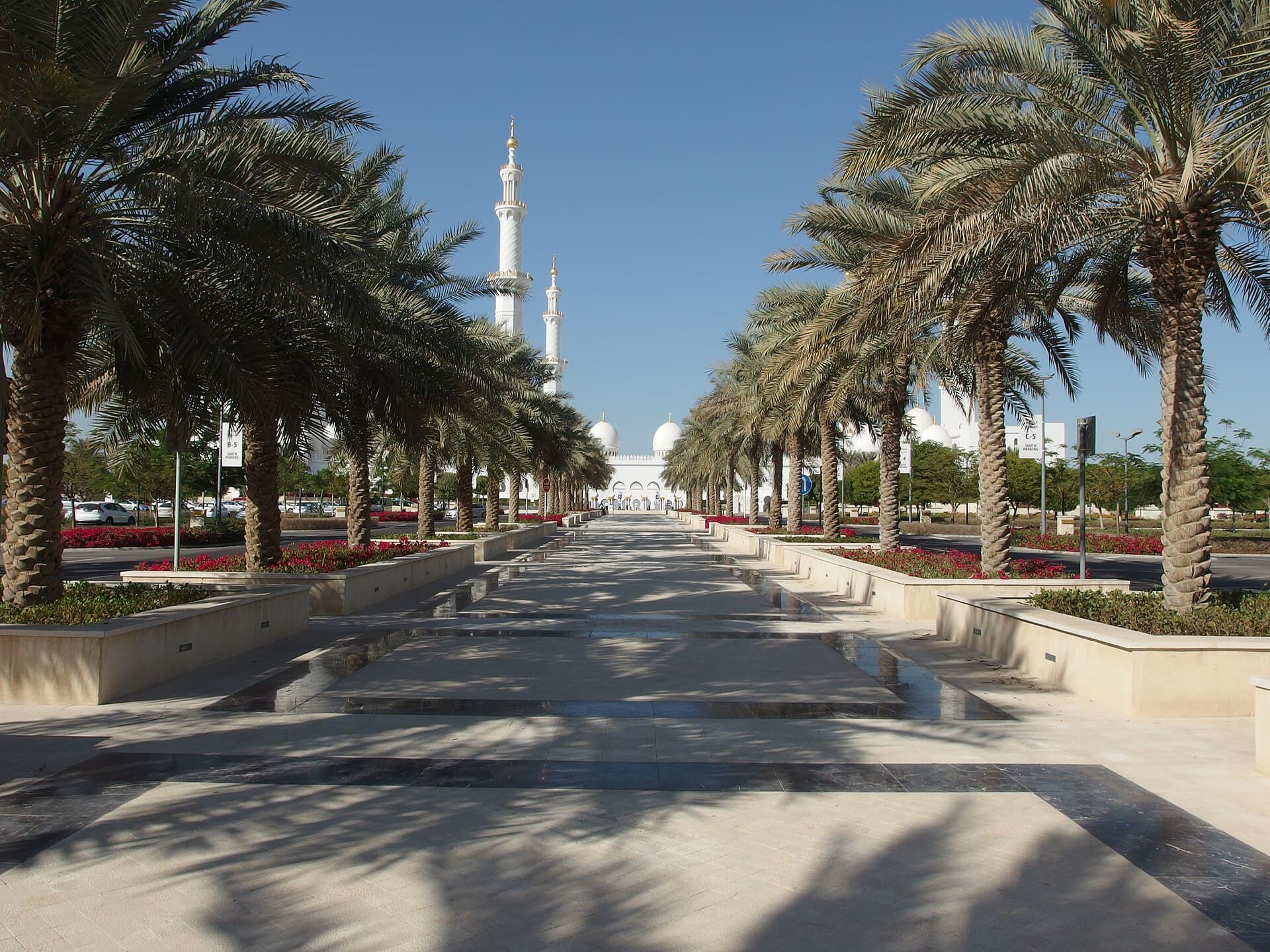
About Sheikh Zayed Grand Mosque
The Sheikh Zayed Grand Mosque is the largest mosque in the United Arab Emirates and one of the best-known landmarks in Abu Dhabi. Its white marble domes, four tall minarets, long colonnades and reflecting pools rise beside the main roads leading onto Abu Dhabi island, and it welcomes visitors of all faiths outside prayer times.
The mosque was conceived by Sheikh Zayed bin Sultan Al Nahyan, the founding president of the UAE, as a place of worship that would also bring together craft and design traditions from across the Islamic world. Artisans and materials came from many countries to create it. The result is both a working mosque, used for daily prayers, Friday prayers and the great Eid gatherings, and a cultural center that introduces visitors to Islam and Emirati heritage.
A visit is calm, beautiful and surprisingly educational. You walk through a vast marble courtyard, into a prayer hall filled with color and light, and past the resting place of the man who founded the country, all in the space of an hour or two.
History in brief
Sheikh Zayed became ruler of Abu Dhabi in 1966 and the first president of the UAE when the federation was formed in 1971. Planning for a grand mosque in the capital began under his leadership, and construction started in the 1990s. Sheikh Zayed died in 2004, before the mosque was complete, and he was buried in a mausoleum on its grounds. The mosque opened for worship in 2007.
The design draws on several traditions of Islamic architecture. Visitors often notice echoes of Mughal India in the domes, of Moorish Spain and North Africa in the arches, and of Persian and Ottoman decorative arts in the details. Rather than copying any single style, the designers combined them, which suits the founder's idea of a mosque that would represent the wider Islamic world.
Today the mosque is run by the Sheikh Zayed Grand Mosque Center, which manages visitor programs, free guided tours, a library of Islamic and Arabic works, and cultural events. At major prayers, the halls and courtyard together can hold tens of thousands of worshippers.
What to see
- The courtyard: A huge open space paved with white marble inlaid with large, flowing floral designs in colored stone. Its brightness at midday is dazzling, and its patterns are easiest to appreciate from the shaded arcades around the edge.
- The domes and minarets: The mosque has more than 80 white domes of different sizes, the largest rising over the main prayer hall, each topped with a gilded crescent finial. Four minarets mark the corners of the courtyard and are visible from far across the city.
- The columns and arcades: Hundreds of white marble columns line the colonnades, inlaid with mother-of-pearl and semi-precious stones in vine and flower designs. Many are crowned with gilded capitals shaped like palm fronds, a nod to the date palm so central to Emirati life.
- The main prayer hall: The floor is covered by a single hand-knotted carpet, among the largest ever made, woven in Iran by hundreds of weavers in sections and then joined on site. Above it hang huge chandeliers of colored crystal and gilded metal made in Germany, which cast a warm glow across the hall.
- The qibla wall: The wall facing Mecca carries the 99 names of God in gold calligraphy against white marble, softly lit from behind. The mihrab at its center, richly gilded, is the focal point of the whole hall.
- The reflecting pools: Long, shallow pools run along the arcades, tiled in deep blue, and mirror the columns and domes. They are especially lovely in the late afternoon and after dark.
- The founder's mausoleum: Sheikh Zayed's resting place lies on the grounds near the mosque. Visitors pass it at a respectful distance, and you should follow staff guidance on photography and behavior here.
- The evening lighting: After dark, a lighting design washes the white exterior in soft blue and gray tones that are designed to change with the phases of the moon, so the mosque looks slightly different from night to night.
Architecture and details worth noticing
Floral motifs appear everywhere, but you will find no images of people or animals, in keeping with mosque decoration. Notice how the same flowers recur in different materials: inlaid in the courtyard marble, set into the columns in stone and shell, woven into the carpet and repeated in the chandeliers and ceilings. This continuity is what makes such a large building feel unified.
Calligraphy runs through the mosque in several classical scripts, including Naskh, Thuluth and Kufic, mostly in the form of Quranic verses. Many visitors find the qibla wall the most moving part of the interior, as the names of God appear to float on the white surface. Notice also how the white stone, the water and the shaded arcades keep the building visually cool in a hot climate, a practical as well as an aesthetic choice.
A guide or the free mosque tour helps here. The architectural tours explain the meaning of features such as the minarets, the ablution areas, the mihrab and the prayer orientation, and the guides are used to answering questions from visitors of every background.
How to get there
The mosque stands near the bridges that carry the main highways onto Abu Dhabi island, a short drive from the city center and from Abu Dhabi International Airport. From Dubai, the drive takes around an hour and a half, depending on traffic and where you start, which makes it a popular day trip. Taxis are the simplest option; public buses also serve the area. Visitors usually enter through an underground visitor center with shops and cafes, then walk up into the courtyard.
How long to spend and when to go
Allow one and a half to two hours, including security, the dress-code check, the walk through the visitor center and time in the courtyard and prayer hall. Add time if you join a guided tour.
Late afternoon is ideal. You see the mosque in daylight, watch the marble turn golden at sunset and stay as the evening lighting comes on. Mornings are quieter but can be very hot in summer, when the marble courtyard reflects the heat. The cooler months, roughly November to March, are the most comfortable and the busiest. Visitor access pauses during prayers, Friday arrangements differ from other days, and hours change during Ramadan, so check current hours, booking requirements and rules before you go.
Tips from our specialists
- Follow the dress code carefully. Wear loose, long clothing that covers your arms and legs, and nothing tight, short or see-through. Women should cover their hair. Visitors who are not dressed appropriately may be refused entry, so do not rely on borrowing clothes at the gate.
- Register or book your visit in advance through the official channels. Entry is free.
- You will remove your shoes before entering the prayer hall, so wear shoes that are easy to slip off.
- Behave as you would in any place of worship: speak quietly, do not touch the Quran stands, avoid public displays of affection, and do not eat or smoke on the grounds.
- Photography is allowed in most visitor areas, but be respectful of worshippers, avoid posed or playful photos, and follow any signs or staff instructions.
- Stay hydrated in the warmer months, and bring sunglasses for the bright courtyard.
- Join a free guided tour if the timing works. It adds real depth to what you see.
Nearby sights to combine
Across the road, Wahat Al Karama is a striking memorial to Emirati service members, with a reflective pool and large leaning panels. Qasr Al Watan, a working presidential palace open to visitors, shows Emirati governance and heritage in a richly decorated setting. On Saadiyat Island, the Louvre Abu Dhabi, opened in 2017 under a vast latticed dome designed by Jean Nouvel, displays art from many civilizations, including ancient Egyptian pieces. Also on Saadiyat, the Abrahamic Family House brings a mosque, a church and a synagogue together on one site. In the city center, Qasr Al Hosn, a restored fort, tells the story of Abu Dhabi before oil, and the Corniche is pleasant for an evening walk.
A full day might start at the Louvre Abu Dhabi, continue to Qasr Al Watan after lunch and finish at the mosque for sunset and the evening lighting.
Frequently asked questions
Is the mosque free to visit?
Yes, entry is free, but you are expected to register or book a time in advance through the official channels. Booking arrangements change from time to time, so check before you go.
Can non-Muslims visit?
Yes. Visitors of all faiths are welcome outside prayer times, as long as they follow the dress code and the etiquette of a place of worship.
What should I wear?
Loose, long clothing covering your arms and legs. Women should also cover their hair, and clothing should not be tight, short or see-through.
Can I take photos?
Photography is generally allowed in visitor areas. Be discreet around worshippers and near the mausoleum, and follow staff instructions.
Can I visit from Dubai in a day?
Yes. The drive takes around an hour and a half each way, so a day trip can easily include the mosque and one or two other Abu Dhabi sights.
Abu Dhabi pairs well with an Egypt trip, often as a day out from a Dubai stopover on the way home, and the mosque is a visit many travelers remember.