Luxury Dahabiya
| Two sharing | $2,990 |
| Single room | $4,190 |
Where you stay
- Cairo · 3 nightsSofitel Downtown Nile (or similar)
- Nile cruise · 4 nightsAyla Dahabiya (or similar)
- Cairo · 2 nightsSofitel Downtown Nile (or similar)
Tour Operator · Egypt, Jordan, UAE, Turkey and Morocco
10 days / 9 nights · Egypt
to · 10 days
A 10-day luxury Egypt tour that pairs Cairo's pyramids with a four-night dahabiya sailing from Luxor to Aswan, in the spirit of Amelia Edwards' 1873 voyage. You fly to Luxor, sail past Edfu and Kom Ombo on a small two-sail boat, visit Philae and Abu Simbel, then fly back to Cairo. A private Egyptologist and both domestic flights are included.
Your trip starts when you land at Cairo International Airport. Make your way to Sofitel Downtown Nile (or similar), a 5-star hotel on the river in central Cairo, and check in. After a long flight, the rest of the afternoon is yours to rest, unpack and adjust to the time difference.
This evening, dinner is included, either at the hotel or at a local restaurant nearby. It is a good first taste of Egyptian cooking: mezze plates, grilled meats, rice and fresh bread are typical.
Your Egyptologist confirms the plan for the coming days and tomorrow's start time. The first full day heads south of the city to Saqqara and Dahshur, so an early night is a sensible choice. Keep some Egyptian pounds in small notes for tips and small purchases, and drink bottled water from the start.
Today you see where pyramid building began. After breakfast your guide drives you south of Cairo to Saqqara, the burial ground of the ancient capital Memphis. The Step Pyramid of Djoser stands at its center. Built about 4,700 years ago from six stacked layers of stone, it is often called the first large stone building in the world, and your Egyptologist explains how it led to everything that followed.
Next comes Dahshur, a quieter site with far fewer visitors than Giza. Here you see two pyramids built for King Sneferu. The Bent Pyramid changes angle halfway up, a sign that its builders corrected their design mid-construction. The Red Pyramid nearby was the first true smooth-sided pyramid.
Lunch is at a local restaurant, and you return to your Cairo hotel in the late afternoon. Wear closed shoes: the ground at both sites is sandy and uneven.
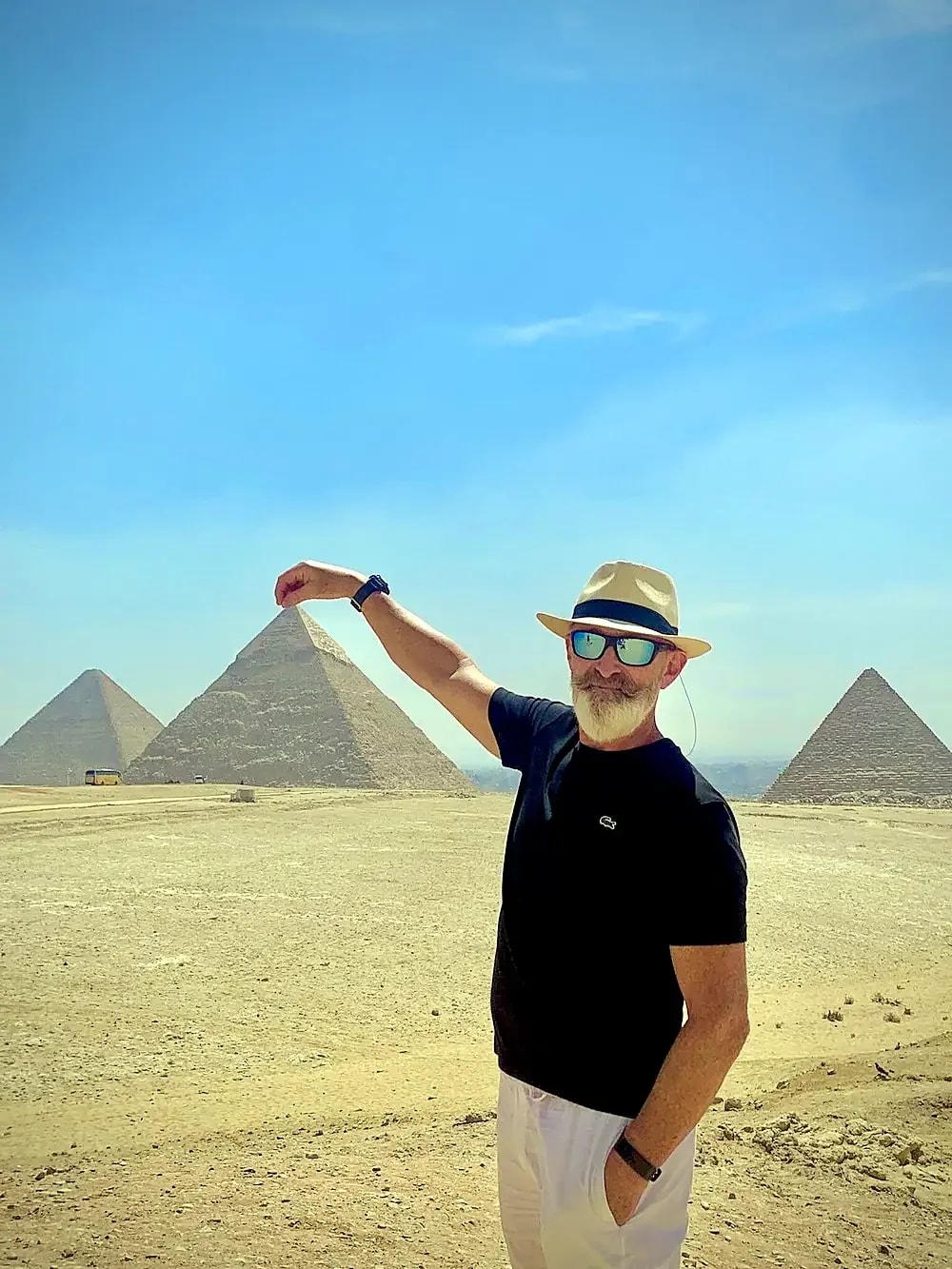
This morning is for the Giza Plateau. With your Egyptologist you walk around the Great Pyramid of Khufu, then the pyramids of Khafre and Menkaure. Seen up close, the scale of each stone block makes more sense than any photo. Your guide covers how the pyramids were built and why.
You then go down to the Great Sphinx, carved from the bedrock of the plateau, and the Valley Temple beside it, where the king's body was prepared before burial. The granite pillars here are some of the best-preserved stonework at Giza.
After lunch, you visit the Grand Egyptian Museum, a short drive away. Your guide leads you through the main halls and the Tutankhamun collection, where the young king's burial treasures are displayed together. You return to your hotel in the evening. Pack tonight: tomorrow you fly south to join the dahabiya.
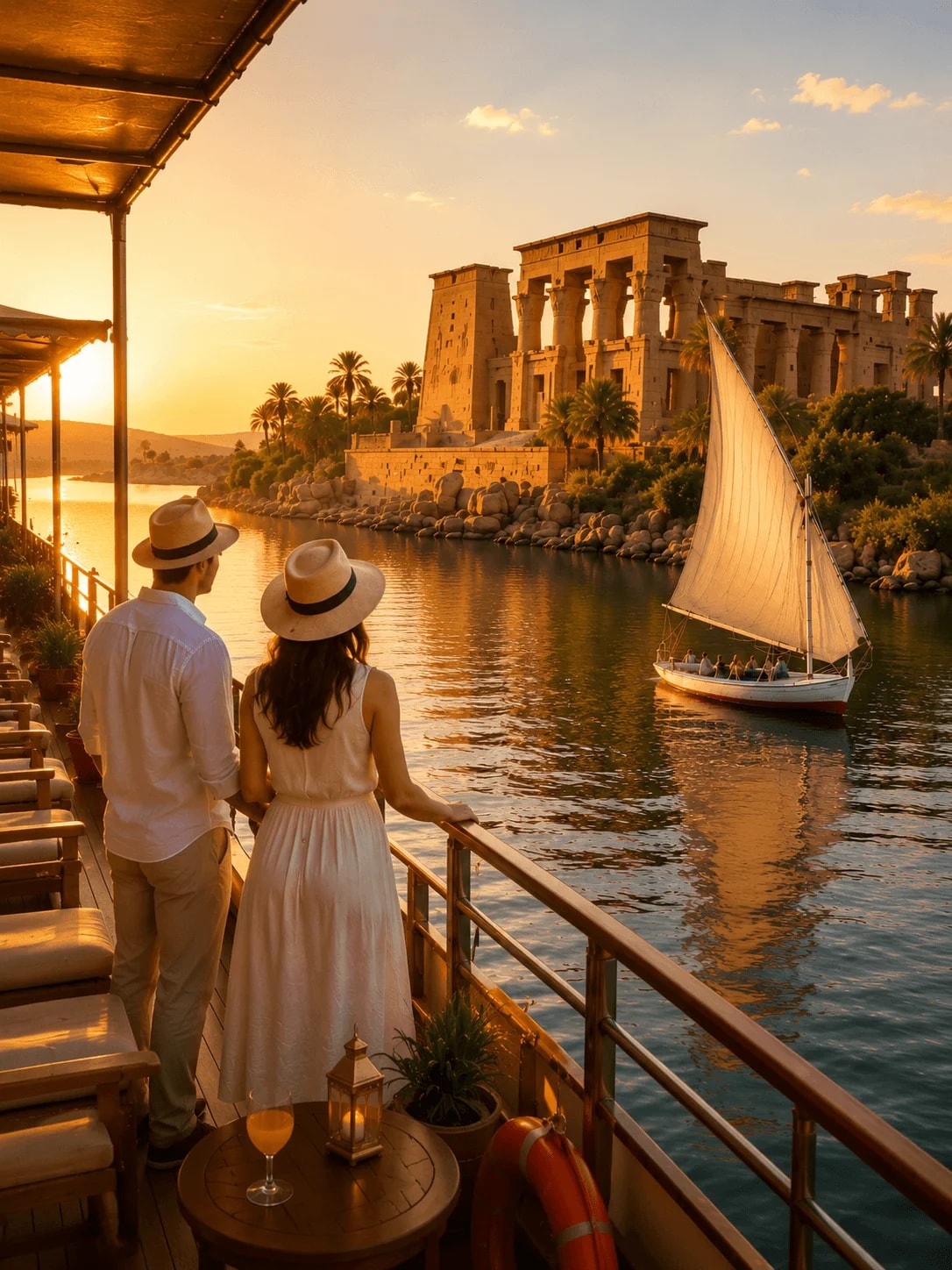
After breakfast you take the domestic flight from Cairo to Luxor, about an hour in the air. In Luxor you board Ayla Dahabiya (or similar), your home for the next four nights. A dahabiya is a traditional Nile sailing boat with two large sails. Ayla has just eight suites, including two Royal Suites, and a glass-walled sunroom restaurant on the sun deck.
In the afternoon your guide takes you to Karnak, the largest temple complex in Egypt. The Great Hypostyle Hall is the highlight: a forest of 134 giant columns, many still carrying their carved and painted scenes. You then continue to Luxor Temple in the center of town, which is especially atmospheric as the light fades.
From today all three meals are served on board. This is the trip Amelia Edwards described in 1873, when she hired a dahabiya and sailed south to Abu Simbel.
Today you cross to Luxor's West Bank, the ancient city of the dead. In the Valley of the Kings you enter three royal tombs, where the painted walls show the pharaoh's journey through the underworld. Colors here are often still bright after more than 3,000 years. Your guide helps you pick tombs that suit the day's crowds.
Next is the Temple of Hatshepsut, set in three wide terraces against the cliffs. Hatshepsut ruled Egypt as pharaoh for about two decades, and your guide explains how she did it. On the way back you stop at the Colossi of Memnon, two seated stone statues that once guarded a large temple.
Back on board, the dahabiya sets sail and passes through the lock at Esna, where boats wait their turn to move between river levels. If you want an early start, you can add a sunrise hot-air balloon flight over the West Bank as an optional extra. All meals are on board.
The dahabiya continues south to Edfu. Your guide walks you through the Temple of Horus, the most complete temple in Egypt. Its tall entrance gate, roofed halls and inner sanctuary are all intact, so you get a clear picture of how an Egyptian temple worked from front to back.
Lunch is served on board as you sail on toward Kom Ombo. This temple sits right on a bend of the river and is unusual because it is a double temple, with two matching sides: one for the crocodile god Sobek and one for the falcon god Haroeris. Look for the carvings of medical instruments and the small museum of mummified crocodiles nearby.
In the evening the crew sets up a barbecue dinner on a Nile island. This is one of the advantages of a small boat: you eat outdoors by the water after dark, away from town and other cruise boats. Bring a light layer, as evenings on the river can feel cool in winter.
You wake in Aswan and have breakfast on the deck of the dahabiya. The river here is wider and rockier, with granite boulders and green islands, and the scenery feels different from Luxor.
A motorboat then takes you across the water to Philae, the Temple of Isis. The temple was moved stone by stone to its current island in the 1970s to save it from rising water after the Aswan dams were built. Your guide shows you the carved halls, the gateways and some of the last hieroglyphic inscriptions ever written.
If you would like more time in Aswan, you can add a visit to a Nubian village as an optional extra. Nubian homes are known for their brightly painted walls, and the village visit is a chance to learn about local culture. Lunch and dinner are served on board for your last night on the dahabiya. Tomorrow starts very early, so pack your bags tonight.
Today begins before sunrise with a packed breakfast. You leave the dahabiya and travel by road from Aswan to Abu Simbel, about three hours each way through the desert near Lake Nasser.
At Abu Simbel, two temples are cut into the sandstone cliff. The Great Temple of Ramses II has four seated statues of the king at its entrance, each about 20 meters tall. The smaller Temple of Nefertari honors his queen. You step inside both and see the carved halls that run deep into the rock. Like Philae, these temples were moved to higher ground in the 1960s to save them from the waters of Lake Nasser.
After the drive back to Aswan, you take an evening flight to Cairo and check in again at Sofitel Downtown Nile (or similar). Only breakfast is included today, so bring snacks and water for the road and plan an easy dinner on arrival.
Your last full day shows a different side of Cairo. Your guide drives you up to the Citadel of Saladin, a medieval fortress on a hill above the city. Inside stands the Mosque of Mohamed Ali, with its large domes and slender minarets. From the terrace you get one of the best views over Cairo.
Next you visit Coptic Cairo and the Hanging Church, named because it was built on top of the gatehouse of a Roman fortress. It is one of the oldest churches in Egypt and still in use today.
In the afternoon you walk the lanes of Khan el-Khalili, Cairo's historic bazaar. Look for spices, brass lamps, silver and cotton, and expect to bargain politely. Women should carry a scarf for the mosque, and everyone should cover shoulders and knees. You spend the night at your Cairo hotel.
Enjoy a final breakfast at your hotel. Your tour ends after breakfast, and you continue on to your international flight or onward plans.
If your flight leaves late in the day, ask the hotel about holding your luggage after check-out. You could use the spare hours for a walk along the Nile corniche near the hotel or a last coffee overlooking the river.
Allow plenty of time to reach Cairo International Airport. Traffic in the city is heavy, and the drive can take an hour or more at busy times. Most international flights need check-in about three hours before departure. Before you leave, make sure you have kept your passport, your visa page and any receipts for items you bought, as security staff can ask about antiques and souvenirs.
Per person, two sharing. Prices are a starting point; your planner confirms the final price for your dates.
| Two sharing | $2,990 |
| Single room | $4,190 |
The tour costs $2,990 per person when two travelers share a double room, and $4,190 per person in a single room. The price covers five nights at Sofitel Downtown Nile in Cairo (or similar), four nights on Ayla Dahabiya (or similar), the Cairo to Luxor and Aswan to Cairo flights, a private Egyptologist guide and the meals shown in the itinerary.
The price includes the domestic flights in the itinerary, a four-night full-board dahabiya sailing from Luxor to Aswan, five nights at Sofitel Downtown Nile in Cairo (or similar), a private Egyptologist guide and the meals listed day by day. Travel insurance is not included, and neither are the optional hot-air balloon flight and Nubian village visit.
A dahabiya is a traditional Nile sailing boat with two sails and only a few cabins. Ayla Dahabiya (or similar) has eight suites, so the atmosphere is quiet and personal. Large cruise ships carry far more guests and dock at busy town moorings. A dahabiya ties up at the riverbank each evening, which allows extras like this trip's barbecue dinner on a Nile island.
In 1873, the English writer Amelia Edwards hired a dahabiya and sailed up the Nile as far as Abu Simbel. Her travel book about the journey, A Thousand Miles Up the Nile, became a classic and later helped inspire the study of Egyptology in Britain. This tour follows the same river south on the same type of boat, with modern comforts and flights for the long Cairo legs.
Yes. Two domestic flights are included: Cairo to Luxor on Day 4, and Aswan to Cairo on the evening of Day 8 after the Abu Simbel visit. Flying saves two long overland journeys, so more of your time goes to the temples and to sailing on the Nile.
You travel by road from Aswan on Day 8, leaving very early with a packed breakfast. The drive takes about three hours each way. You visit both the Great Temple of Ramses II and the Temple of Nefertari, then return to Aswan for the evening flight to Cairo.
October to April is the best time, with warm days and cool evenings in Luxor and Aswan. From May to September, southern Egypt is very hot by late morning, so sightseeing starts early. Departures run on Fridays from late October 2026 through October 2027, with a short pause from late July to mid-August 2027.
You need average fitness and should be comfortable walking two to four hours a day on uneven, sandy ground and steps. Tombs in the Valley of the Kings involve sloping corridors, and Day 8 has about six hours of driving. The tour suits travelers aged 10 to 70 who can manage early starts and heat.
A deposit secures your booking, and the balance is paid before you travel. The tour runs for groups of 2 to 16 travelers. Tell us your preferred Friday departure and room type, and we confirm availability on Ayla Dahabiya (or similar) and your Cairo hotel.
The Nile Valley from Luxor to Aswan and the Abu Simbel road are well-traveled routes for visitors. Your private Egyptologist stays with you on all touring days and handles the logistics at each site. We still recommend checking your government's travel advice before you go and buying travel insurance, which is not included in the price.
TALK TO A REAL LOCAL EXPERT
Book a free 30-minute consultation with one of our Egypt specialists. We’ll talk through your ideas, answer your questions and help you plan the perfect trip.
“We are here, plan your Egypt journey with people who know it best.”