Luxor · Egypt
Colossi of Memnon
Continue your trip
Tour Operator · Egypt, Jordan, UAE, Turkey and Morocco
Luxor · Egypt
Continue your trip
TALK TO A REAL LOCAL EXPERT
Book a free 30-minute consultation with one of our Egypt specialists. We’ll talk through your ideas, answer your questions and help you plan the perfect trip.
“We are here, plan your Egypt journey with people who know it best.”
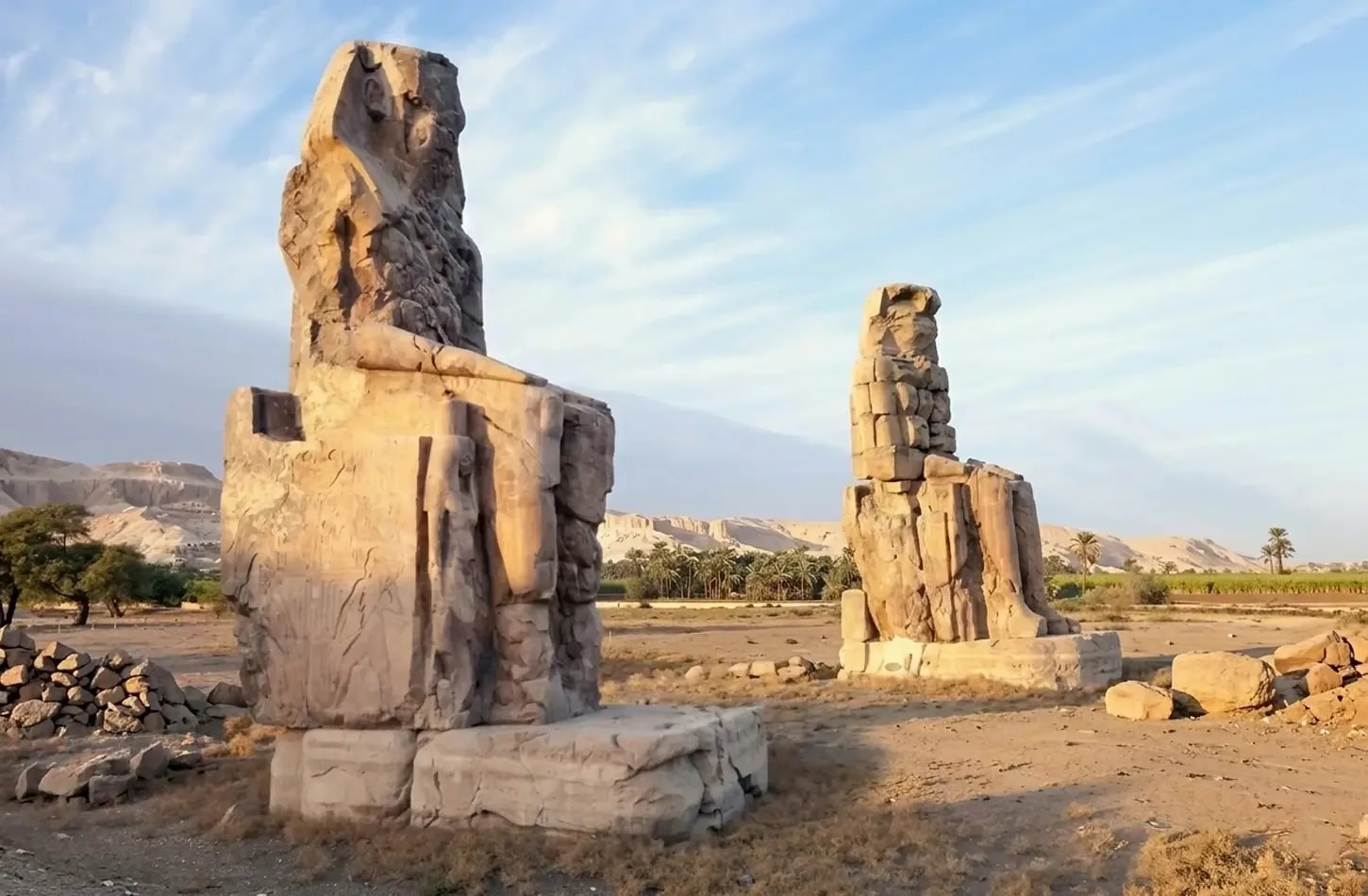
The Colossi of Memnon are two enormous seated statues of the pharaoh Amenhotep III that stand in the fields of Luxor's West Bank, beside the main road toward the royal tombs. Each is roughly 18 meters high, and for more than 3,000 years they have looked out across the plain toward the Nile.
For most travelers they are the first monument of a West Bank day and a short stop, but they deserve more than a quick photograph. They are the most visible survivors of what was once a vast temple complex, one of the largest ever built on the West Bank, and they carry a story that fascinated visitors in the Greek and Roman world.
Standing at their feet, you get a sense of the confidence of Egypt under Amenhotep III, a long and prosperous reign that also gave Luxor the core of Luxor Temple and major work at Karnak.
Amenhotep III, who ruled in the 14th century BC during the 18th Dynasty, had the statues carved to guard the entrance of his mortuary temple. Each shows the king seated on a throne with his hands resting on his knees, with smaller figures of royal women, including his wife Queen Tiye and his mother, Mutemwia, standing beside his legs. Each statue was carved from a single block of quartzite sandstone, brought from a distant quarry.
The temple behind them was largely lost to flooding, to later builders who reused its stone, and to time. Its location on the flood plain meant the annual Nile flood reached it, which some scholars see as deliberate, linking the temple to the idea of creation rising from the waters. Archaeologists working at the site, known as Kom el-Hettan, have spent recent decades uncovering and re-erecting statues and fragments, and you can see some of this work from the road.
The Colossi of Memnon and Kom el-Hettan Conservation Project, an international mission working with Egyptian authorities, has worked to protect the site from rising groundwater, reassembled broken statues from scattered fragments and documented a great many pieces. Their work has shown that the colossi were only the first of several pairs of giant statues that once lined the approach through the temple's gateways, and that the temple courts held many statues of the king and of Sekhmet.
The name comes from the Greeks, who linked the statues to Memnon, a hero of the Trojan War, the son of Eos, goddess of the dawn. After an earthquake damaged the northern statue in antiquity, it was said to make a sound at dawn, and visitors traveled to hear it, among them the Roman emperor Hadrian. The sound is reported to have stopped after the statue was repaired in Roman times.
The story of the singing statue is a well-documented tourist attraction of the ancient world. Greek and Roman travelers came to hear the sound at sunrise and recorded their visits by carving inscriptions on the statue's legs. Some describe hearing it clearly, while others admit they heard nothing on their first try. To the Greeks, the sound was Memnon greeting his mother, the Dawn.
Modern explanations usually suggest that changes in temperature and humidity at sunrise caused the cracked stone to make a sound. Ancient sources say the repairs, often linked to the emperor Septimius Severus, silenced it, though the details of that repair are not certain.
The statues also show how Egyptian royal sculpture worked as a statement of order. The king sits calm and frontal, with his family at his side and the symbols of a united land on his throne. Even in their damaged state, the message of stability and permanence is clear.
The faces of both statues are badly worn, so you will not see the fine features of Amenhotep III here. For that, visit the Luxor Museum on the east bank, where well-preserved statues of the king show the full, rounded face and almond eyes typical of his reign. Seeing the two together helps you imagine how the colossi looked when they were newly carved and painted, with their crowns and royal headcloths intact.
The Colossi stand beside the main road on the West Bank, a short drive from the river and on the way to the Valley of the Kings, the Temple of Hatshepsut and Medinet Habu. From the east bank, it is usually around 20 to 30 minutes by road, depending on traffic and where you start. You can also cross the Nile by ferry or boat and take a taxi on the West Bank. The statues are visible from the road, and there is a small parking area beside them.
Most visitors spend 15 to 30 minutes here, enough to walk around both statues, look at the details and take photographs. Access arrangements can change, so check the current situation, but in most cases this is an easy stop that needs little planning.
Early morning is the best time, both for the softer light and the cooler air. If you take a sunrise hot air balloon flight over the West Bank, you may also see the Colossi from above as you float over the fields. Winter, roughly October to April, is the most comfortable season.
The Colossi sit at the start of almost every West Bank route. Medinet Habu, with its deep carvings and remaining color, lies a short drive south. The Ramesseum, the mortuary temple of Ramesses II, is close by to the north. Further on, you reach the Temple of Hatshepsut, the Valley of the Kings, the Valley of the Queens, Deir el-Medina and the Tombs of the Nobles. Howard Carter's house, near the road to the Valley of the Kings, is another short stop.
They represent the pharaoh Amenhotep III, not the Greek hero Memnon. The name was given by Greek visitors, who linked the statues to the legend of Memnon.
No. Ancient sources say the sound stopped after the northern statue was repaired in the Roman period. Today the statues are silent.
About 15 to 30 minutes is enough for most travelers. It is a quick but rewarding stop on the way to other West Bank sites.
Access arrangements and fees can change, so check the current situation before you go. In general, it is one of the easiest sites on the West Bank to visit.
The mortuary temple of Amenhotep III was damaged by Nile floods, reused for stone and later shaken by earthquakes. Archaeologists are still uncovering and restoring statues and fragments at Kom el-Hettan.
Yes. Because they stand right beside the main road, the Colossi fit easily into even a half-day West Bank tour. Most guides stop here on the way in or on the way back from the tombs and temples.
The Colossi of Memnon are an easy first or last stop on a West Bank day from Luxor, whether you are on a city stay or a Nile cruise.