About Jemaa el-Fnaa
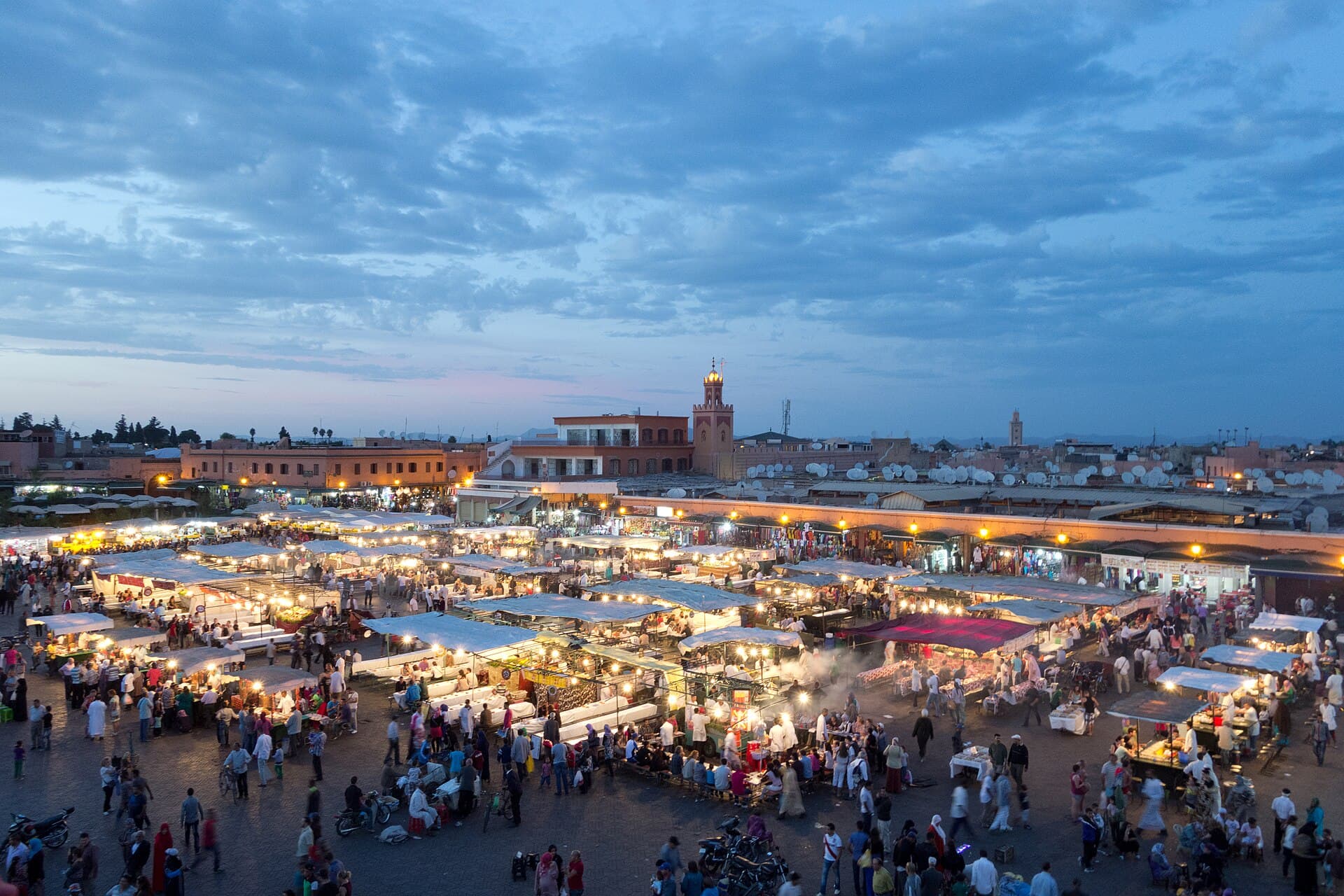
Jemaa el-Fnaa is the great open square at the heart of the medina, the old walled city of Marrakech. By day it is a busy crossroads of orange juice sellers, henna artists, water carriers and herbalists. As the afternoon fades, rows of food stalls are set up, smoke rises from the grills, and circles of listeners gather around musicians and storytellers, turning it into one of the liveliest public spaces in North Africa.
The square matters not for any single building but for what happens in it. In 2001 UNESCO named the Cultural Space of Jemaa el-Fnaa among the first Masterpieces of the Oral and Intangible Heritage of Humanity, and it is now on the Representative List of the Intangible Cultural Heritage of Humanity. It also lies within the Medina of Marrakech, a World Heritage site, a short walk from the Koutoubia Mosque and the entrance to the souks.
Coming here is less about sightseeing than about taking part. You stand in a circle around a performer, drink mint tea on a terrace, eat at a long bench beside strangers, and let the rhythm of the square carry the evening.
History in brief
Marrakech was founded in the eleventh century by the Almoravids, a Berber dynasty whose empire stretched across northwest Africa and into Spain. The city became so important that it gave its name to Morocco itself in many languages. An open space near its heart has served as a market and meeting place for much of the city's history, at the point where routes into the medina meet.
In the twelfth century the Almohads took the city and built the Koutoubia Mosque beside the square. Its minaret, one of the great Almohad towers, is closely related to the Giralda in Seville and the Hassan Tower in Rabat, and it still serves as the landmark that tells you where the square is.
The origin of the square's name is debated. Jemaa is usually linked to a gathering or a mosque, while fnaa has been read as a courtyard or as annihilation. That has produced interpretations such as the assembly of the dead, sometimes connected to public executions said to have taken place here, or the mosque of nothing, after a mosque that was never finished. None is certain, and locals will happily give you their own version.
In the twentieth century writers and artists made the square famous abroad. As modern development threatened its traditions, the Spanish writer Juan Goytisolo, who lived in the medina, campaigned for its protection. His advocacy helped inspire UNESCO's program for intangible heritage, and Jemaa el-Fnaa was among the first places honored for its living culture rather than its architecture.
What to see
- The halqa: Circles of listeners form around storytellers, musicians, acrobats, comedians and other performers, a tradition known as the halqa. Most stories are told in Moroccan Arabic, so you may not follow the words, but the gestures, timing and audience reactions are worth watching. Performers expect a small tip if you stay.
- Gnawa musicians: You will often hear the clatter of qraqeb, heavy iron castanets, and the deep notes of the guembri, a three-stringed lute. Gnawa music, with roots in sub-Saharan Africa and Sufi tradition, is itself on UNESCO's intangible heritage list.
- The water sellers: Men in red costumes with wide fringed hats, brass cups and leather water bags once supplied drinking water to the crowds. Today they mostly pose for photographs, for a fee.
- The evening food stalls: At dusk, numbered stalls with long benches and open grills are set up in the center of the square. You will find grilled meat skewers, merguez sausages, fried fish, harira soup, bowls of snails in a spiced broth and, at some stalls, steamed sheep's head. Look for tanjia, the Marrakech specialty of meat slow-cooked in a clay urn.
- The spiced tea stalls: Small stands serve a hot, peppery drink made with ginger, galangal and other spices, often with a slice of dense spiced cake, a local cure for chilly evenings.
- Fresh juice stands: Numbered carts sell freshly squeezed orange juice and other fruit juices through much of the day. Ask for your glass to be squeezed in front of you.
- Herbalists and henna artists: Stalls display dried herbs, spices, roots and natural cosmetics, and henna artists offer designs for your hands. Fortune tellers sometimes sit under umbrellas nearby.
- The rooftop terraces: Cafes around the edge of the square, including the long-established Café de France, have upper terraces where you can watch the action from above. Sunset, when smoke from the grills rises against the Koutoubia, is the classic moment.
Stories behind the site
Storytelling here once meant long performances spread over many evenings, with tales drawn from folk legends, religious stories, heroic epics and collections such as the Thousand and One Nights. Masters would stop at a cliffhanger so the crowd would return the next night. Fewer traditional storytellers perform today, and their decline is one reason UNESCO's recognition mattered. Some cultural cafes in the medina now host storytelling evenings in English and Moroccan Arabic, where younger tellers learn from older ones.
The square also changes with the calendar. During Ramadan, daytime is quieter, and the square fills after the sunset meal. During festivals, music and crowds can stretch late into the night.
How to get there
The square is in the center of the medina, about 15 to 20 minutes by taxi from Marrakech Menara Airport, depending on traffic. Cars cannot drive into the square itself, so taxis usually drop you near the Koutoubia, a short walk away. Most riads in the medina are within walking distance, through lanes that can be confusing at first. Marrakech is around three hours by train from Casablanca.
How long to spend and when to go
The square is open at all times and free to enter. Visit twice if you can: once in the morning or early afternoon to see it relatively calm, and again from late afternoon into the evening, when it is at its most animated. Allow at least two hours for an evening visit, including dinner and time on a terrace.
Spring and fall are the most pleasant seasons. Summer days are very hot, often above 40 degrees Celsius, so you will want to come in the evening. Winter days are mild and sunny, but nights can be cold, so bring a warm layer.
Tips from our specialists
- Agree on a price before you photograph performers or water sellers, accept henna, or sit down at a food stall. Carry small notes and coins in dirhams.
- At the food stalls, check what is included before you eat, since bread, olives and sauces may be added to the bill. Choose busy stalls where food is cooked fresh in front of you.
- Keep your bag closed and in front of you, and keep phones and wallets secure in the crowds.
- Be polite but firm if you are not interested. A simple no thank you, and walking on, is usually enough.
- If a stranger tells you a street is closed or offers to lead you somewhere, decline politely and use a map or ask a shopkeeper.
- For henna, ask for natural henna and avoid dark black henna, which can contain chemicals that irritate the skin.
- Please avoid paying for photos with monkeys. The Barbary macaques shown here are an endangered species, often taken from the wild.
- Ask before photographing local people, and dress modestly, especially in the evening crowds.
- Rooftop cafes expect you to order something, so treat a drink as the price of the view.
Nearby sights to combine
The Koutoubia Mosque and its gardens are a few minutes west of the square; non-Muslims cannot enter the mosque, but the minaret and gardens are lovely at sunset. The souks begin on the northern edge of the square, a maze of lanes specializing in leather, metalwork, textiles and spices. Deeper in the medina, the Ben Youssef Madrasa is a former Quranic college with superb carved cedar, stucco and tilework, and Le Jardin Secret is a restored riad garden. To the south are the Bahia Palace, the Saadian Tombs, the ruins of the El Badi Palace and the old Jewish quarter, the Mellah. The Majorelle Garden and the Yves Saint Laurent Museum are a short taxi ride away in the new town.
Frequently asked questions
Is Jemaa el-Fnaa safe at night?
The square is busy and well policed in the evening, and most visitors enjoy it without problems. The main risks are pickpockets and overcharging, so keep valuables secure and agree prices first.
Is the food at the stalls safe to eat?
Many visitors eat there happily. Choose busy stalls, eat food cooked hot in front of you, and drink bottled water.
Do I need a guide?
Not for the square itself, but a licensed guide is very useful for your first walk through the souks and lanes of the medina.
What is the best time to visit?
Late afternoon into the evening, when the food stalls open and the performers gather. A morning visit shows a calmer side.
Can I take photographs?
Yes, but performers and water sellers expect payment, and many people prefer not to be photographed. Ask first, and agree on a price.
Marrakech combines well with an Egypt trip, connected by flights via Casablanca, and an evening in Jemaa el-Fnaa is a good way to begin.