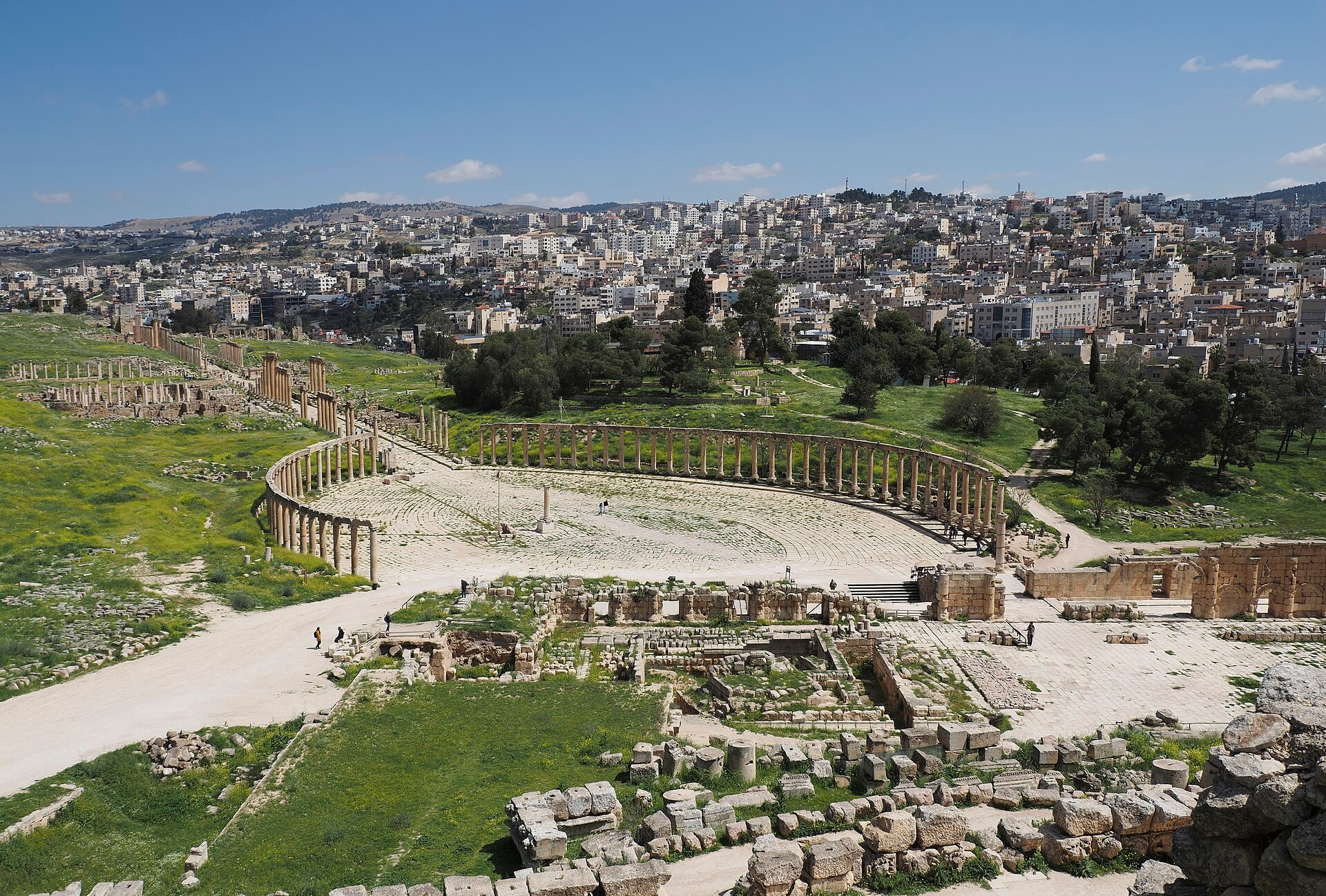
Jerash · Jordan
Jerash
Photo: Petar Milošević / Wikimedia Commons (CC BY-SA 4.0)
Tour Operator · Egypt, Jordan, UAE, Turkey and Morocco
Jerash · Jordan
Photo: Petar Milošević / Wikimedia Commons (CC BY-SA 4.0)
TALK TO A REAL LOCAL EXPERT
Book a free 30-minute consultation with one of our Egypt specialists. We’ll talk through your ideas, answer your questions and help you plan the perfect trip.
“We are here, plan your Egypt journey with people who know it best.”
Jerash is one of the best-preserved Roman provincial cities in the Middle East, located in the green hills of northern Jordan. Its colonnaded streets, temples, theaters and monumental gates stretch across a wide valley, giving you a clear sense of how a prosperous city of the Roman East was laid out and lived in.
Known in antiquity as Gerasa, it is Jordan's largest Roman site and, after Petra, one of the country's most rewarding ruins. It is also easy to reach, just under an hour's drive north of Amman, which makes it a natural half-day or full-day trip.
What makes Jerash special is its completeness. Rather than a few isolated monuments, you walk through a whole urban plan: a main street lined with columns, side streets, squares, a market, fountains, temples, theaters and churches. The modern town of Jerash sits beside the ancient city on the eastern side of the valley, so you can see how life here has continued over the centuries.
The site was settled long before the Romans, and a Hellenistic town grew up here in the centuries after Alexander the Great. Gerasa flourished after the Roman general Pompey brought the region under Roman control in 63 BC. It became one of the cities of the Decapolis, a group of Greco-Roman cities in the region, and grew rich on agriculture, trade and its position on routes linking the cities of the area.
The city's golden age came in the first and second centuries AD, when much of what you see was built or rebuilt. After the Nabataean kingdom was annexed in AD 106 and new roads were laid, trade increased. The emperor Hadrian spent the winter of AD 129 to 130 in the city, and a triumphal arch was built to mark the occasion.
In the Byzantine period many churches were added, often reusing stone from older buildings, and Christianity became the dominant religion. The city continued under early Islamic rule, and remains from the Umayyad period, including a mosque, have been found. A major earthquake in AD 749 caused heavy damage, and the city slowly declined. Much of it lay buried under sand and soil for centuries, which helped protect it until excavation and restoration began in the twentieth century.
Jerash shows classic Roman town planning adapted to the land. The Cardo forms the main axis, crossed by two side streets, and the junctions are marked by tetrapylons, monuments with four pillars or pedestals standing at the crossroads.
Look up at the capitals of the columns. Along the Cardo they change from Ionic to the more ornate Corinthian style, showing that the street was rebuilt and widened in stages. The Oval Plaza's columns are Ionic and carry stone lintels, giving it a different feel from the main street.
In the Temple of Artemis, ask your guide about the columns that are said to move slightly in the wind. Small details like this, together with the inscriptions on statue bases and theater seats, help you imagine the city as it was.
Jerash lies about 50 kilometers north of Amman, just under an hour's drive in normal traffic. Most visitors come on a guided day trip from Amman, often combined with Ajloun Castle. The site entrance and visitor area are on the southern side, near Hadrian's Arch.
From Egypt, the easiest route is a flight from Cairo to Amman, with Jerash as a day trip from your hotel.
Plan on at least two to three hours to walk the main route from Hadrian's Arch to the Temple of Artemis and back, and longer if you enjoy archaeology. A half day lets you see the highlights at a comfortable pace, while a full day allows you to explore the side streets and the North Theater. The site is large and open, with little shade.
Spring and fall are the best seasons, and spring is especially lovely, when wildflowers grow among the ruins and the hills are green. Summer is hot, so start early or come late in the afternoon. Winter can be cold and wet but quiet. In summer, the Jerash Festival brings concerts and performances to the ancient theaters. Dates, opening hours and ticket arrangements vary, so check current details before you go.
Two to three hours covers the main sights. If you love archaeology, or want to explore at a slower pace, plan for half a day.
Yes. Petra and Jerash are very different. Petra is Nabataean and carved into rock, while Jerash shows the planned stone city of the Roman East, and many travelers find the two complement each other.
Yes. They are about half an hour apart, and together they make a full day trip from Amman, returning in the late afternoon.
The main route is mostly level but long, with uneven paving and some steps up to the temples and theaters. Take your time, rest in the shade, and choose a shorter route if you need to.
The Jerash Festival is an annual summer festival of music, dance and performance held in the ancient theaters and plazas. Dates and programs change each year, so check before you travel.
Jerash slots easily into a combined Egypt and Jordan itinerary as a day trip from Amman.