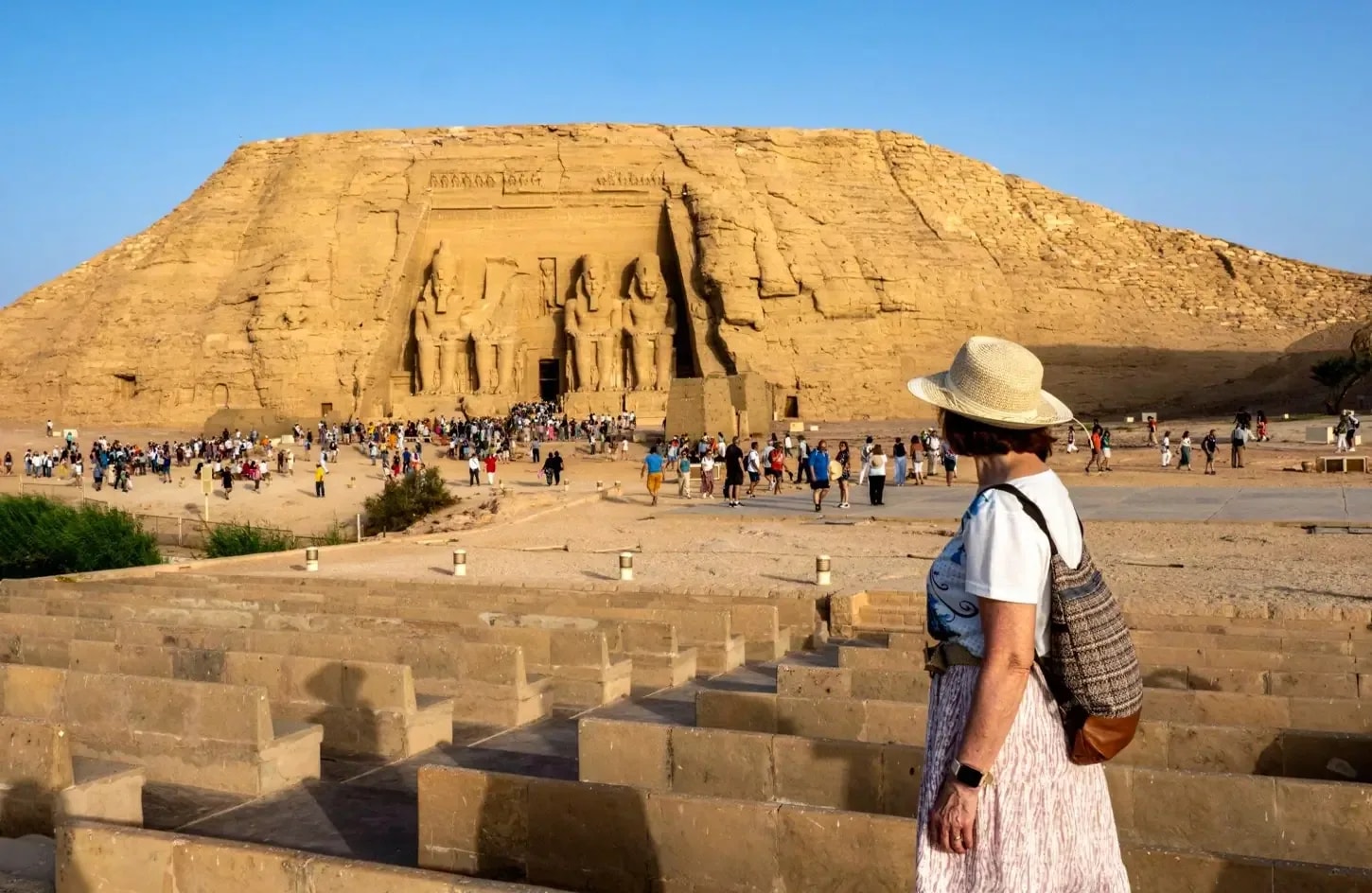
Abu Simbel · Egypt
Tour Operator · Egypt, Jordan, UAE, Turkey and Morocco
Abu Simbel · Egypt
TALK TO A REAL LOCAL EXPERT
Book a free 30-minute consultation with one of our Egypt specialists. We’ll talk through your ideas, answer your questions and help you plan the perfect trip.
“We are here, plan your Egypt journey with people who know it best.”
The Abu Simbel Temples are two rock-cut temples built by Ramesses II on the west bank of Lake Nasser, about 280 kilometers south of Aswan and close to the border with Sudan. The Great Temple, fronted by four colossal seated statues of the king, is one of the most recognizable monuments of ancient Egypt, and the Small Temple beside it honors his queen Nefertari and the goddess Hathor.
They matter for two reasons. They are among the most ambitious works of Ramesses II, built to proclaim his power and his divine status on Egypt's southern frontier in Nubia, where anyone traveling up or down the river would see them. And they survived thanks to a remarkable engineering rescue in the 1960s, when the entire site was cut apart and rebuilt on higher ground to escape the rising waters of Lake Nasser.
The journey to reach them is part of the experience. Whether you cross the desert from Aswan before dawn, fly in over the lake or arrive slowly by boat, you come to a remote place where the colossi face the water and the morning sun. Few sights in Egypt combine scale, art and setting in quite the same way.
The temples were carved out of a sandstone cliff in the 13th century BC, during the long reign of Ramesses II of the 19th Dynasty. Nubia was rich in gold and other resources, and Egypt controlled it for long periods. Ramesses built several temples in the region, but Abu Simbel was among the grandest. The Great Temple was dedicated to the gods Amun-Ra, Ra-Horakhty and Ptah, and to the deified Ramesses himself. The Small Temple was dedicated to Hathor and to Nefertari, his principal queen.
Over time, the site was largely forgotten. An earthquake, probably not long after the temples were completed, brought down part of one of the colossi, and over the centuries sand drifted against the facade until only the heads of the statues were visible. The site was little known to the outside world until the Swiss traveler Johann Ludwig Burckhardt saw it in 1813. In 1817, the Italian explorer Giovanni Belzoni cleared enough sand to enter the Great Temple, and later travelers and archaeologists gradually freed the facade.
When the High Dam was built, the temples faced permanent flooding by the new lake. Between 1964 and 1968, as part of an international UNESCO campaign supported by many countries, engineers cut the temples and the cliff around them into more than a thousand large blocks, lifted them and reassembled them on higher ground above and behind the original site. Artificial domes were built behind the facades to recreate the hillside, and the temples were placed in the same relationship to each other and to the sun as before.
The Great Temple was aligned so that, twice a year, the rising sun shines straight down the length of the temple and lights the statues in the sanctuary. Ptah, a god linked with the underworld, is said to stay in shadow while the others are lit. Today this happens around 22 February and 22 October. Many people link these dates to the king's birthday and coronation, though that is a popular tradition rather than an established fact. Because the temples were moved, the dates have shifted slightly from the original ones.
The Battle of Kadesh, shown so prominently inside, was fought around 1274 BC against the Hittites. Ramesses presented it as a great personal victory, but the outcome was closer to a stalemate, and years later Egypt and the Hittites signed one of the earliest known peace treaties. The reliefs are a powerful example of royal propaganda, and a good guide will help you read the story panel by panel.
The rescue itself remains one of the most celebrated achievements of international cooperation in cultural heritage. When you look closely at the facade, you can still see the lines where the blocks were cut and rejoined, carefully placed to be as discreet as possible.
Most travelers come from Aswan. By road, the drive takes roughly three to four hours each way through the desert, and tours usually start before dawn so that you arrive in the morning. The road trip is often done by private car with a guide or by tour vehicle. A short flight from Aswan, or sometimes from Cairo, is the faster option, with a transfer from the local airport to the temples.
You can also arrive on a Lake Nasser cruise, which sails between Aswan and Abu Simbel and moors near the temples, often allowing a visit in the evening and again in the early morning. This is a relaxed way to see the site and the other rescued temples along the lake.
Allow at least two hours at the site to see both temples properly and look at the facade from a distance. Some visitors stay overnight in Abu Simbel to see the evening sound and light show and the temples in early morning light, when the facades glow and the crowds have not yet arrived.
The cooler months from October to April are the most comfortable, but the site can be busy then. In summer, the heat in this part of Egypt is extreme by late morning, so an early visit is essential. The sun festival mornings are very busy, with large crowds gathering before dawn. Ticket prices, hours and travel arrangements change, so check current details before you go.
For most travelers, yes. It is a long day, but the temples are among the most impressive in Egypt, and the remote setting adds to the experience. If you prefer a shorter day, the flight from Aswan saves several hours.
No. In the 1960s they were cut into blocks and rebuilt on higher ground above and behind the original site to save them from Lake Nasser. They keep the same orientation and layout, so the sun still reaches the sanctuary twice a year.
The solar alignment happens around 22 February and 22 October each year. The site is very crowded on those mornings, so plan transport and accommodation well in advance.
Yes. Most travelers do it as a full-day trip by road, leaving before dawn and returning in the early afternoon, or on a short flight.
Definitely. The Small Temple of Nefertari and Hathor is elegant and less crowded, and its reliefs of the queen are some of the finest of the period. It takes only a short extra time to visit.
Abu Simbel is usually a full-day excursion from Aswan, often added before or after a Nile cruise, and it rounds off the story of the Nubian monuments you meet along the way.