Petra without a night away
The whole trip, from Sharm to the Treasury and back, fits into a single day.
Tour Operator · Egypt, Jordan, UAE, Turkey and Morocco
From Sharm to Petra's Treasury and back in one day, by road and ferry
This is a long, full-day group excursion from Sharm El Sheikh to Petra in Jordan, with a 1:30 AM hotel pickup, a road transfer to Taba, a ferry across the Gulf of Aqaba, and a guided walk through the Siq to the Treasury. Lunch, the Jordan visa, and Petra entry are included. It suits fit, early-rising travelers who want to see Petra without an overnight stay.
Petra was the capital of the Nabataeans, a desert people who grew rich on the incense and spice trade and carved their city straight out of the rose-red sandstone of southern Jordan. Two thousand years later, its tombs, temples, and water channels draw travelers from every corner of the world, and the moment the Treasury appears at the end of the Siq remains one of the great arrivals in travel.
This full-day excursion gets you there from Sharm El Sheikh by road and sea. You leave your hotel in the middle of the night, drive north through the Sinai to Taba, and cross the Gulf of Aqaba by ferry to Jordan. From Aqaba, the road climbs through desert landscapes to Petra, where you walk the Siq to Al-Khazneh with an English-speaking guide.
After lunch at a local restaurant, you return to Aqaba for free time by the sea before the ferry back to Taba and the drive to your hotel. Ferry tickets, the Jordan entry visa, Petra entrance fees, the guide, and lunch are included. It is a long, demanding day, and it lets you see Petra from Sharm without spending a night away.
The whole trip, from Sharm to the Treasury and back, fits into a single day.

Ferry tickets and the Jordan entry visa are included, with arrival assistance in Aqaba.

An English-speaking guide leads you from the entrance to Al-Khazneh and explains the site.
A local lunch and time in Aqaba break up a long day of travel.
This day starts while Sharm El Sheikh is still asleep. Your pickup from your hotel is at approximately 1:30 AM, and you travel in an air-conditioned vehicle north through the Sinai toward Taba, where Egypt meets Israel at the head of the Gulf of Aqaba. The drive takes about three and a half hours.
Treat this leg as part of your night's sleep. Bring a light jacket or shawl, as the air conditioning and the desert night can both be cool, and a small travel pillow makes a real difference. Eat something light before you leave, and carry water and a snack for the early hours.
Most important of all, keep your passport on your person and easy to reach. Entry rules depend on your passport and can change, so please check the official source before you travel. You will need your passport at the port in Taba and again on arrival in Jordan. Transportation from Sharm takes you to join a group with other travelers, so expect to meet your fellow excursion guests along the way. As dawn breaks, the mountains of the eastern Sinai and the Arabian coast across the water begin to take shape.
At Taba Port you board the ferry for Aqaba. The crossing is short, and it is a beautiful piece of geography: the narrow northern tip of the Gulf of Aqaba, where Egypt, Israel, Jordan, and Saudi Arabia all face one another across the water. Try to get a spot by a window or on deck, as the early light on the mountains on both shores is lovely.
The Gulf of Aqaba is a deep, narrow arm of the Red Sea, formed along the same great fault system as the Dead Sea and the Jordan Valley. Aqaba itself has been a port since antiquity and played a famous role in the Arab Revolt during the First World War.
On arrival in Jordan, local representatives assist you with the arrival procedures before the journey continues. Your Jordan entry visa and the round-trip ferry tickets are included in the trip. Follow your representative's instructions closely here, keep your group in sight, and have your passport ready; border formalities run smoothest when everyone is prepared. Ferry departure and arrival times can vary with weather and operating schedules, which may shift the timing of the day.
From Aqaba, you travel by road through Jordan's desert landscapes to Petra, the ancient capital of the Nabataean Kingdom. The route climbs away from the coast into high, open country of sandstone outcrops and wide plains, and the change of scenery is dramatic after the Sinai.
This is a good time to learn who the Nabataeans were. Originally a nomadic Arab people, they grew wealthy by controlling caravan routes that carried frankincense, myrrh, and spices from Arabia to the Mediterranean world. Petra became their capital, and at its height in the first century, it was a busy city with temples, markets, theaters, and elaborate tombs carved into the cliffs. The Romans annexed the kingdom in 106 AD, and over the following centuries, as trade routes shifted and earthquakes struck, the city faded.
Petra was never truly lost to the Bedouin who lived around it, but it was largely unknown in Europe until the Swiss traveler Johann Ludwig Burckhardt reached it in 1812. Today it is a UNESCO World Heritage Site and one of the most visited places in the Middle East.
At the entrance to Petra, a traditional horse ride may be available for the first stretch before you continue on foot; horses are limited, though, and the visit is sometimes done entirely on foot. Then you enter the Siq, a narrow canyon running for more than 1.2 kilometers between sandstone cliffs that rise far above your head and in places almost touch.
The Siq is not just a passage but a gallery. Look for the channels cut into the rock walls on either side, part of the Nabataeans' sophisticated system for carrying water into the city and controlling flash floods. Watch for carved niches and eroded figures, including the remains of a camel caravan relief, and for the extraordinary swirls of red, pink, ocher, and purple in the stone.
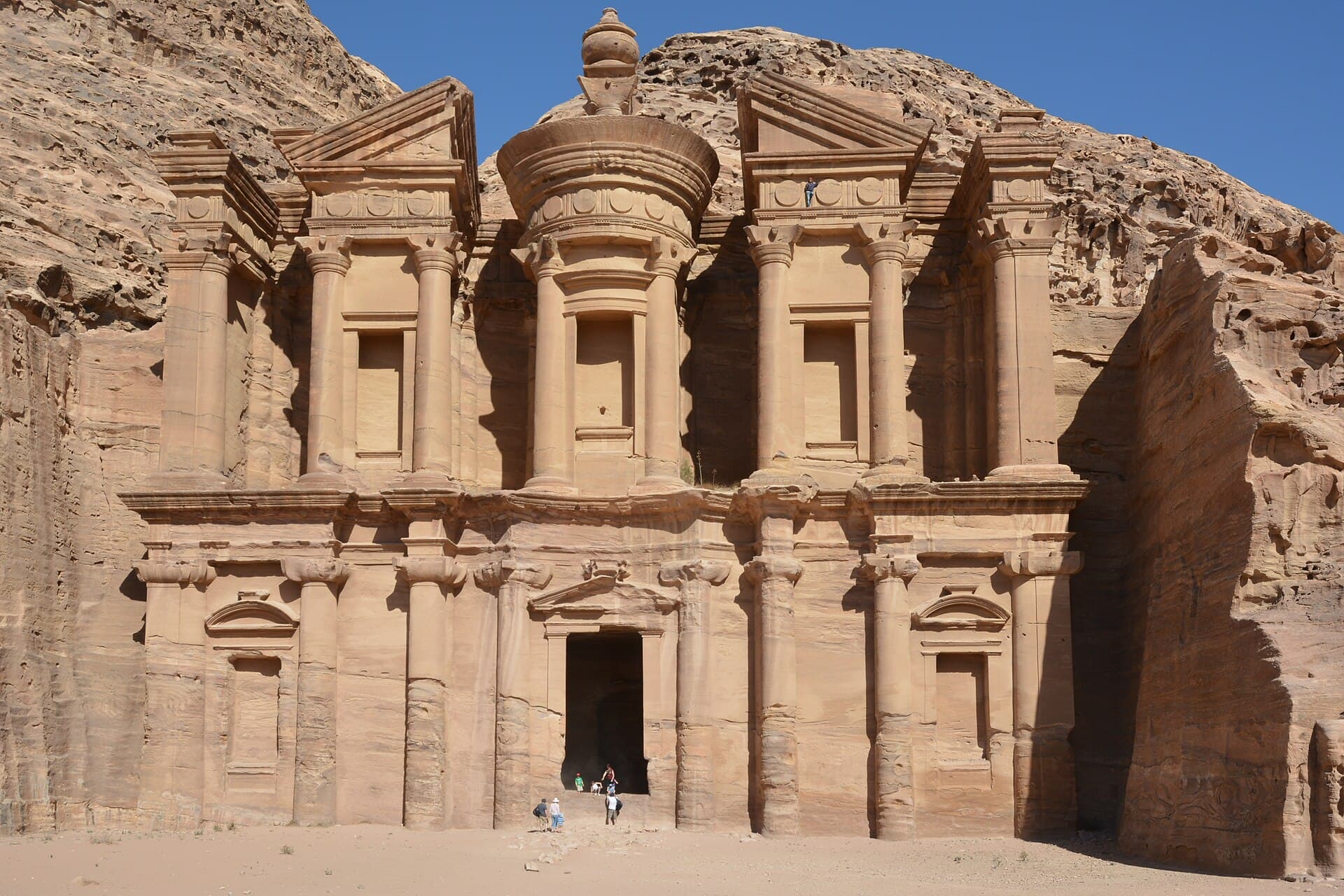
Then the canyon narrows one last time and, through the gap, you see Al-Khazneh, the Treasury, its columned facade carved directly into the cliff face. Despite the name, it was most likely a royal tomb. Your English-speaking guide accompanies you from the entrance to the Treasury, telling the story of the site and its builders. Stay hydrated, wear a hat, and take your time on the uneven, rocky ground.
After exploring Petra, you sit down to lunch at a local restaurant, which is included in the trip. After the walk through the Siq and the early start, you will be ready for it, and this is your chance to rest your legs, cool off, and take stock of what you have seen.
Jordanian cooking shares much with the wider Levant: mezze such as hummus, salads and pickles, flatbread, rice, and grilled or slow-cooked meat. The national dish, mansaf, made with lamb, rice, and a sauce of fermented dried yogurt, is a celebratory meal of the Bedouin tradition, though what appears on the table will depend on the restaurant. Drinks are not included, so carry some small change or a card for soft drinks or water beyond what you have with you.
Use the break to look through your photographs and refill your water bottle. The walk back out of Petra and the journey home are still ahead, and good hydration makes the rest of the day far more comfortable. If you have dietary requirements, mention them when you book so they can be passed on.
Before returning to Egypt, you travel back to Aqaba, where you have free time to enjoy the city at your own pace. After the intensity of Petra, Aqaba's seafront is a gentle change: palm-lined, breezy, and busy with local families as well as visitors.
Use the time however suits you. Stroll the waterfront, sit in a cafe with a cold drink, or browse the shops in the town center, where you will find spices, Dead Sea cosmetics, embroidered textiles, sand bottles, and other souvenirs. Prices are usually open to friendly negotiation in smaller shops. Remember that personal expenses, drinks, and extras are not part of the trip, so keep some money handy.
The most important thing during your free time is to keep an eye on the clock. Return to the meeting point your representative gives you well before the agreed time, as the group needs to reach the port for the ferry, and ferry schedules can change. Keep your passport on you, not in a shopping bag, since you will need it again at the port shortly.
You board the ferry back to Taba for the return crossing of the Gulf of Aqaba. In the late light, the mountains on both shores turn pink and bronze, and the crossing is a quiet moment to sit back after a long day. Once you are back in Egypt and through the arrival procedures, you transfer by vehicle to your hotel in Sharm El Sheikh.
The drive south retraces your route of the early morning, this time in darkness for much of the way, so expect to arrive back at your hotel late. Because ferry departure and arrival times can change according to the weather and operating schedules, the exact return time cannot be fixed in advance. Plan nothing for that evening, and keep the following morning free if you can; most travelers want to sleep in.
It is a long day, but it is also a remarkable one: two countries, a sea crossing, and one of the most famous ancient cities on earth, all between one night and the next. For many visitors, standing in front of the Treasury is the moment that makes every hour of the journey worthwhile.
Petra sits in high desert country and the walk is often in strong sun. The night drive and early ferry can feel cool, so dress in layers you can peel off.
Sturdy walking shoes are essential for the rocky, uneven ground of the Siq. Add a hat, sunglasses, and a light jacket for the 1:30 AM start and the ferry decks.
This is an active, very long day with extended walking at Petra. A horse ride may be available for the first stretch, but horses are limited and the visit is sometimes entirely on foot.
The Jordan entry visa is included in the trip. Entry rules depend on your passport and can change, so please check the official source before you travel. Keep your passport with you all day for the Taba and Aqaba border crossings.
Pickup is at about 1:30 AM, followed by a drive of roughly three and a half hours to Taba. Ferry times can change with weather and schedules, so the return time is not fixed.
Ferry tickets, Petra entrance fees, and lunch are included; drinks are not. Tips are customary and not included, so carry some cash for the guide, drinks, and personal purchases.
Entry rules depend on your passport and can change, so please check the official source before you travel. You must carry your passport with you throughout the day. The Jordan entry visa is included in the trip. When you book, we ask for your passport details in advance so the arrangements can be made.
The drive from Sharm El Sheikh to Taba takes about three and a half hours, and the group needs to reach the port in time for the ferry to Aqaba. The early start is what makes it possible to see Petra and return in a single day.
It is a group excursion. You travel from Sharm to join a group with other travelers, with transfers in a shared air-conditioned vehicle.
Quite a lot. The Siq alone is more than 1.2 kilometers each way, on uneven and rocky ground, and horses at the entrance are not always available. Wear comfortable, broken-in walking shoes with good grip.
The English-speaking guide accompanies you from the entrance to the Treasury. Any time beyond that is at your own pace within the group schedule your representative gives you.
The very early start, long day, and extended walking make it hard going for young children. Older children who walk well can manage it, but tell us their ages when you request a quote so we can advise you honestly.
Drinks, tips, personal expenses, and any extras not mentioned in the program are not included. What your booking covers is confirmed in your quote.
Ferry departure and arrival times can vary with the weather and operating schedules, which may shift the timing of the day. Your representative will keep the group informed, and you should plan for a late return to Sharm El Sheikh.


Photo credits: Petra — Azurfrog / Wikimedia Commons (CC BY-SA 3.0) · Jordan — Mohammad hajeer / Wikimedia Commons (CC BY-SA 4.0)
TALK TO A REAL LOCAL EXPERT
Book a free 30-minute consultation with one of our Egypt specialists. We’ll talk through your ideas, answer your questions and help you plan the perfect trip.
“We are here, plan your Egypt journey with people who know it best.”